







NParks opens forensics centre, launches dog unit to bolster Singapore’s fight against illegal wildlife trade
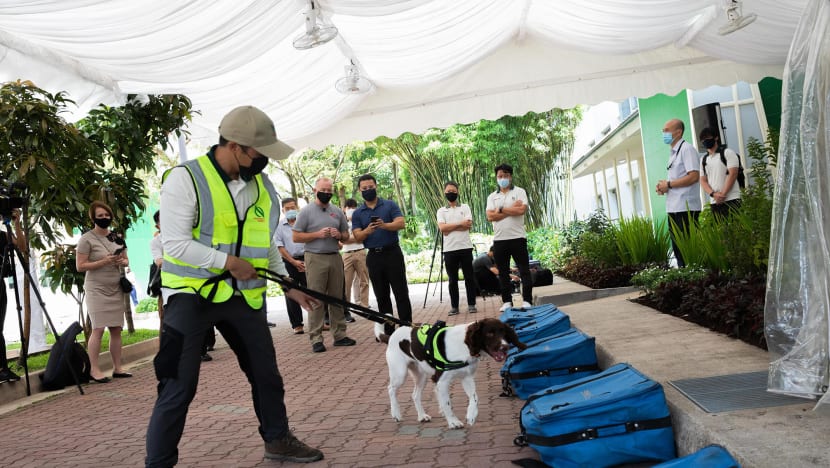
The dogs from the new NParks K9 unit at the Centre for Wildlife Forensics doing a demonstration to seize wildlife parts on Aug 27, 2021.


- The new centre was officially opened on Aug 27
- Previously, forensics work was conducted in laboratories across NParks’ various divisions
- The centre will improve on existing technology to identify, analyse illegal wildlife specimens seized in Singapore
- The National Parks Board also unveiled a K9 unit with dogs trained to sniff out wildlife, wildlife products
SINGAPORE — To better contribute to the global fight against the illegal wildlife trade, the National Parks Board (NParks) has set up a wildlife forensics centre to strengthen Singapore’s detection and diagnostic capabilities in identifying and analysing specimens that are seized here.
The board also now has its own K9 unit with dogs that are trained to sniff out commonly trafficked wildlife and wildlife products, such as elephant ivory and pangolin scales, NParks announced on Friday (Aug 27).





On the same day, National Development Minister Desmond Lee officially opened NParks’ Centre for Wildlife Forensics.
Before the centre was launched, specimen analysis was done in laboratories across NParks’ many divisions, such as the Centre for Animal and Veterinary Sciences and the Herbarium at the Singapore Botanic Gardens.
The new Centre for Wildlife Forensics will consolidate these resources and improve on the technology used by NParks’ divisions to beef up its diagnostic capabilities and make more meaningful contributions to the international fight against the illegal wildlife trade.
Mr Lee said that the research and analyses done at the centre could be shared with and used by regional and international partners, so that they can better target their enforcement efforts against poaching and wildlife trafficking at source.
“Such cross-border collaboration is crucial if we want to stop illegal wildlife trade… We can collectively strengthen our global expertise and enforcement efforts against the criminal syndicates and networks that conduct illegal wildlife trade,” he said.
Singapore is a signatory to the Convention on International Trade in Endangered Species of Wild Fauna and Flora, a global treaty that prevents species from becoming endangered or extinct owing to international trade.
But the country was also named a major transit point for illegal ivory trade.
Dr Adrian Loo, group director of wildlife management at NParks, said that Singapore has seen a record amount of seizures for pangolin scales and elephant ivory over the years.
The authorities impounded more than eight tonnes of elephant ivory in July 2019 and seized 37.4 tonnes of pangolin scales in April and July that year.
A ban on domestic trade in elephant ivory, announced in 2019, will take effect on Sept 1, prohibiting the sale and display of ivory and ivory products.
CENTRE FOR WILDLIFE FORENSICS
The Centre for Wildlife Forensics, the first of its kind in Singapore, aims to beef up detection and diagnostic capabilities in identifying and analysing specimens involving the illegal wildlife trade.
It will focus on wildlife and wildlife products most affected by the illegal trade, such as elephants, rhinoceros, pangolins, sharks, rays as well as timber.
The forensic work done by the centre will enable the authorities to better identify specimens seized and provide greater insights into them, such as their origins.
NParks said that such information could help international organisations and origin countries carry out further investigation and enforcement against poachers and smugglers.
The centre does wildlife forensics in three main areas: Fauna — or animal specimen — identification and analysis; flora — or plant specimen — identification and analysis; as well as molecular diagnostics and analysis.
It uses methods such as deoxyribonucleic acid (DNA) bar-coding and genotyping (the process of determining DNA sequence) to accurately identify illegally traded animal parts, as well as molecular genotyping to determine the geographical origins of a specimen and match it to familial sources at the origin country.
INTERNATIONAL TIE-UPS
The Centre for Wildlife Forensics is also involved in two studies that are under way with conservation biologist Samuel K Wasser from the University of Washington.
The first study with Professor Wasser analyses the genetic links between ivory seizures made globally from 1995 to 2019. This is done by genetically matching elephant-tusk specimens to identify if samples are from the same elephant or from its close relatives in the same herd.
Such information can help wildlife law enforcers gain a deeper understanding of the criminal networks and their modus operandi in the origin country by combining evidence from separate investigations from countries where seizures were made, said NParks.
The second study, also with Prof Wasser, looks at developing and validating sampling protocols that will help in the analyses of large volumes of pangolin or pangolin parts.
The research group seeks to establish a comprehensive panel of DNA markers for all eight pangolin species to create a genetic reference map.
The map could then be used to identify familial relationships between pangolins across various seizures and determine the origins of the pangolin parts.
This could also help authorities pin down the dynamics and networks of organised pangolin poaching and trafficking.
K9 UNIT
Meanwhile, NParks’ new K9 unit marks the first time that Singapore is deploying sniffer dogs to detect wildlife and wildlife products.
The sniffer dogs can help uncover items that cannot be detected by other tools and methods, such as radiographic scanners and visual inspections.
The dogs and their handlers will support Singapore’s border-control agencies at checkpoints to ferret out wildlife and wildlife products.
Mr Lee, the National Development Minister, said: “This will help us to crack down on illegal wildlife smuggling operations and do our part to disrupt the global supply chain of illegally traded wildlife and wildlife products.”




