







NTU scientists create electrically charged glue that works underwater
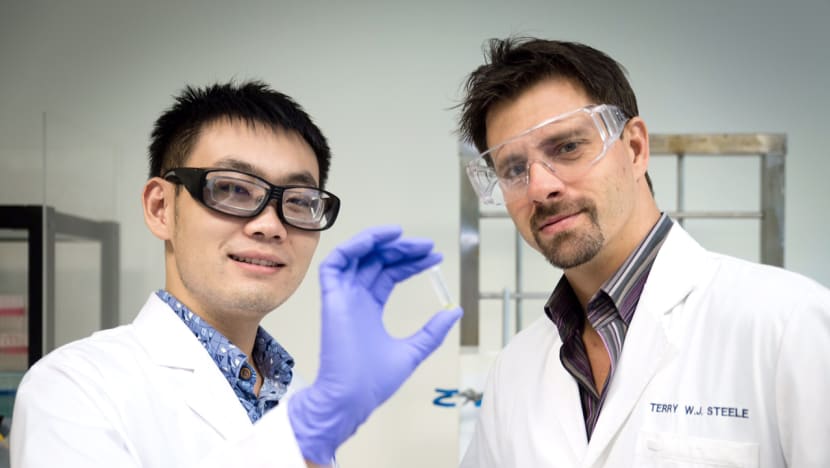
The project, led by Asst Prof Terry Steele (right) from NTU’s School of Materials Science and Engineering, was awarded a competitive research grant of S$900,000 by the Ministry of Education this month. Photo: NTU
SINGAPORE — Scientists from Nanyang Technological University (NTU) have invented a glue that hardens when voltage is applied to it, which could be useful in wet environments such as when making repairs underwater.
The adhesive, dubbed Voltaglue, is created from hydrogels consisting of carbon molecules called carbenes, which are attached to tree-shaped plastics called dendrimers. Upon contact with electricity, the carbenes are activated and grab onto available surfaces. By controlling the charge, the researchers can determine the bonding strength and adhesive properties of the glue. This process of “electrocuring” allows the glue to be used in different situations.
The project, led by Assistant Professor Terry Steele from NTU’s School of Materials Science and Engineering, was awarded a competitive research grant of S$900,000 by the Ministry of Education earlier this month.
The research team is now studying how it can “reverse” the glue’s properties, making it possible for items assembled with the glue to be easily “unassembled”.





Asst Prof Steele said it took him and his team of 11 researchers over a year to develop an adhesive that could work in wet conditions.
Adhesives like superglue harden upon contact with moisture in the air, while epoxy, often used in electronic mobile devices, has to be baked in high heat of about 150° C, or made using two different chemicals mixed together.
The characteristics of such adhesives make them unsuitable for use in wet environments.
For example, when gluing metal panels underwater, the glue should be hard, but for medical applications such as joining body tissues together during surgery, the glue should be rubber-like so that it does not damage surrounding soft tissues in a person’s body, said Asst Prof Steele.
“Electrocured” glue would sidestep the problems of conventional chemically cured or snap-cure adhesives.
The technology is currently patented through NTUitive, the university’s commercialisation arm. The findings of the researchers were also recently published recently in Nature Communications, a peer-reviewed scientific journal. Moving forward, Asst Prof Steele and his team are working to improve the glue so it can harden in just a few seconds, compared to about 30 seconds now. They will also look for the best way to commercialise the technology through a new start-up or via industry partnerships.




