







Offer constructive criticism, build trust with govt leaders, ESM Goh tells LKYSPP academics
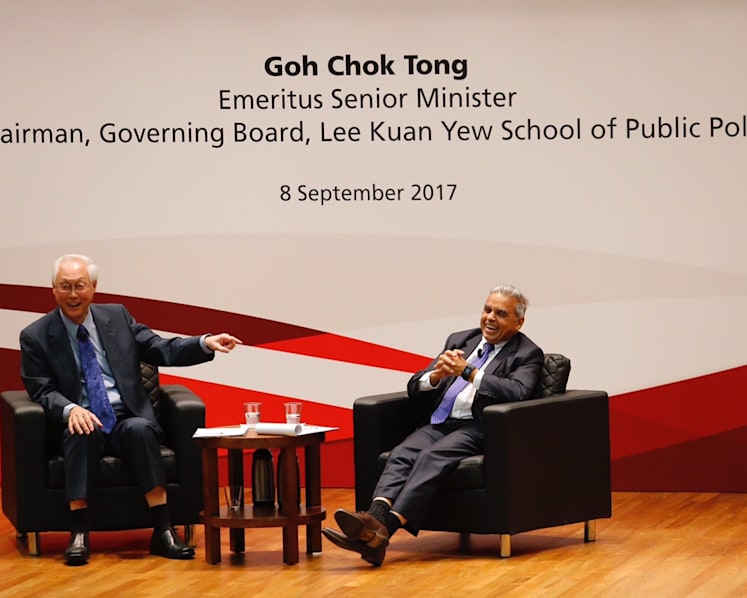
ESM Goh Chok Tong (left) speaking at Lee Kuan Yew School of Public Policy's (LKYSPP) 13th anniversary dialogue session on Friday (Sept 8), with LKYSPP dean Kishore Mahbubani moderating the event. Photo by Najeer Yusof/TODAY


SINGAPORE — While academics from the Lee Kuan Yew School of Public Policy (LKYSPP) should offer the Government critical alternative views, they should do so constructively and build trust with political leaders, Emeritus Senior Minister Goh Chok Tong said on Friday (Sept 8).
Speaking at the LKYSPP’s 13th anniversary dialogue session, Mr Goh, who became the school’s governing board chairman in April, said that the LKYSPP, having reached a “comfortable” size, is in a good place to examine how it can “provide greater value-add to policymaking”.
He said the Government is not getting its “money’s worth” in terms of ideas being contributed by the LKYSPP.
“I want to get this flow-back to the Government. It’s a good tool (and) you must’ve very good opinions, you must be able to challenge the thinking of the Government in some areas,” Mr Goh added.





While he did not refer expressly to recent episodes in which the Government called out the school’s academics, including its dean Kishore Mahbubani, over remarks they made publicly, the Emeritus Senior Minister said: “To be fair, no leader likes to be criticised ... neither do I. But do it constructively. You must build up that trust between one another.”
On several occasions in recent months, government leaders have slammed comments by LKYSPP academics.
In July, Professor Mahbubani’s commentary arguing that small states such as Singapore must always behave as such and refrain from commenting on matters involving great powers drew sharp rebuttals from Law and Home Affairs Minister K Shanmugam and diplomats, among others.
In April, a Facebook post by LKYSPP’s associate dean Donald Low also led to a rebuke from Mr Shanmugam, who said the academic’s comments had “seriously misconstrued” the statements the minister had made in an interview with TODAY, with regard to considering public opinion when deciding on criminal sentences.
Mr Low later apologised.
While Mr Goh said the school has done well since its inception, he acknowledged that “we want to do better”.
First, the link between theory and practice should be burnished, he said.
Noting the need to go beyond public-policy theories, Mr Goh said the school should find ways to better meld the experience and lessons of its many “practice professors” with vast experience in the public service with its professors’ academic lectures.
Pointing out that foreign delegations turn to the LKYSPP to study Singapore’s public policies, Mr Goh said the school has a “front-row” seat. To this end, it introduced a compulsory module for all its master’s students this year, giving an overview of Singapore’s policies.
Besides tapping the expertise of former officials, Mr Goh said the school could also consider inviting current senior civil servants to serve as “practice fellows”.
“This integration of theories and practice will set the school apart from other public-policy schools,” he added.
FAIR TREATMENT FOR ALL
In Friday’s dialogue, attended by 300 students, alumni and academics, Mr Goh, asked how the LKYSPP and the Government’s Civil Service College can be bridged, said formal links between the two institutes to share ideas and collaborate are in the offing.
Right now, there are interactions and sharing of case studies between them, but these are done informally, he added.
Fielding a question on how race and ethnicity have figured in Singapore’s success, Mr Goh said Singapore’s approach towards public-housing ethnic quotas, if tried in other countries, would have seen the Government thrown out or sparked riots.
But Singapore set out to take this approach “from day one” to treat all races fairly and justly.
He also cited the example of religious buildings in the early years. Christians, for instance, could pay the market price for land to build churches, but the Muslim community, which was then poorer, faced greater difficulty.
“As the Government, you (had) to make sure that (there are) places to go and worship. But how do you do that and yet not attract unhappiness from the other religious groups?” he asked.
Hence, the Government reserved sites for them, so tenders were not necessary, but the community still had to pay market prices.
To help them do this, a Mosque Building Fund was set up, with Muslims contributing a small sum from their monthly wage to build mosques in their housing estates.
This allowed the Government to balance the interests of all the religious communities, Mr Goh said.
S’PORE AS A CATALYST
Asked whether Singapore can maintain its position in South-east Asia amid the emergence of neighbouring countries such as Indonesia and Thailand, Mr Goh said the Republic can serve as a “catalyst” to establish a “smart” or “digital Asean” by helping neighbouring nations go digital and connecting the countries’ economies.
This will allow start-ups, entrepreneurs and innovators in the region to compete against China.
While Singapore would not be a base for these start-ups, a “multi-super-corridor”, or an “Asean Silicon Valley”, could be set up through links between the various countries.
“It can be done ... Singapore can, therefore, play a role of being a catalyst. We have got the resources (and) can help Indonesia to build up its digital capabilities if necessary,” he added.
In response to another question, Mr Goh also singled out terrorism and sustaining high economic growth yet changing the mindset of younger Singaporeans to accept a slower pace of economic growth, compared with decades past, as the main challenges for the country going forward.
He then turned to Prof Mahbubani, who moderated the dialogue, and asked the academic about the biggest challenge that will confront Singapore.
Prof Mahbubani said the country has created one of the most successful middle-class societies, and has a top-notch education system and a “globalised” population.
“The political culture in Singapore has got to change and adapt to this new environment ... The philosophy of governing Singapore that worked very well in our first 50 years need not necessarily work well in the next 50 years,” added Prof Mahbubani.
“That process of continuous change is what I see as the biggest challenge.”




