







One Belt, One Road a boost for trade, infrastructure in Asia
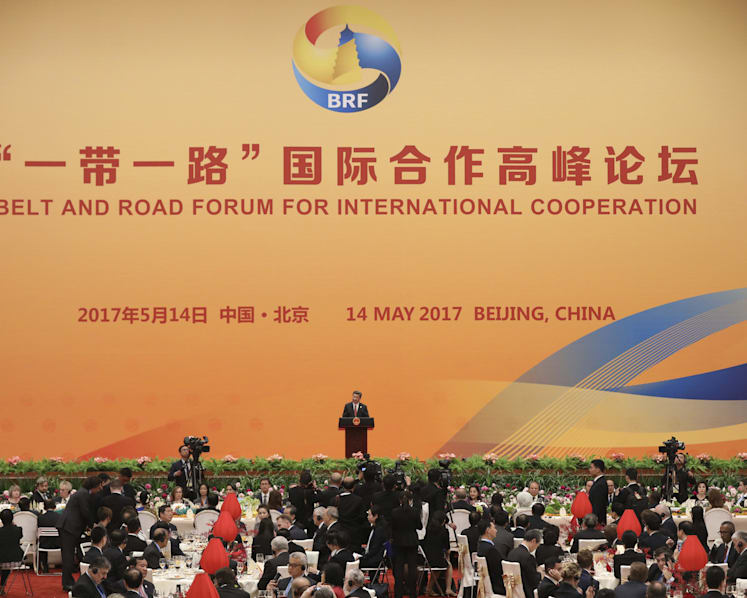
File photo of Chinese President Xi Jinping delivering a speech, during a welcome banquet for the Belt and Road Forum at the Great Hall of the People in Beijing. Photo: AP


SINGAPORE — China’s One Belt, One Road (OBOR) initiative holds significant advantages for infrastructure as well as trade and economic integration in the region, said Finance Minister Heng Swee Keat yesterday.
Speaking at a dialogue held at the McKinsey & Company’s Global Infrastructure Initiative summit — where he was asked a couple of questions on the OBOR, including Singapore’s role in it — Mr Heng also expressed Singapore’s support for the massive plan to develop railways, bridges and ports, among other infrastructure, to foster trade and connectivity throughout Asia and Europe.
“It is a plus for a number of reasons ... The amount of investments needed in infrastructure in the coming years, whether in Asia or the world, will grow quite significantly. So being able to provide that capital is one major step,” he said.
The initiative also signals the importance of trade connectivity and economic integration, an impact “particularly important” at a time when support for globalisation is fraying in some parts of the world, he added.





On Singapore’s involvement, Mr Heng said he hopes the Republic can offer its experience in planning and structuring infrastructure projects. Private-sector players here can also play a “very important role” in looking at how they can meet needs in the region, such as in terms of power plants, water, and industrial parks, he noted. “There has been a lot of knowledge that has been gathered, and I hope that will be useful,” he said.
China’s grand plan — which will cover 64 countries in four continents, with a combined population of 6.4 billion (about 62 per cent of the world’s total) — also presents opportunities for multilateral organisations, including development banks, Mr Heng said. “They can really have new breakthroughs, not just in providing financing, but in building expertise,” he said, urging multilateral development banks to work with governments around the world in enhancing the efficiency of infrastructure planning, designing and operations.
These banks can also help catalyse private-sector investments by adopting more “creative ways of financing and de-risking”, he said, citing the World Bank’s Masala Bond Programme as an example of innovative re-financing.
Mr Heng said: “My hope is that economies will get more deeply integrated, trade will continue to flourish, and so, in that regard, all these initiatives are to be welcomed.”
During the 30-minute dialogue, he addressed a range of questions, including on Singapore’s experiences in city planning, developing human capital, and its upcoming initiatives such as the Smart Nation drive and Jurong Innovation District.
On the future economy, Mr Heng stressed that Singapore cannot immediately write off certain sectors as “sunset industries”. He said: “I don’t think we are in such a great state to be able to say this is going to be an industry of the future and this is going to be a sunset industry. What we mustn’t have is the sort of sunset thinking.”
Nevertheless, the digitisation wave is one every nation will have to deal with, he said. The key consideration in building a Smart Nation is how quality of life can be enhanced for Singaporeans and businesses here, he said.
“From day one, the belief in sustainable development, in creating a good environment for our people, was a very important guide,” he said, recalling earlier initiatives such as planting heritage trees and setting up an anti-pollution unit.
Singapore will continue to position itself as a “living laboratory” that will invite businesses and researchers to work together and experiment with new ways of managing the city, he said.
Held over three days, the summit brings together leaders in infrastructure and capital projects to identify ways of improving the delivery of infrastructure, among other things.




