







Over 400,000 students to get Covid-19 vaccine invites from June 1, starting with some graduating cohorts: MOE
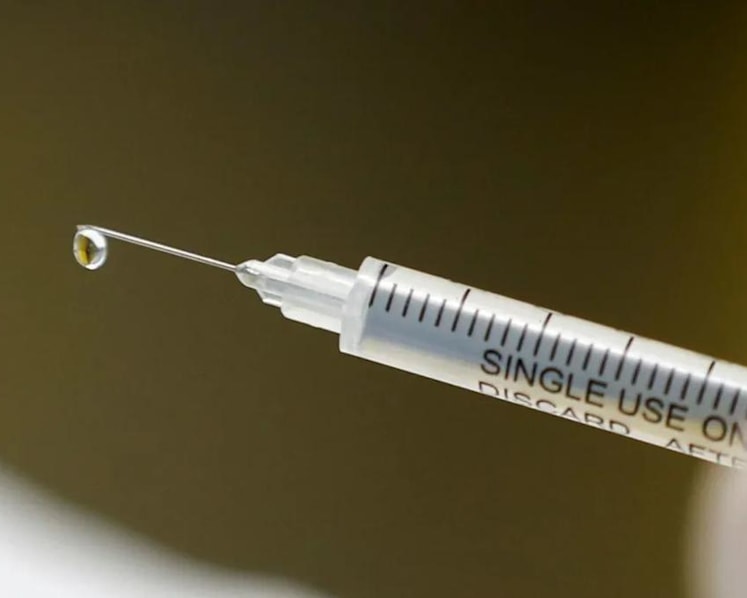
Invitations for Covid-19 vaccinations for students across Singapore will be sent out starting from June 1, 2021.




- Invitations will be first rolled out to graduating cohorts at the secondary schools and pre-university levels
- Students can be vaccinated at community vaccination centres, as well as four dedicated MOE vaccination centres
- Students under 18 years old will need consent from a parent or guardian before inoculation
- Autonomous universities and some international schools will also be included in the exercise
SINGAPORE — Starting Tuesday (June 1), more than 400,000 students from Singapore’s schools and institutes of higher learning will be progressively invited to sign up for vaccination against Covid-19, the Ministry of Education (MOE) said.
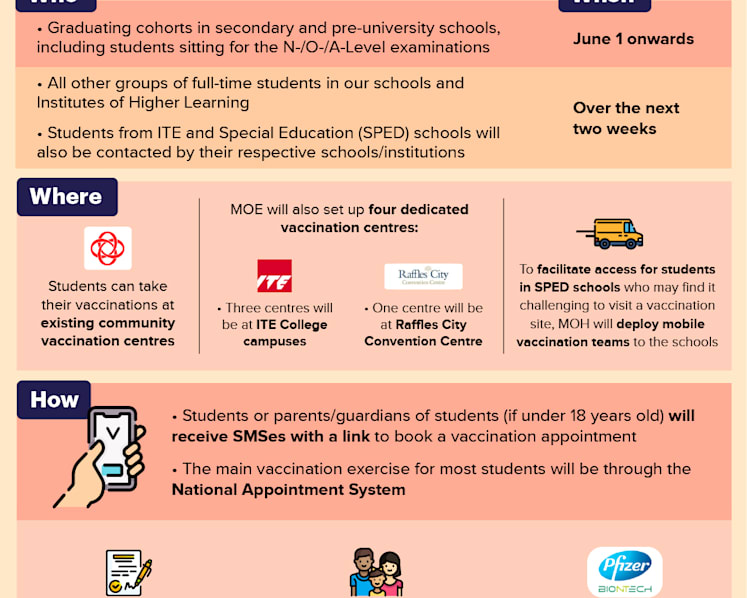
The invitations will be first rolled out to graduating cohorts at the secondary schools and pre-university levels, particularly those sitting for the GCE N-, O- and A-Level examinations, or those of equivalent qualifications, in the second half of the year, MOE said in a statement on Monday.





This is so that these students can have “greater flexibility in scheduling their vaccination appointments in view of their upcoming national examinations.”
The earliest vaccination slots for these students will be available starting Thursday.
This decision follows the approval of the use of the Pfizer-BioNTech Covid-19 vaccine for those aged 12 to 15 by the Health Sciences Authority (HSA)
Based on HSA’s approval of the medical suitability of the vaccines, individuals below the age of 18 will be offered only the Pfizer-BioNTech Covid-19 vaccine, while individuals aged 18 and above can opt for the Pfizer-BioNTech or Moderna vaccine, MOE said.
Over the next two weeks, vaccination invitations will be progressively extended to other groups of full-time students at schools and institutes of higher learning, including privately funded schools, madrasahs and special education schools.
It expects this vaccination exercise of 400,000 students to be completed some time in August.
Associate Professor Kenneth Mak, director of medical services at the Ministry of Health (MOH), said that data from clinical trials on adolescents showed that adverse effects from the vaccine were uncommon for children aged 12 to 16 and were generally mild.
He was speaking at a press conference on Monday held by the Government’s Covid-19 task force.
“Children generally have a stronger immune system compared to adults, and they may experience a slightly higher incidence of minor effects like fever, injection site pain, tiredness and headaches (than) adults,” he said.
These reactions demonstrate that the immune system is functioning well and responding to the vaccines.
“The safety profile was very similar to other vaccines that are normally offered to children… These reactions will resolve within an average of one to two days,” he added.
WHERE WILL THE VACCINATIONS TAKE PLACE?
Medically eligible students may be vaccinated at community vaccination centres.
Four dedicated MOE vaccination centres will also be set up. Three of them will be at the Institute of Technical Education (ITE) College campuses, jointly set up by MOE and the Health Promotion Board, and one at Raffles City Convention Centre from June 7.
“As all three ITE campuses will have MOE vaccination centres, ITE will arrange for their students to take their vaccinations on-campus, to make use of this dedicated capacity,” MOE said.
MOH will deploy mobile vaccination teams to special education schools to carry out vaccinations for all students there aged 12 and above.
This is to facilitate access for students at special education schools who may find it challenging to visit a vaccination site, MOE said.
The special education schools will share the registration instructions and guidelines with students and their parents and guardians.
HOW DO PARENTS AND STUDENTS SIGN UP
Students aged 18 and above, and parents and guardians of students under 18 years old, will receive SMSes with a unique link for them to book vaccination appointments at any of the vaccination centres, including the four dedicated MOE vaccination centres.
Those who are below 18 years will be offered appointment slots only at sites with Pfizer-BioNTech vaccines.
“We encourage all to book their vaccination appointments once the SMS invitation is received to secure a desired time slot and location,” MOE said.
For most students, their vaccination will be scheduled via the National Appointment System for better flexibility in choice of dates and venues. Students at ITE and special education schools will be contacted directly by their school administrators.
MOE added that for students who require more support, the schools will look into alternative vaccination arrangements when school reopens, which includes providing transport to the vaccination centres.
Parents or guardians of students under 18 will be able to give their consent via the National Appointment System and this will apply to both doses of the Covid-19 vaccine.
Parents and guardians will need to accompany only children aged 12, and children at special education schools, to their vaccination appointments.
Students aged 13 and above may go unaccompanied to their vaccination site.
If a student is unable to be vaccinated during the MOE vaccination exercise — due to illness, for example — they may do so later when vaccination is open to the general public for their age bands and if they are medically eligible to do so then.
AUTONOMOUS UNIVERSITIES AND INTERNATIONAL SCHOOLS
The vaccination invitations will also be extended to full-time students from madrasahs, autonomous universities, and the international arms of Anglo Chinese School, Hwa Chong Institution and St Joseph's Institution.
Other international schools are not included in this exercise, MOE said, due to logistical and time constraints. Students from these international schools will be vaccinated based on age bands along with the rest of Singapore.
MOE said that institutes of higher learning and autonomous universities typically have large campuses with thousands of students.
“With these vaccinations, we will be able to have more of these teaching and learning activities resume on campus.”
The ministry added that when vaccinating people in institutes of higher learning, it will be prioritising the full-time students, including those pursuing their masters and PhDs, as they will spend more time on campus compared to part-time students.
“While the Covid-19 vaccination is not mandatory, we would like to encourage all medically eligible students to be vaccinated when the vaccine is made available to them,” MOE said.
“This is our way of protecting not just our students and education institutions, but also their families and the wider community.”
CHILDREN WITH DEPRESSION, MYOCARDITIS
Assoc Prof Mak said at the press conference that there have been isolated reports of adolescents with a known history of depression who reported their symptoms worsening after their vaccination.
However, he said that there is “insufficient data to assess whether this is due to the vaccine or not”.
“Nonetheless, we recommend that children with a history of depression or anxiety should first be assessed by the doctors and assured that the condition is stable and under control before they go for vaccination.”
He also said that there have been isolated reports of myocarditis in children who had received the vaccine.
Myocarditis is an inflammation of the heart muscle that may lead to complications such as heart attack and stroke.
Assoc Prof Mak said that so far, the number of cases reported does not appear to be more common than what is generally present in unvaccinated children within the population.
“We are monitoring this trend closely and we'll see if our vaccination strategies need to be adjusted over time as more data emerges.”




