







Overall rail reliability improved in first nine months of 2015: LTA
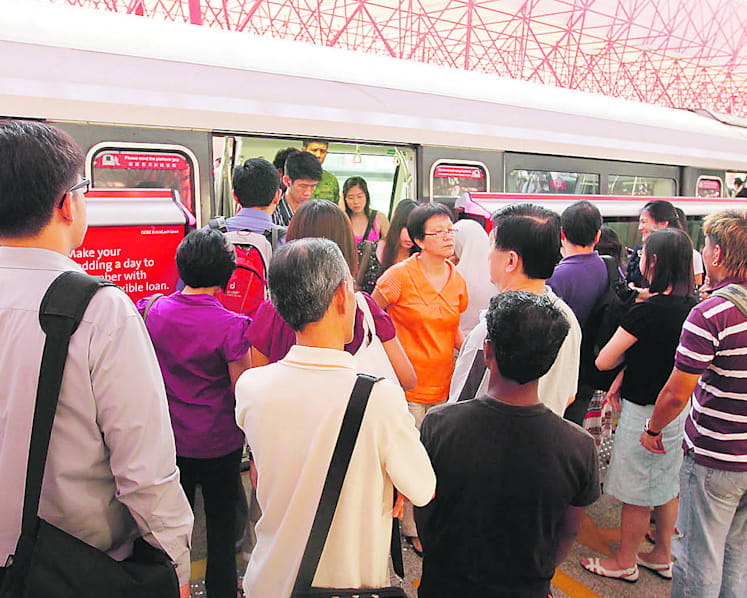
Overall rail reliability seems to have improved in the first three quarters of this year compared to 2014. TODAY File Photo


SINGAPORE — Overall rail reliability has improved in the first three quarters of this year compared to 2014, based on latest statistics from the Land Transport Authority (LTA) released today (Dec 11).
LTA also introduced a new methodology to report train service delays and to better measure the progress made in improving rail reliability and to facilitate international benchmarking.
The first change is that delays caused by external factors will now be excluded. This refers to factors beyond the control of operators or authorities, such as the actions of passengers.
In the first nine months of this year, about 15 per cent of delays of more than five minutes were due to external factors.





Secondly, while the number of delays per 100,000 kilometres was used as a measure in the past, the revision will now use the average distance travelled by trains during the time between rail delays. This means the longer the distance, the better the reliability.
For delays of more than 30 minutes, the absolute number will still be reported, as LTA said the occurrence of such serious disruption should be minimised. A similar methodology is also used in Hong Kong and New York.
Professor Lee Der Horng from the National University of Singapore’s Department of Civil and Environmental Engineering said he believes the old methodology may be more straightforward for the general public, but the new methodology could be more effective for engineers.
“The new methodology can actually tell the engineers the overall performance, especially since the last breakdown, and also the efforts we put in to rectify the older problems, whether it has been effective or not. But we also need to strike a balance between the engineers and the persons who are really in charge, in doing the maintenance and repairing, as well as the perception from the public,” said Professor Lee.
“I think, no matter how you tell the public about improvements, the major breakdowns and the major breakdowns may register a bigger impact in the minds of commuters,” he said.
DOWNTOWN LINE SEES BIGGEST IMPROVEMENT
With the new methodology applied to past figures, rail reliability seems to have improved between 2014 and the first three quarters of this year.
The mean distance travelled between delays of more than five minutes saw its sharpest increase in the last five years – up from 93,000 in 2014 to 149,900 kilometres in the first three quarters of this year.
The new Downtown Line 1 which began operations in 2013 saw the biggest improvement - though LTA says that’s because new lines typically take six to nine months to stabilise.
The oldest North South and East West Lines were the next most improved, followed by the North East Line, and the Circle Line.
Prof Lee said this shows work to improve rail reliability has been effective and the overall system looks like its stabilising. But he noted one area that may be missing in the numbers – the severity of breakdowns.
For instance - Singapore saw its worst disruption in July this year, when the North South and East West lines were down for more than three hours, affecting more than 250,000 commuters.
“Using the new methodology (on) this kind of large scale breakdown, the magnitude would not be reflected. We also need to find a way to inform the passengers, the general public, (of) the number of breakdowns and the scale of the breakdown. To paint a good picture, we can also bear this in mind,” said Professor Lee.
“So that at the same time, when the old system has improved, which is what we are witnessing at this point in time, the public can actually make the comparison between the previous performance and the current and the future performance,” he added.
There were seven delays that stretched more than 30 minutes between January and September 2015, compared to 10 in 2014.
This year’s numbers have not included disruptions on the North East Line in October and the North South Line in November. Both delays lasted about two hours.
LRT RELIABILITY DIPS
While the MRT network may have seen some improvements, statistics were not as favourable for the Light Rail Transit (LRT) system.
After reaching a peak of 58,000 kilometres in 2013, the average distance travelled between delays of more than five minutes dipped to 44,000 kilometres last year, and 39,000 kilometres in the first three quarters of this year.
The Sengkang and Punggol LRT lines proved more problematic – with the distance travelled between delays of more than five minutes falling from last year to this year. On the other hand, the Bukit Panjang LRT saw a slight improvement.
The number of delays lasting more than 30 minutes on the LRT has already gone up from four in 2014 to 11 in the first three quarters of 2015.
Prof Lee said this should sound an alarm over the reliability of the LRT system, which has seen ridership increase over the years. CHANNEL NEWSASIA




