No transition period for changes to P1 registration taking effect from 2027: Desmond Lee
Several Members of Parliament called for a transition period as some families have made residential arrangements based on the existing framework.
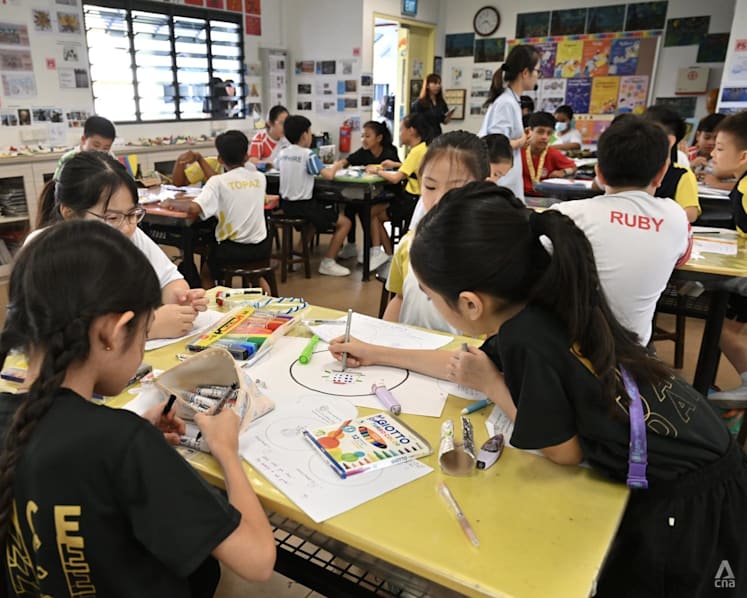
A classroom at Oasis Primary School on Jul 8, 2025. (File photo: CNA/Jeremy Long)

This audio is generated by an AI tool.


SINGAPORE: Changes to the Primary 1 registration framework will go ahead from 2027 without a transition period, despite calls from several Members of Parliament (MPs) to give families more time to adjust.
Speaking in parliament on Wednesday (Oct 7), Education Minister Desmond Lee said: “On implementation timing, we recognise that on one hand, some families have made residential arrangements based on the existing framework.
“But on the other hand, more families would benefit the sooner we implement the changes. In fact, some have asked why we did not make these changes earlier for the 2026 Primary 1 registration exercise.”
Mr Lee was responding to parliamentary questions filed by MPs calling for a transition period. The MPs pointed out that some families may have already made significant decisions on where to live, childcare and schooling based on the existing registration rules.





Urging the ministry to defer the changes by one year, Ms Tin Pei Ling (PAP-Marine Parade–Braddell Heights) said these families had made “significant and long-term decisions” based on the current framework.
Another MP, Ms Gho Sze Kee (PAP-Mountbatten), proposed a transition period of about three years for those who had already made residential, childcare and schooling arrangements.
To this, Mr Lee said that the changes to the framework do not by themselves lead to a more diverse socio-economic mix in schools.
“Many other factors, including parents’ preferences and eventual school choices, matter too.
“We will thus monitor the implementation of the two changes, continually review our Primary 1 registration framework, and make further refinements as needed,” Mr Lee said.
The 2027 changes to the Primary 1 registration framework which MOE announced in September include an increase to the number of places for Phase 2C from 40 to 60 for most primary schools.
Phase 2C is open to all children regardless of prior connection to a school, so more reserved places should widen access for those without such ties, MOE previously said.
The larger Phase 2C allocation could reduce the number of places available in Phase 2A, which is for children whose parent is a former student of the school.
In addition, 12 schools in neighbourhoods where public housing makes up less than 40 per cent of homes within 2km will also split their Phase 2C places into two tracks – one for applicants living within 2km, another for those beyond it – with no home-school distance priority within either track.
This two-track scheme applies to schools such as CHIJ (Katong) Primary School and Ngee Ann Primary School.
On Wednesday, Mr Lee said the changes are intended to enable schools to “remain open and accessible”.
“Our schools are important common spaces where children from different backgrounds interact and learn together, in turn appreciating different perspectives and developing mutual understanding,” said the minister.
“This helps to lay the foundations for a cohesive and inclusive Singapore.”
Mr Lee also highlighted that the parent volunteer scheme remains unchanged, providing an opportunity for parents who wish to contribute to and get to know the school.

NO RESERVED PLACES ALONG SOCIO-ECONOMIC LINES
Responding to a parliamentary question by Ms Elysa Chen (PAP-Bishan Toa Payoh) on whether a proportion of Phase 2C places could be reserved for children living in public rental flats or smaller flats in place of or alongside the two-track distance criterion, Mr Lee said MOE does not intend to do so.
“As our objective is to broaden opportunities for access, rather than to reserve places for specific socio-economic groups, we have not introduced priority for particular socio-economic groups including those living in rental flats,” he said.
Instead, the two-track scheme for Phase 2C for the 12 schools is based on the proportion of public housing “as it is simple and easier to implement”, said Mr Lee.
It also gives greater certainty to parents given that housing make-up does not change frequently, he added.

SOCIO-ECONOMIC MIXING
Ms Goh, the MP for Mountbatten single member constituency, asked about public housing within 2km of the 12 schools.
Said the MP: “With this new framework, we are simply drawing a circle around a school and handicapping every (child) living within that circle. Worse, this framework makes the assumption that children living outside of that circle will be from different social economic backgrounds, but I feel that this is clearly wrong.”
Responding, Mr Lee said that an average of about 15 per cent of students at these schools come from public housing, which was a “very low” proportion.
“So ultimately, whether this works will depend, as I said, on parental decisions.
“But at least now we widen the circle and give opportunities. And for those living within zero to two kilometers, we are preserving access for those, we're not taking it away,” Mr Lee said.
In response to a supplementary question by Non-Constituency MP Andre Low on how the government assesses socio-economic mixing and whether “baseline” indicators will be used, Mr Lee said there was no such construct as “no two schools are identical, and no two schools are the same”.
“The school mix is a function of the legacy of the school, a function of the so-called popularity of the school, a function of the makeup of its neighborhood.”
Several MPs also raised concerns about potentially higher school bus costs and longer journey times.
Mr Lee said many of the 12 schools under the two-track scheme are accessible by MRT or major bus routes.
School bus operators will also determine school bus routes and pick-up points based on students’ demand, he said.
“In addition, MOE will provide financial assistance to Singapore citizen students in need, including subsidies to reduce the cost of public transport and school bus fares if required,” Mr Lee added.