







Personal opinion trumped online criticism when it came to GE voting
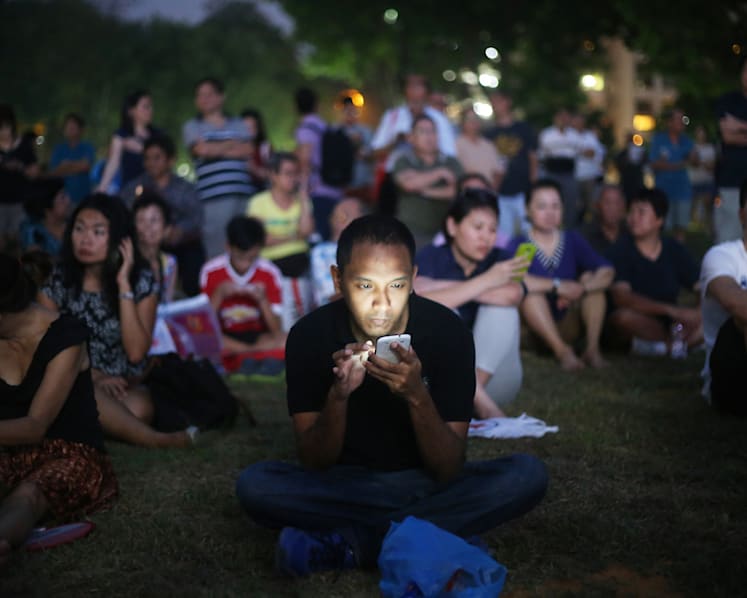
A participants seen using his phone at the Singapore People’s Party rally during the GE in September 2015. TODAY file photo


SINGAPORE — Users of open social-media platforms, such as Facebook, were perceived to be most critical of the Government at the General Election (GE) last year, in contrast to closed social-media users, who were perceived to be less critical, a study on media and Internet use during the polls has found.
However, the opinions expressed on closed social-media platforms, such as WhatsApp, appeared to have been more significant in influencing voting patterns, according to the study by National University of Singapore’s (NUS) communications and new media assistant professor Elmie Nekmat.
Still, Dr Elmie noted that personal opinion had more weight in nudging voting behaviour.
His study showed that users of open platforms were perceived by voters to be the most dissatisfied with the Government’s handling of issues such as transport and housing, even though these voters themselves might have felt that the Government was dealing with these issues well.





Dr Elmie’s research, which focused on the opinion climate during the polls, drew from an online survey commissioned last September by the Institute of Policy Studies (IPS), which canvassed responses from 2,000 citizens.
“There is this general feel that social-media (users) are most critical. Personally, (the respondents) think they (the Government) are okay,” he said.
Dr Elmie’s study also found that voters’ perceptions of how fellow users in closed social-media groups felt about the Government’s performance on housing and transport issues were the second-most-significant influence on voting behaviour.
By contrast, voters’ perceptions of how users on their open social networks felt about the Government’s handling of housing, transport and population issues appeared to have no influence on voting patterns.
Both of these were, however, outweighed by the respondents’ personal opinions, which figured most heavily in how they voted.
Dr Elmie was one of five researchers who presented the findings of their studies at an IPS symposium on Wednesday. Their studies, which offered a closer look at media and Internet use during GE2015, follow the release of the main findings of an IPS study with the same focus last November.
The IPS study had found that although social media had some impact, it was not a strong factor in GE2015.
Mainstream media, for one, was found to have played a bigger role than social media in the election.
Echoing this point on Wednesday, IPS senior research fellow Carol Soon, who moderated a panel discussion at the symposium, said mainstream media was used and trusted more during the election than social media.
“Within the media ecology, we (were) also seeing mainstream media posing to be quite a fierce competitor (to) social media,” Dr Soon said, in response to an audience member’s question on what likely negated the effects of social media during the election.
In a separate study, Dr Natalie Pang, an assistant professor at the Wee Kim Wee School of Communication and Information (WKWSCI) at Nanyang Technological University, found that post-retirement users aged between 65 and 69 were more likely to use social media for informational purposes, such as requesting information on a candidate, than respondents from other age groups.
Those with primary or lower-secondary qualifications were most expressive, and tended to seek or share information on social media more frequently than individuals with higher qualifications.
Young voters between the ages of 20 and 29 were the most active in posting and sharing election information, with 80 per cent in this age group doing so, another survey by WKWSCI assistant professor Debbie Goh revealed.
Those with secondary qualifications or below had the largest proportion of non-users, at 42 per cent, compared with the non-use rate of 25 per cent for university-degree holders, her survey showed.




