







Pilot programme helps children with disabilities by caring for their caregivers
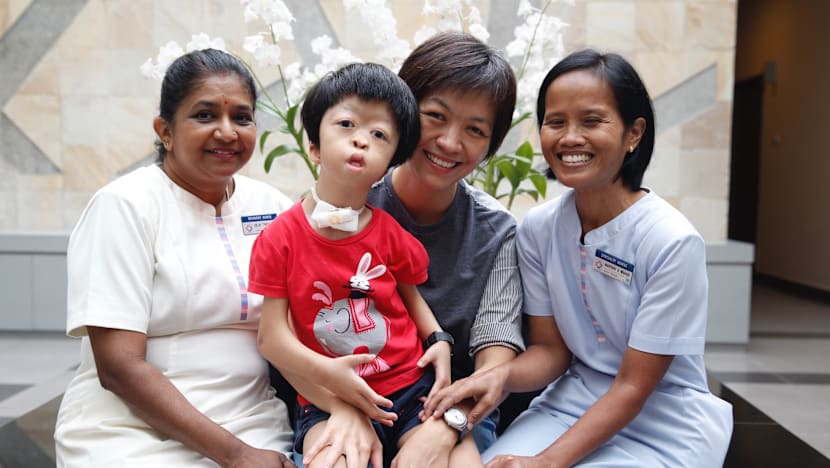
Madam Lee Seu Hong (second from right) poses for a photo with her daughter, En Ning, who has Antley Bixler syndrome, and respite nurses Selvi Thevatha (left) and Maryani Abdul Wahab.
SINGAPORE — After her daughter was born with a rare genetic disorder six years ago, caring for her took a toll on Madam Lee Seu Hong.
While her husband is supportive, extra help arrived two years ago through a pilot programme at the KK Women’s and Children’s Hospital (KKH).
The Caregiver Support Programme, which began in Sept 2016, provided counselling sessions to those caring for chronically ill children. Participants also received three free sessions where trained nurses took over caregiving duties for four hours every two months.
It screened 326 caregivers who had infants or children under KKH’s Paediatric Home Care Programme for perceived stress and mental health risks, and found 179 of them at moderate to high risk. Some 110 of them, including Mdm Lee, agreed to participate in the Caregiver Support Programme.





Started in 2001, the Paediatric Home Care Programme allows children with moderate to severe disabilities, and who depend on life-sustaining technology, to be cared for at home.
With a nurse standing in for her, Mdm Lee, 42, said she was able to go out with her husband, and have some time to herself.
En Ning has Antley Bixler syndrome, which is characterised by malformations in the head and facial area, as well as skeletal abnormalities. She has one kidney, two holes in her heart, and has undergone multiple surgeries including a tracheostomy — which involves creating an opening in the neck to place a tube into her windpipe.
Mdm Lee has to be by her side constantly, removing mucus from her windpipe and lower airway when needed. She also accompanies En Ning to kindergarten, where the little girl learns sign language, among other things.
“There is no time for (yourself) at all,” said Mdm Lee to reporters on Wednesday (Oct 17).
Caregivers are regarded as the hospital’s second patients as their health affects that of the primary patients, the children, said Associate Professor Chan Yoke Hwee.
The pilot programme was the result of a 10-month survey that started in March 2015, said Assoc Prof Chan. Of 88 caregivers from the Paediatric Home Care Programme surveyed, nearly half of them were at risk of clinical depression.
One of the key areas of support requested was respite services.
“Perceived social support is very important… because if they perceive they have good social support, their risk of depression, and quality of life and family function is better,” said Assoc Prof Chan, who is advisor of both programmes.
Seventy per cent of the pilot programme’s participants showed an improvement in perceived stress, while 86 per cent said they were no longer feeling as depressed.
The Caregiver Support Programme received funding of S$513,000 from Temasek Foundation Cares for two-and-a-half years, and is due to run its course by February 2019.
There are plans to extend the respite care service and possibly include community partners, said Assoc Prof Chan.
Caregivers may also have to pay for the service in future, although cost estimates are not available yet. A KKH spokesperson said it is in discussions with community partners, and is “exploring funding mechanisms though subsidies”.
The pilot programme also received warm response from KKH’s nurses, 51 of whom signed up to provide respite care over and above their regular duties at the hospital. They were compensated for their services.
Assistant Nurse Clinician Selvi Thevathas said she signed up because she felt it was something new. She underwent about 18 hours of training and has provided four respite sessions so far.
Her first patient was En Ning.
“It makes you feel good to know (Mdm Lee) had a good time and that she did not have to worry about her child,” said Ms Selvi, a healthcare worker of 36 years.
Sign up for TODAY's WhatsApp service. Click here:




