







Pipe burst problems cannot be entirely eradicated, say experts
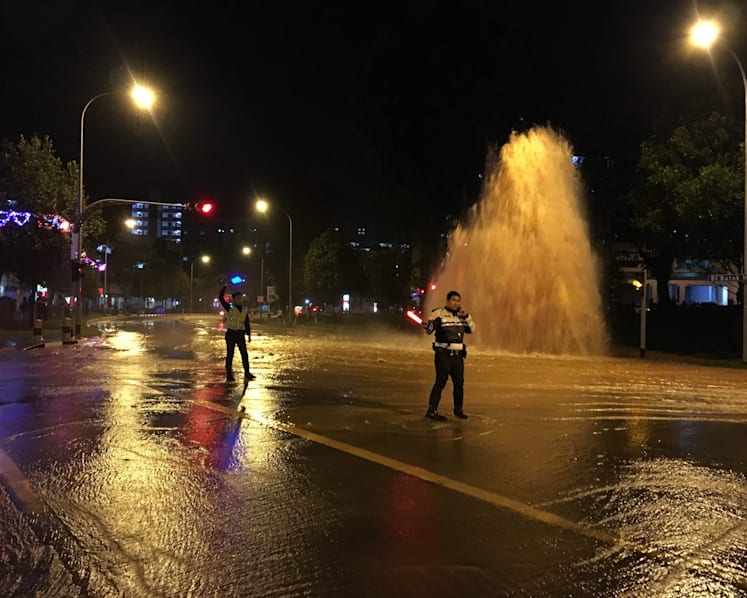
Despite a decline in the overall number of burst water pipes in the last few years, experts say the problem cannot be entirely eradicated. TODAY file photo


SINGAPORE — Despite a decline in the overall number of burst water pipes in the last few years, experts say the problem cannot be entirely eradicated. They cited corrosion, soil settlement and weather patterns affecting the structural integrity of the pipes as difficult factors to control.
A number of high-profile incidents in recent months have put the problem back into the spotlight, with Opposition party member Leon Perera asking in a Facebook post on Thursday (Jan 18) if burst water pipes “are yet another infrastructural issue” now plaguing Singaporeans.
On Jan 10, he had also posed a Parliamentary question to the Minister for the Environment and Water Resources Amy Khor on the statistics of pipe leaks.
Statistics released by PUB show that the number of burst water pipe cases fell from a high of about 10 leaks per 100km of pipes in 2003 to 4.6 in 2016.





Considering that PUB operates some 5,500km network of pipes in the Republic, this translates to about 550 cases of burst pipes in 2003 as compared to 253 in 2016.
While last year’s figures are still being compiled, there were at least five high-profile leaks occurring within a span of two weeks in November alone, in areas such as Tampines, Bukit Batok and Serangoon.
Most recently, a water pipe leak on Somerset Road last Tuesday (Jan 16) caused three of four lanes of the road to be temporarily closed to traffic.
Civil engineering experts cited corrosion and weather extremities as reasons that could cause a pipe to burst.
Assistant Professor Imran Halimi Ibrahim from the University of Glasgow, an overseas partner of the Singapore Institute of Technology (SIT), said that corrosion is the most common factor causing a pipe burst.
“Bearing in mind that the pipes might sometimes only carry 30 to 40 per cent of water at times, they might be exposed to air and humidity, and air bubbles will then be created, promoting corrosion,” said Assistant Prof Imran.
PUB said that its pipes are made from ductile iron and steel. They are lined with cement and coated with polyurethane, which helps protect against corrosion.
Despite being made to withstand corrosion, Er. Lum Chong Chuen from the Institution of Engineers Singapore (IES) said it is still possible that “minor faults”, like small specks of dust caught in the materials of pipes”, could possibly cause the materials to corrode faster than expected.
“These faults are extremely difficult to detect because pipes are manufactured over a few hundred metres at one time,” he added.
Assistant Prof Imran also suggested that “greater weather extremities” may have resulted in structural fatigue in the piping network.
The fact that the water pipes are underground also limits the effectiveness of sensors that have been put in place by the PUB.
“As these pipes are underground and out of sight, it takes time and much more effort to detect if there are any faults,” said Er. Lum, a member of the mechanical & electrical engineering technical committee, IES.
He added that it is also unfeasible to conduct checks on every pipe, given the extensive network of pipes here.
“The rate of such incidents happening is very low here. It is impossible to do checks on every single pipeline, and there are bound to be leaks,” said Er. Lum.
Singapore’s water agency said “despite its best efforts, leaks cannot be fully prevented”.
Giving an update on last week’s Somerset Road incident, PUB said the leak was due to soil settlement.
It added that it had set up temporary supply connections from hydrants to provide water supply to nearby customers during the course of repair work.
Assistant Prof Imran suggested the use of design tools like Computational Fluid Dynamics to minimise chances of burst pipes and subsequently inconvenience to users.
He said: “Such programmes can calculate and analyse the amount of water pressure at various points of the pipes passing through one end of the pipe to another, depending on the water load. This allows engineers to better understand which parts of the pipes might need more reinforcement.”




