







PM to visit Dr M in Malaysia on Saturday, calls Pakatan Harapan win 'momentous development'
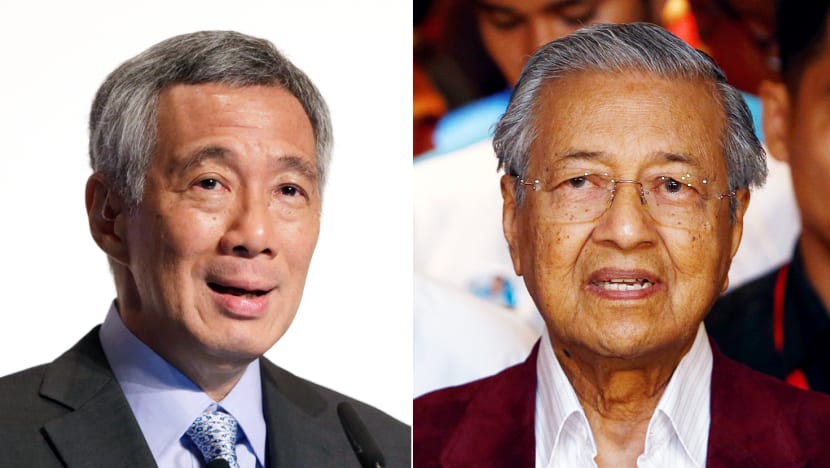
Prime Minister Lee Hsien Loong will visit Malaysia this Saturday (May 19) and meet with his new Malaysian counterpart Mahathir Mohamad.


SINGAPORE — Prime Minister Lee Hsien Loong said he will visit Malaysia this Saturday (May 19) and meet his new Malaysian counterpart Mahathir Mohamad to signal Singapore's intention to work with its closest neighbour "for mutual benefit".
"As Malaysia's closest neighbour, we need to pay close attention to our relationship with them," said Mr Lee in a wide-ranging speech in Parliament on Wednesday on the implications of external changes on Singapore.
He described the May 9 election in which Dr Mahathir's Pakatan Harapan (PH) pact defeated the Barisan Nasional (BN) coalition as a "momentous development", with BN losing power for the first time in six decades.
"The two countries have deep historical, economic and people-to-people ties," said Mr Lee.





He added that the Republic has enjoyed good relations with Malaysia under former Prime Minister Najib Razak, and both sides cooperated on major projects for mutual benefit. The two countries also completed several major projects when Dr Mahathir was Malaysian premier from 1981 to 2003.
This included the Second Link at Tuas when Dr Mahathir was in power.
Mr Lee added that he also knew Mr Anwar Ibrahim well, who is touted to be Dr Mahathir's successor in a year or two, as they were both previously deputy prime ministers at the same time.
Mr Anwar regained his freedom and was given a full royal pardon on Wednesday after serving a jail term for sodomy on what he called politically motivated charges.
Mr Lee stressed that the Republic will work hard on its ties with Malaysia and Indonesia — which is set to hold local elections this year and national polls next year — "regardless of political cycles or electoral outcomes".
"Their success makes for a more peaceful and prosperous region, and that is good for us," said Mr Lee.
Last Wednesday, Dr Mahathir's PH pact romped to a historic victory, clinching 113 out of 222 parliamentary seats in a bitterly fought election. PH's Warisan Sabah ally also won eight seats.
BN took 79 seats, with the rest going to the Islamist opposition Parti Islam Se-Malaysia as well as other smaller parties and independent candidates.
In the wake of BN's crushing defeat at the polls, which ended its 61-year unbroken rule, the embattled former prime minister Najib Razak stepped down as BN chairman and president of its leading party, the United Malays National Organisation.
He and his wife Rosmah Mansor were also barred from leaving the country, having been blacklisted by Malaysia's immigration authorities on the instruction of Dr Mahathir, the newly minted prime minister.
In Parliament on Wednesday, Mr Lee added that the Republic hopes Malaysia remains stable and prosperous.
"The expectations of the new Malaysian government are very high, and I think Dr Mahathir will be very busy in the days to come," he added.
In his hour-long speech, Mr Lee also touched on the 6 per cent Goods and Services Tax (GST) in Malaysia, a source of great unhappiness for voters this time around.
Mr Lee said the Dr Mahathir-led government’s pledge to abolish the GST was not due to the tax’s economic merits or demerits. In fact, it was better than the sales tax which it replaced, he noted.
“But politically, Malaysians linked the GST with other complaints they had with the previous government and they rejected the explanations and the persuasions and they said, ‘no, I don’t accept this; out with it’. Does that mean that no government should ever raise taxes? Alas, that’s not the real world,” said Mr Lee.
Malaysia’s GST will be reduced from 6 per cent to zero from June 1, the Malaysian authorities announced on Wednesday.
In Singapore, the GST is set to rise from the current 7 per cent to 9 per cent sometime between 2021 and 2025.
From time to time, Mr Lee said a country will have to spend more on healthcare, defence and education, for instance, and it will have no choice but to bump up taxes.
“Then the government must convince the population that it is raising taxes for a good reason, for the right reason, and whether the voters accept that will depend not just on the arguments, but also crucially whether they trust the government,” added Mr Lee.
Turning to Indonesia, Mr Lee pointed to the country's impending local and national elections, saying he has good working ties with President Joko Widodo, as he did with former President Susilo Bambang Yudhoyono.
"I hope we can maintain friendly and productive ties with Indonesia, too," the Prime Minister said.
Noting the uncertain external environment, Mr Lee singled out countries, particularly those in the West, that have questioned the benefits of openness and free trade, and of the free movement of people.
While the US has been a champion of the post-war international system — promoting free trade, welcoming immigrants and sharing technology, for instance — many Americans now "no longer believe this, including the Trump Administration", said Mr Lee.
These segments of American society feel that other countries are gaining more from the global system at their expense, and the US has made trade a top issue, especially with China.
Not only do the trade tensions between the US and China hurt business, Mr Lee said their "unilateral and tit-for-tat actions undermine the multilateral trading system".
These moves also threaten global prosperity, especially for smaller countries like Singapore.
With both the US and China jockeying for position and advantage, Mr Lee said that the US increasingly has to accommodate the presence of China. Though the two superpowers are far from going to war with each other, it is unclear which way relations will tilt, he added.
If relations veer towards greater conflict, this will be bad not only for the two powers, but the rest of the world. However, if relations tilt to the "other extreme", in which they agree to divide up the world between themselves and set rules only to their benefit, it would be "just as detrimental, especially for small countries, which will have no say", said Mr Lee.
He recounted what founding Prime Minister Lee Kuan Yew used to say – "when elephants fight, the grass suffers, but when elephants make love, the grass suffers also" – and added: "Therefore, we must be aware of what is happening around us, and prepare ourselves for changes and surprises."




