







Police Coast Guard to train up sea version of terrorism police
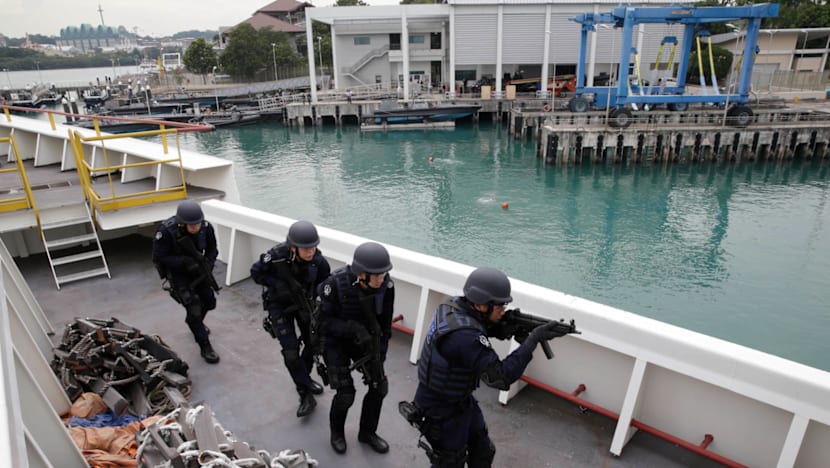
Simulation of Police Coast Guards going on board a vessel to neutralise a threat at the Police Coast Guard HQ on April 3, 2017. Photo: Wee Teck Hian/TODAY


SINGAPORE — To bolster the Republic’s borders and guard against terrorists who try to infiltrate via surrounding waters, the Police Coast Guard (PCG) will step up training for frontline officers to deal with armed attackers at sea promptly and effectively.
From June, every patrol vessel – such as boats deployed in the Marina Reservoir during the National Day Parade – will have officers trained under the Emergency Response Force (ERF), versed in counter-assault skills and equipped with sophisticated weaponry to respond swiftly to an attack, announced Minister for Home Affairs and Law K Shanmugam on Friday (April 7) at the annual Police Workplan Seminar attended by about 1,000 police personnel and invited guests.
The ERF officers at sea will bear the same mission as their land comrades in the Emergency Response Team rolled out last year: To take out the enemy quickly and minimise casualties in an armed attack.
They will be activated when the boat they are on is charging towards a target, when a routine boarding operation is found to involve people bearing arms, or when gunmen hijack a vessel or are spotted on any of the offshore islands, among other scenarios.





Clad in bulletproof vests that double up as life vests, ERF officers will also wear ballistic helmets, ballistic glasses, tactical gloves that protect their hands from cuts, as well as elbow and knee guards.
Their weapon is the HK MP5 sub-machine gun affixed with optics and lights to help them locate targets quickly. Officers will also be equipped with carbines and adequate firepower.
ERF officers will be certified only after they have passed new and tougher fitness tests customised for the maritime domain.
“Singapore’s economic lifeline is intrinsically tied to the country’s safety and security, and there has to be acommensurate enhancement in security measures to safeguard Singapore from terror attacks,” said a spokesperson from the Singapore Police Force.
It started training up ERF officers last December.
Among the raft of gizmos the PCG started testing last year to beef up its capabilities to detect threats include unmanned aerial vehicles and electro-optic sensors that give instant 360-degree views.
The first unmanned aerial vehicle – to be tethered to patrol craft to allow surveillance from the sky in cluttered waters – will arrive in the first half of this year.
The panoramic electro-optic sensors, which come with video analytics capabilities that can alert operators to suspicious movements sighted in the waters, will be installed from the middle of 2018.
To beef up support for the police during national emergencies and major security events, National Servicemen who served their National Service with the police will be roped in to form public order troops. The first of these troops will be operationally-ready by 2018, and will be recalled for training and anti-crime patrols during their reservist stints. They may also be deployed to support the police tactical troops during public order operations.
By early next year, all existing community watch groups will also be integrated under a common scheme, to enhance training and help them play a more active role in crime prevention and response. "With more skilled and competent volunteers, (we will have) wider reach (and) more capacities to tackle terrorism and other crime tasks," said Mr Shanmugam.




