







Political polarisation among key threats to social cohesion: DPM Heng
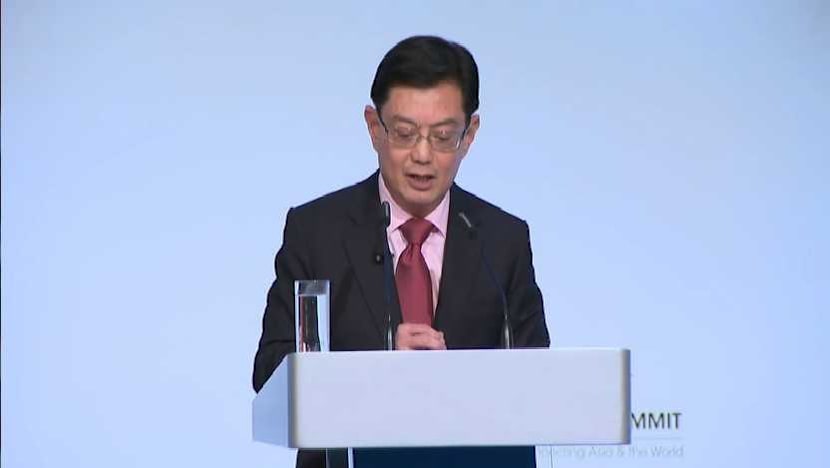
Deputy Prime Minister Heng Swee Keat speaking at the Singapore Summit at the Shangri-la Hotel on Friday (Sept 20).
SINGAPORE — While the global economy has recovered since the financial crisis in 2008, the benefits of its recovery have been distributed unevenly, said Deputy Prime Minister Heng Swee Keat on Friday (20 Sept).
This has led to the growth of nationalist and populist movements around the world, resulting in fractured societal interests that have made it difficult for many governments to secure a mandate to make important changes, he said, speaking at the Shangri-la Hotel.
Mr Heng, who is also Finance Minister, was giving the keynote speech at the Singapore Summit, an annual forum bringing together leaders from around the world to discuss global trends in business, finance and geopolitics.
The challenges facing societies include political polarisation in many parts of the world — exacerbated by technology and social media, he said.





Mr Heng highlighted widening inequality and the growing intergenerational divide as the two other challenges that need to be addressed before societies can renew the social compacts which held them together.
He also called for business leaders to do more to “renew” the social order of the countries they operate in and “revitalise the international system” through efforts such as environmental sustainability and promoting education.
Here’s a quick look at the three threats to social cohesion that Mr Heng highlighted in his speech and what Singapore is doing to counter them:
INCREASING POLITICAL POLARISATION
Political polarisation was becoming visible in parts of the world such as the United States where the Republican and Democratic parties have become increasingly divided along ideological lines
Technology has exacerbated these divisions by enabling “echo chambers, silos and fake news”
Mr Heng said that political polarisation “pits people against one another” and undermines the cohesion of a country
To counter this trend, the common space needed to be broadened, with people of opposing views brought together
Singapore’s response:
Singapore has resisted political pressures to “pander to narrow interests”
It has adopted an inclusive approach to bring people together through measures which ensure that race and religion do not divide the country
Governments, unions and businesses also work together to grow the economy, rather than “confront each other across the picket line”
In response to new divisions in society which may emerge along the lines of wealth, age and ideology, Mr Heng launched the “Singapore Together” movement several months ago
The movement emphasises a governance model that brings people of different backgrounds, concerns and perspectives together to a common cause
WIDENING INEQUALITY
Globalisation and technology have fuelled inequality in societies
Globalisation has resulted in massive wealth accumulation of those at the top, but exposed those in the middle to sharper competition
Meanwhile, technology has enabled innovation and growth but also disrupted and displaced people’s livelihoods
If these issues are unaddressed, it would challenge “the opportunity for every individual to build and have a better life”, said Mr Heng
Singapore’s response:
Singapore’s response to inequality has been to ensure that economic and social policies “go hand in hand”
In Singapore, real incomes for households in the bottom 20 per cent have grown faster than the top 20 per cent, said Mr Heng
Singapore has invested in its people, particularly in education. For instance, the Government recently extended its investment in preschool education and encouraged life-long learning for those in the workforce
Singapore also strengthened its social safety nets by “raising the bottom and not by capping the top”
GROWING INTERGENERATIONAL DIVIDE
There was a growing intergenerational divide in some societies. This was especially so in ageing societies due to “real differences in the interests and concerns of different generations”
Opinions on Brexit in the United Kingdom, for instance, were divided by age groups. Older voters had chosen to leave the European Union while younger voters had chosen to remain
To maintain intergenerational equity, Mr Heng said governments must invest in their young, and the young must, in turn, share the fruits of progress with their seniors
Singapore’s response:
Singapore adopts a “fair and sustainable fiscal approach”, which reflects the social compact between generations
The compact is not just a matter of finances but also one of “trust and a collective sense of mission”
The Singapore Government has invested in the long-term future of the country, such as in the education of its people and its infrastructure
Mr Heng said that to ensure that future generations have enough to see through crisis, the Government will try its best to keep politics focused on long-term challenges and opportunities
COUNTRIES MUST FIND THEIR OWN FORMULA FOR SOCIAL COMPACTS
Concluding his speech, Mr Heng said that each society must renew its own social compact to address these challenges effectively.
“It must find a formula that fits its unique circumstances, its own blend of social and economic policies to give everyone a stake and its own political narrative to reignite the imagination of its people,” said Mr Heng.
He added that countries should also not forsake multilateralism simply because current ground sentiments are shifting away from it. He called for leaders around the world to “uphold this system collectively and convince others that this remains the best way forward”.
Mr Heng called on business leaders to play a bigger role in the countries they operate in.
While many businesses have already stepped up to take on greater social responsibility, such as through initiatives to support gender equality or environmental sustainability, they can do more, said Mr Heng.
Businesses can “unlock the tremendous possibilities” of Asia by 2030 if they can find a way to do well and do good at the same time, he added.




