What's keeping private-hire drivers away from EVs?
Many private-hire drivers remain reluctant to make the switch to electric vehicles, citing concerns over charging times and lost earnings.
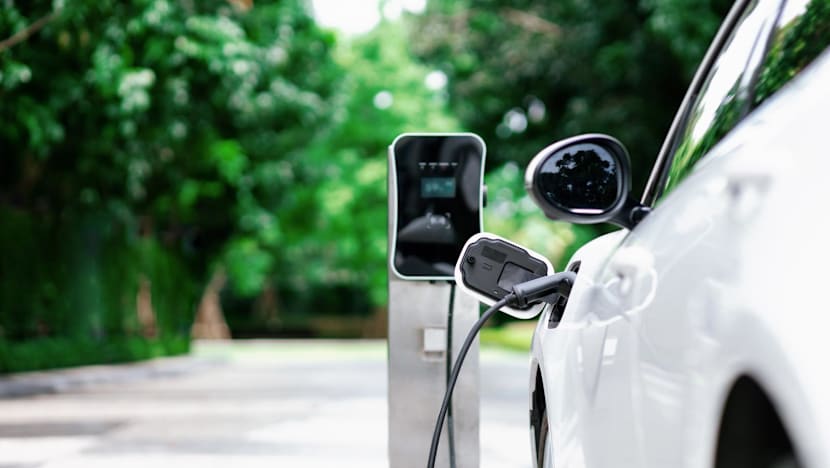
Private-hire drivers are hesitant to switch to EVs as charging takes significantly longer than refuelling a petrol car, they said. (File photo: iStock)

This audio is generated by an AI tool.


SINGAPORE: Singapore's roads are seeing more electric vehicles (EVs) than ever, but private-hire drivers are hesitant to join the transition, with many saying the switch does not make economic sense.
By the end of 2025, EVs made up 7.4 per cent of Singapore's total car population, reaching 49,262 vehicles – nearly double the 4 per cent share recorded in 2024.
Yet among private-hire vehicle drivers, whose livelihoods depend on maximising time on the road, adoption remains sluggish.
Mr Chia, 60, who currently drives a hybrid, said he would not consider switching to an EV, as charging takes significantly longer than refuelling a petrol car.
“If you want to do a fast charge, it will be about one hour, and that time will just be wasted,” said Mr Chia, who declined to give his full name.
“If I don’t need to charge so long, and there are more places that can charge quickly, maybe I’ll consider it.”
Mr Augustine Lai, 62, a full-time private-hire driver who works up to 14 hours a day, had similar reservations. For him, the refuelling trip to the petrol station at the end of his shift is part of a reliable routine.
“This is so tomorrow will be a new day with my tank fully topped up,” said Mr Lai, who also drives a hybrid car.
Though he has weighed the fuel savings an EV might offer, Mr Lai said the inconvenience outweighs the potential savings.
“I’ll have to charge maybe three or four hours, and then I have to come down to disconnect it, and I’m already very tired,” he said.
Adding to his concerns is the limited charging infrastructure near his Housing and Development Board (HDB) block, where only six EV charging points serve the estate.
“I will be taking up space for the charging point, and sooner or later (residents) could have arguments about it,” he said.


RENTAL FIRMS FEEL THE PINCH
Car leasing firms say these concerns have translated into weak demand for EV rentals among private-hire drivers.
Mr Chiam Soon Chian, chief operating officer of private-hire vehicle rental firm Lumens Group, said his company purchased 40 EVs two years ago, but uptake has been low.
Since then, the firm has sold half the fleet at a loss. The remaining 20 vehicles are now used primarily for short-term rentals rather than private-hire use.
“From the driver’s perspective, every hour, they can take one-and-a-half to two trips, which can fetch them S$30 to S$40 (US$23 to US$31), instead of waiting for one hour for the car to be charged,” he said.
“At the end of the day, it’s just a cost thing, and it is unlikely that things can change much as long as the driver doesn’t earn,” said Mr Chiam.
Public charging is also generally more expensive than home charging, and most private-hire drivers rely on chargers located in HDB estates or public car parks, said Mr Kenneth Lee, honorary treasurer of the Vehicle Rental Association (VRA).
“The savings aren't big enough to justify the inconvenience,” he said.
Mr Ng Chee Haw, a general manager at rental firm Bolt Car Leasing, added that many private-hire drivers are older and may find EVs more complex to operate.
“While this is not a definitive industry-wide issue, it may contribute to hesitation among drivers who are more accustomed to conventional internal combustion engine vehicles,” he said.
PLATFORMS REMAIN OPTIMISTIC
Despite the lukewarm response from drivers, private-hire platforms say they remain committed to electrification.
Grab said that utilisation rates for EVs under its rental arm, GrabRental, remain “consistently high”, driven by fuel cost savings. The company has set a target for half its rental fleet to be fully electric by 2030.
“Our focus is on turning EV adoption into a practical, driver-first transition that delivers real benefits on the road, every day,” a Grab spokesperson said.
Last year, Grab announced plans to expand its EV fleet with up to 50,000 BYD vehicles across Southeast Asia.
A Gojek spokesperson also said EV adoption is also “gaining momentum” among its drivers, although figures were not disclosed.
“In support of Singapore’s broader electrification goals, we work with partners on initiatives such as charging discounts and rental campaigns, alongside regular communication to educate drivers on the long-term benefits of EVs,” the spokesperson said.

FOR SOME, THE SWITCH WORKS
Not all drivers are resistant. Mr Roy Lee, 45, recently made the switch to an EV and said proper planning has made the transition seamless.
Driving around 300km daily, he said the vehicle’s range is sufficient for his needs.
“I only need to spend once or maximum twice a day charging my car for 30 minutes each time, so that can be done during my regular breaks and does not disrupt my time on the road,” he said.
Having several fast chargers located within his HDB estate has been crucial.
“I’ll just charge during dinner without worrying about it.”
However, Mr Lee acknowledged that conditions have improved significantly since his first experience with EVs between 2018 and 2020, when limited infrastructure made driving far more challenging.
“Perhaps as the number of EVs increases in years to come, having even more fast chargers will be a plus point,” he said.
The use of electric vehicle chargers in HDB car parks has nearly doubled in just three months. The Land Transport Authority said about 18% of chargers are now in use at any given time — up from 10% last September. Nine in 10 HDB car parks now have EV chargers. Even with the increased usage, operators said there aren't enough EVs around to justify a rapid scale-up. Eugene Chow reports.
INFRASTRUCTURE, MINDSET SHIFTS NEEDED
Industry players say more needs to be done to make EVs practical for high-usage drivers.
Mr Ng from Bolt said solutions that significantly reduce downtime would be crucial.
“Battery swap technology is one potential option, as it could allow drivers to replace depleted batteries quickly rather than wait for charging,” he said.
He added that a wider network of fast, reliable and strategically located chargers would also be critical.
Drivers CNA spoke to agreed that having more chargers islandwide — both fast and standard — would improve the EV driving experience and encourage more to make the switch.
Mr Lai said the presence of a fast charger in his Clementi HDB estate would make a meaningful difference.
“Maybe if (I can charge the car) in one hour, I can go home, take my shower, have dinner, then immediately come down to disconnect the charger,” he said.
Beyond infrastructure, industry players say a mindset shift is also necessary.
Grab said fast charging sessions typically take 30 to 45 minutes to charge a car from 20 to 80 per cent.
“We actively advise our driver-partners to adopt ‘opportunistic charging’ – matching fast-charging sessions with natural breaks or meal times to minimise disruptions to their driving schedule,” the spokesperson said.
Mr Lee from VRA stressed the importance of preparation.
“Find a reliable charger near your home or somewhere convenient so you don't need to scramble when in need,” he said.