







‘Prosper thy neighbour’: Singapore, Malaysia can always forge ‘win-win’ solutions, says Khaw
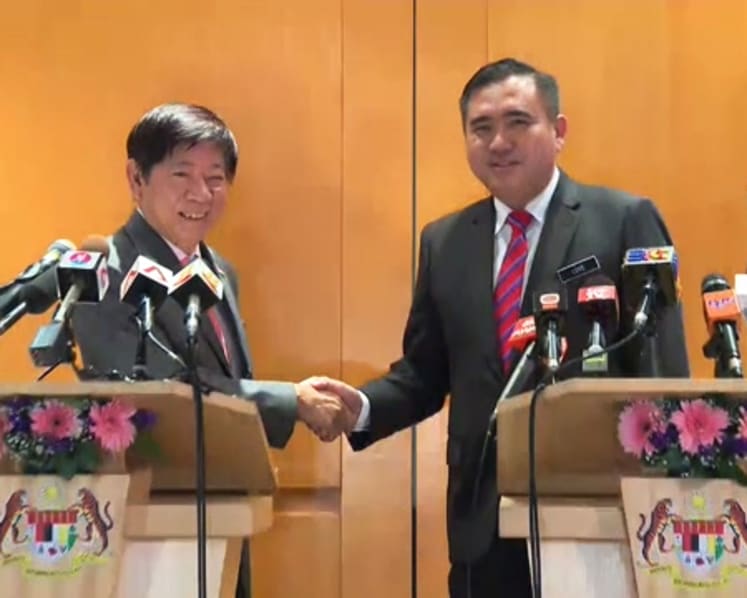
Singapore's transport minister Khaw Boon Wan (photo, left) at the press conference in Kuala Lumpur with his Malaysian counterpart Anthony Loke.


KUALA LUMPUR — In managing bilateral issues with Malaysia, Singapore comes to the table with a "prosper thy neighbour" mentality and the two sides can always reach “win-win” outcomes, Transport Minister Khaw Boon Wan said on Monday (April 8).
Both countries have been embroiled in a series of bilateral disputes of late over water prices, maritime boundaries and airspace.
In life, Mr Khaw noted that there are very few zero-sum games, except possibly when it comes to courting a spouse.
“It’s either ‘you marry me’ or ‘you marry him’,” he said at a press conference with his Malaysian counterpart Anthony Loke at the Kuala Lumpur International Airport.





“But in life and many other matters (such as) economic affairs and so on, with some creativity and goodwill, you can always forge some win-win solutions.”
Mr Khaw is in the Malaysian capital as part of a high-level delegation accompanying Singapore Prime Minister Lee Hsien Loong for an annual leaders’ retreat hosted by Malaysian PM Mahathir Mohamad.
Citing the example of visitors to Singapore, Mr Khaw said seven in 10 will go on to other countries in the Association of South-east Asian Nations (Asean) after they visit the Republic.
“If the motive is clear — prosper thy neighbour — we can achieve such a positive, mutually beneficial outcome, not just for Malaysia and Singapore, (but) in fact, for the whole region,” Mr Khaw said.
Earlier, Mr Khaw told reporters that a high-level committee chaired by senior transport officials from the two countries had been set up to review the present airspace arrangement, after Malaysia expressed its wish to take over control of the provision of air traffic services over southern peninsular Malaysia, which Singapore oversees.
The arrangement had been brokered by the International Civil Aviation Organisation (ICAO) at a 1973 regional air navigation meeting. States in the region agreed on it and it was approved by the ICAO Council, Mr Khaw added.
When asked whether Singapore was working towards not having to manage that airspace, Mr Khaw reiterated that Singapore would negotiate the matter with Malaysia in “good faith” and keep an open mind to the latter’s “aspirations and legitimate concerns”.
He added that he has some ideas on how the two countries can approach the issue, so that their core interests are protected and considered.
One of Singapore’s main interests is Changi Airport and its growth, said the transport minister.
Asean’s civil-aviation industry is booming, and Mr Khaw said that countries such as Malaysia, Singapore, Thailand and Indonesia will play a huge part in its growth.
Malaysia has a lot of capacity to tap this “huge increase of the pie”, he added.
He noted that passengers flying into Kuala Lumpur International Airport are greeted by large tracts of land and that Malaysia will expand and build more runways and terminals if required.
In contrast, Singapore’s potential to expand on this front is “very limited”, Mr Khaw said.
With Changi Airport’s Terminal 5 and a third runway being constructed, Singapore has reached its “maximum”, he added.
Kuala Lumpur’s growth would benefit Singapore as visitors to the Malaysian city could make side trips across the Causeway, said the minister.
MANAGING AIRSPACE ‘A COMPLICATED MATTER’
Calling airspace management a “complicated matter”, Mr Khaw said that many countries find it logical, safer and more efficient for airspace to be outsourced to other parties.
“The key point is the airspace is there, the traffic growth is rapid and huge, how do you squeeze in as many flights into this limited airspace as efficiently as possible and as safely as possible? So, that, I think, must be the key outcome,” Mr Khaw added.
Mr Loke argued that the airspace in question is its sovereign airspace and that Malaysia wants to manage it.
“After 45 years of delegating that airspace to Singapore, it’s high time right now for us to review the agreement and we’re ready in terms of (the) technical (aspect),” he said.
Over the years, Malaysia has invested funds into equipment and air-traffic-control readiness, Mr Loke added.
For instance, it is establishing a Kuala Lumpur Air Traffic Control Centre in Sepang, where its international airport is also based.
Mr Loke also noted his “very good working relationship” with Mr Khaw.
“We had a lot of discussions over the last two to three months and… that resulted in the win-win situation that we can look forward to a mutually beneficial relationship,” Mr Loke said.
“We are committed to having more collaboration and to working together even closer, in order to achieve benefits for both countries.”




