







Singapore tops global gains in QS university subject rankings, driven by focus on skills and employability
The country has the third-highest number of subjects ranked in the global top 10, behind only the US and the UK.
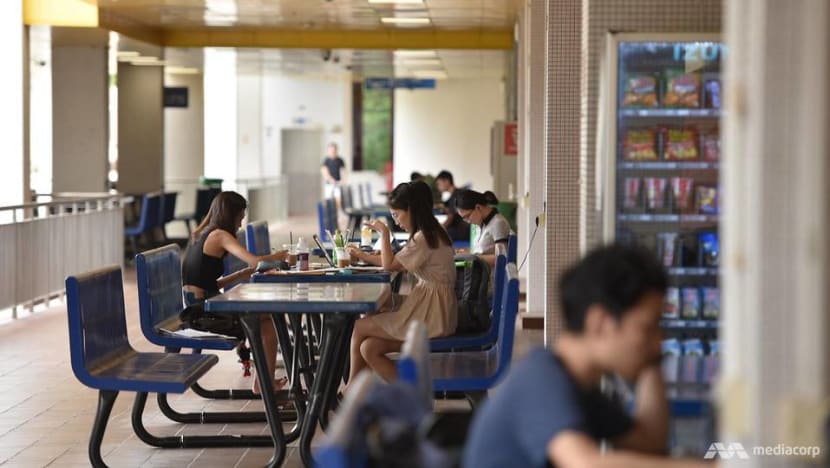
Students sit at a common area in NUS. (File photo: Darius Boey)

This audio is generated by an AI tool.




SINGAPORE: Singapore’s higher education system has emerged as the world’s most improved in the latest Quacquarelli Symonds (QS) World University Rankings by Subject, released on Wednesday (Mar 25).
The country’s universities now have 42 subjects ranked in the global top 10, placing it first in Asia and third worldwide behind the United States and the United Kingdom.
About two-thirds of subjects - 76 out of 115 - also climbed in the rankings.
Experts said strong investment in research and talent, including AI, coupled with a strong focus on skills and employability, is driving Singapore’s global competitiveness in higher education.
NUS RECORDS MOST SUBJECTS IN GLOBAL TOP 10
At the National University of Singapore (NUS), a record 28 subjects were ranked in the global top 10, marking the school’s strongest performance since the QS subject rankings were introduced in 2011.
These include civil and structural engineering, where students combine classroom learning with real-world applications.
The course rose one place to No. 2 this year.





Fourth-year civil engineering student Tan Sue-Ann said the programme’s strong global standing and industry relevance were key factors in her decision to enrol.
The 23-year-old is now gaining hands-on experience in AI and machine learning through both her studies and internship.
This approach has translated into strong employment outcomes, with more than 96 per cent of graduates securing jobs within six months - above the university’s average.
“There's a rise of focus in bringing AI and machine learning to improve construction productivity,” Ms Tan told CNA.
“I think that's where the specialisations like digital urban infrastructure that we have, are really aimed at, and that equips our students, as well as myself, very well for the industry.”
The course emphasises close collaboration with industry partners and practical problem-solving, from underground space utilisation to coastal protection and ageing infrastructure. Robotics and automation in the built environment are also becoming a growing focus.

Associate Professor Pang Sze Dai from NUS’ department of civil and environmental engineering said the curriculum is continuously evolving to keep pace with technological disruption.
“We do foresee that our graduates will continue to be able to help to transform the workforce and will be less disrupted, making use of AI to help to increase productivity,” he noted.
NUS improved in over 60 per cent of its subjects, with gains in courses such as materials science and data science and AI.
It also achieved seven top-three subject rankings, the most outside the US and UK - cementing its position as Asia’s leading institution.

STRONG RESULTS AT NTU, SMU
Nanyang Technological University (NTU) also posted strong results, recording its most ranked subjects with several at their highest positions.
Its communication and media studies programme is now ranked second globally. New efforts are underway there to broaden students’ skill sets, said Professor Jack Qiu, chair of the Wee Kim Wee School of Communication and Information.
“We are starting to make a plan to teach more library and information science to our undergraduate students. That way, our students can have more balance between making content and also doing data analytics,” he added.
AI is also reshaping how communications students learn, serving as a tool to enhance thinking, creativity and storytelling, said Prof Qiu.
Meanwhile, Singapore Management University (SMU) was among the world’s most improved institutions in the QS rankings, with about 80 per cent of its subjects rising in the rankings.
In particular, its law programme saw a significant jump of 45 places.
SMU president Lily Kong, nevertheless, cautioned that different sets of rankings give a different indication of quality.
“There are some rankings that are entirely focused on research, and then they give you a different measure. So if I were an 18-year-old thinking about getting into a university, that research ranking might be seductive, but it might be less immediately relevant to me,” she told CNA938.
“If a subject ranking is based entirely on research, then it tells us nothing about whether that … translates into good programmes, which then translate into good employment.”
She stressed that a job applicant could have good academic results from a well-ranked university, but hirers are “fully cognisant” that they are hiring someone, not the institution they are from.
“I don't knock rankings per se, in the sense that for institutions and organisations that are subject to the rankings, it is useful for us to reflect, looking at how we perform, where we might be able to improve - but not blindly doing so,” Prof Kong added.
According to QS, employability remains a key driver behind Singapore’s success.
QS senior vice president Ben Stower said employers are “looking for efficient routes” to find the best graduates to hire, with Singapore standing out as competitive in that regard.
“I think there is a sort of a causal loop between employability driving the rankings, and then the rankings making a destination more attractive from an employability perspective, and therefore employability further driving the rankings.”
This year’s QS subject rankings analysed more than 21,000 programmes across 1,900 institutions in 100 countries, spanning 55 disciplines and five broad faculty areas, including arts and humanities, engineering and technology, and social sciences and management.




