







Race matters to voters, Govt had to make ‘judgment call’ for reserved election: Shanmugam
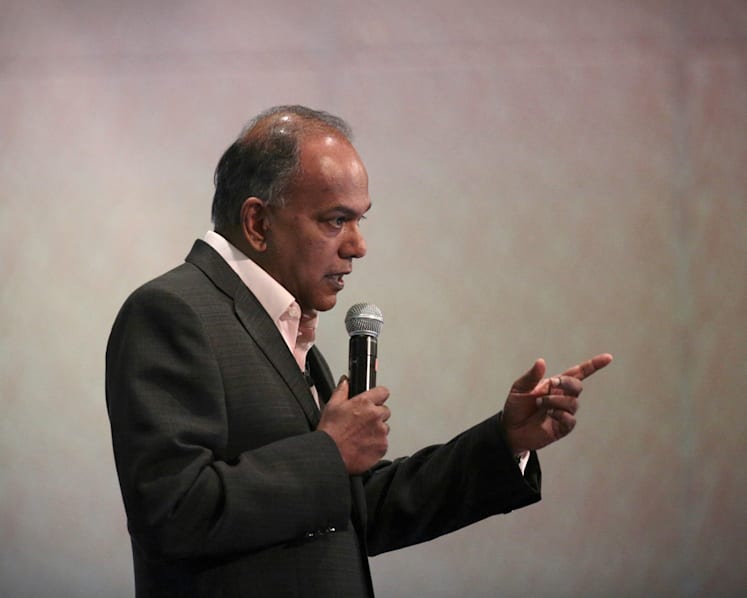
Minister K Shanmugam speaks at the IPS Forum on the Reserved Presidential Election on 8 Sept, 2017. Photo: Jason Quah


SINGAPORE — While some segments of the population may have their reasons for opposing the reserved Presidential Election, it was a “judgment call” the Government had to make to ensure multiracial representation in the position for Singapore’s head of state.
Law and Home Affairs Minister K Shanmugam reiterated this point on Friday (Sept 8), at an Institute of Policy Studies forum on the reserved Presidential Elections.
He noted that the country’s Group Representation Constituency (GRC) system for the General Elections, as well as the Ethnic Integration Policy in public housing were also controversial when first mooted, but these have helped keep the society’s multiracial fabric intact.
“In all of these things, there is no clear right and wrong answer… I grant that other people can disagree on this, but I think what we can agree on, is that all of these are judgment calls and reasonable people can differ,” he said. “As long as you understand the basic premise is in one direction: A multiracial representation,” he added.





Asked if there was a “groundswell” from the Malay community asking for this election to be reserved, he said: “We know that the Malay community has generally felt that, you know, there isn’t a Malay president. I won’t say there was a groundswell of clamour, but there was certainly a considerable body of opinion and viewpoints that they don’t have a Malay presidency.”
The September vote is reserved for Malays following constitutional changes passed last November, providing for presidential elections to be “reserved” for a particular community group, if no one from the community has held the presidency for five terms, or 30 years.
Singapore’s last Malay president was Yusof Ishak, who served as the Republic’s first head of state from 1965 until his death in 1970.
The Singapore Government is “activist” and wants to “move ahead of the problems”, Mr Shanmugam said.
“We don’t wait for the problems to surface… When you see that you haven’t had a Malay president for 40-odd years. And if you take a calculated view of the structure and what you believe is best for the country, then it is the duty of the Government to do something about it,” he explained, adding that allowing presidential elections to be reserved is “not politically attractive”.
“But just like (the value of) the GRC system is today unquestioned… This (reserved elections) system, in another 20 years, people will say it is very good,” he said, drawing laughter from the audience. Close to 300 people attended the forum, including civil servants, academics, students, civic groups and retired professionals.
Mr Shanmugam noted that race has proven to be a relevant factor in voting around the world. Even when Mr Barack Obama became the United States’ first black president, the figures behind his mandate show that race still came into play.
“He lost the white vote. He got 43 per cent of the whites’ vote, he had 60-odd per cent of the Hispanic vote, he had 95 per cent of the African-Americans. Race is not important? Let’s get real,” he said.
A nationwide survey by the Institute of Policy Studies and Channel NewsAsia last year also found that the vast majority of Singaporeans surveyed prefer the country’s top leaders to be of the same race.
While the opposition parties here have been critical of policies supporting the multiracial tenet, such as the GRC scheme, the Workers’ Party has consistently fielded Chinese candidates when contesting for single seats in the General Elections, Mr Shanmugam pointed out.
“What does that tell you?… I am not saying society remains static... But the point I am making is race is a factor, has always been a factor,” he said.
Speaking at a separate dialogue on Friday evening at the Lee Kuan Yew School of Public Policy, Emeritus Senior Minister Goh Chok Tong said that reserving an election for minority communities was part of the Government’s multiracial policy, even though he noted that the move was “quite unpopular with a large proportion of the population”. The thinking is that it seemingly goes against the principle of meritocracy, where candidates are judged by their capabilities. ADDITIONAL REPORTING BY KENNETH CHENG




