







Reliability on North-South, East-West lines to get much better by 2019: Khaw
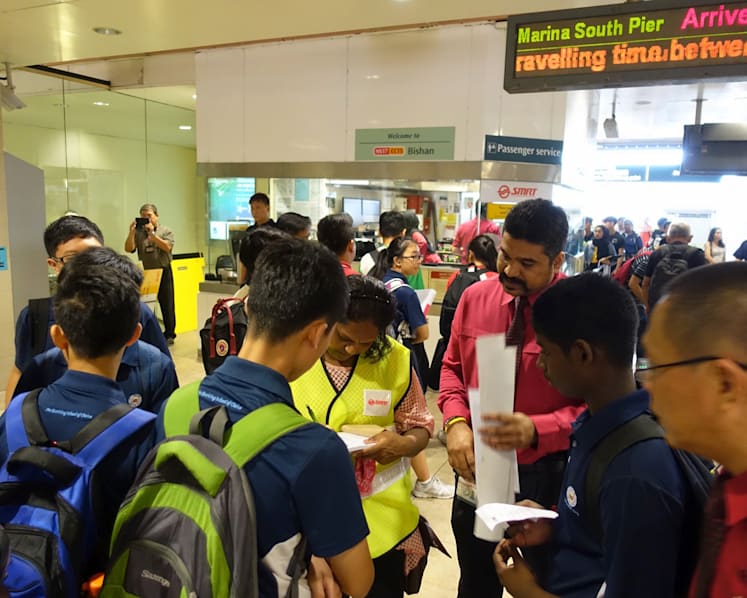
MRT staff issuing excuse slips to students and commuters at Bishan MRT Station after a service disruption of the North-South Line during a morning rush hour in August. TODAY file photo


SINGAPORE — With work to replace the power-supplying “third rail” on the North-South and East-West lines (NSEWL) finished, efforts to overhaul Singapore’s oldest MRT lines are a third complete. Hence, commuters will be able to see vast reliability improvements by 2019, Transport Minister Khaw Boon Wan said on Tuesday (Sept 12).
The remaining major projects for the two lines will wrap up by 2024, but even before that, trains could travel one million train-km before hitting short delays by 2020.
This is more than three times higher than the 300,000 train-km target set for this year, measured by mean kilometre between failure (MKBF), or the average distance trains run between delays of more than five minutes.
Mr Khaw, who is also Coordinating Minister for Infrastructure, said he was “probably reckless” in promising the improvements when he took on the portfolio in 2015. However, he was “truly confident” now as he has turned around the culture of “finger-pointing” among the various parties involved in the rail network’s operations.





He was speaking at Bishan Depot on Tuesday to mark the completion of the NSEWL’s third-rail replacement, the second major project to spruce up the 30-year-old train lines, after work to replace timber track-sleepers with concrete ones finished last December.
Work began in September 2015 to replace 180km of composite aluminium-and-stainless-steel rails, and wrapped up in mid-August.
The project is expected to minimise faults linked to the third rail and raise the lines’ reliability.
The third rail, which feeds electricity into passing trains to power components such as motors and lights, has been blamed for several train service trip-ups over the years.
For instance, a massive breakdown on the NSEWL in 2015, which hit an estimated 250,000 commuters, was found to have stemmed from problems with the third rail’s insulation.
As part of the replacement work, each conductor-rail was unbolted and removed, and a new conductor-rail lowered in its place, before being reconnected to a high-voltage electricity network.
While the authorities and operator SMRT work to overhaul the NSEWL by 2024, Mr Khaw said significant improvements will be seen sooner.
The Government has repeatedly stressed that the NSEWL’s renewal is a “multi-year effort”.
On Monday, Mr Khaw told Parliament that each of the lines’ core systems — including the signalling system, power supply and track circuits — must be replaced before reliability can be bumped up.
In an update on Tuesday, he said the Government aims to start more intensive tests on the East-West Line’s (EWL) new signalling system in December.
Major tests were earlier suspended to prevent further complication and unhappiness until the North-South Line (NSL) stabilises, after delays linked to ongoing trials of the same signalling system on the NSL left commuters fuming.
The Government is pushing for the NSL’s re-signalling work to wrap up before December. The plan is for the entire EWL to run on the same system by 2018.
Also in the offing are new trains armed with condition-monitoring and diagnostic systems, and an upgraded power-supply system promising fewer power-related incidents.
The first train in the new fleet, which will replace the NSEWL’s 66 first-generation trains, will go into service in 2021.
The final project to replace the NSEWL’s track-circuit system will begin next year and wrap up by 2024, the Land Transport Authority (LTA) and transport operator SMRT revealed on Tuesday.
The new system is expected to allow quicker recovery in cases of a signalling-system failure and detect broken rails more easily.
Mr Khaw acknowledged that he was unsure if the MRT network can reach the one million MKBF target by 2020. Still, with the political will and financial resources to replace ageing rail assets, and also the big pool of workers hired over the years, he was confident this could be attained.
Mr Khaw added that, when he set new targets after taking over as Transport Minister, he was not confident they could be met.
Incidents then resulted in “a lot of finger-pointing”. “The LTA said maintenance (was) lousy. Maintenance said design (was) lousy.”
Mr Khaw drilled into all parties — the Government, politicians and transport operators — that they were in “this business together”, because commuters “don’t care who is to blame” when an incident hits.
“This (working as a team) itself cannot guarantee success, but ... is a very essential factor if we want to complete this mission.”




