







Rising nationalism in Asia a double-edged sword: PM Lee
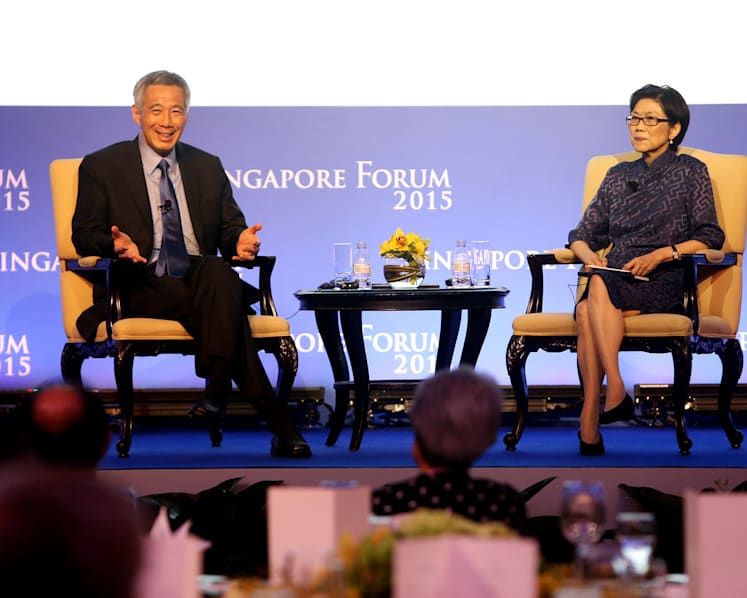
Prime Minister Lee Hsien Loong speaking at a dialogue session moderated by Prof Chan Heng Chee, Ambassador-at-Large and Chairman of the Lee Kuan Yew Centre for Innovative Cities, at the Singapore Forum 2015 on 10 April 2015. Photo: Don Wong


SINGAPORE — As a positive force, the wave of nationalism sweeping through Asia could push the continent to greater heights. But it could also derail the region’s economic ascent, along with other factors such a territorial disputes and terrorism, Prime Minister Lee Hsien Loong cautioned yesterday.
During a dialogue at the inaugural Singapore Forum which was attended by about 250 Singaporean and foreign delegates, Mr Lee said that rising nationalism needs to be watched closely. “It gives you pride, it gives people the motivation to go and do well and outdo the other fellow ... but it is also a possible cause for people to turn inwards,” he said. “You are not arguing over resources but over historical issues, which are difficult to resolve and to come to a single consensus about.”
Using China and Japan as examples, Mr Lee said that it is necessary for countries in conflict to move forward from their positions and “detach themselves” from historical tensions. Such conflicts, nevertheless, are seen worldwide and not just in Asia, he noted.
Mr Lee described nationalism as a response to uncertainty, often caused by an influx of foreigners. People need more confidence and assurance, he added, to address such anxieties.





The two-day event was organised by the S Rajaratnam Endowment, which seeks to deepen international and regional ties. During the opening 45-minute dialogue, Mr Lee also said that the Association of Southeast Asian Nations (ASEAN) is on track — about “80 to 85 per cent” - towards establishing the ASEAN Community by the end of the year, and achieve some progress in terms of economic integration, as well as political and security cooperation.
However, ASEAN members would have to contend with territorial disputes such as those in the South China Sea. These are “not going to disappear”, he said. “No country is going to stand back and say, ‘my claim is less legitimate than yours’… When two things are indisputable, you have a dispute,” he said. ASEAN has a role to play in preventing China’s claims in the South China Sea — delineated with a nine-dash line — from escalating into violent conflict, he said. “No country in this world, in this age is an island… I think that will constraint the calculations, and I hope also the conduct and the actions of the participants in these disputes.”
A third factor that could impede Asia’s progress is the terrorism threat, said Mr Lee. Referring to the Islamic State of Iraq and Syria (ISIS), Mr Lee said: “ISIS is far away in the Middle East, but it’s not far away in the Internet. It’s one click away... and ISIS is attracting people from all over the world to go and become fighters for their crazy cause.
“The tally is maybe 20,000 fighters who have gone on to ISIS in the last couple years. which is more than the total number of fighters who have gone to Afghanistan over a very long period when the Soviets were there.”
Noting that people from Indonesia, Malaysia and Singapore, for example, are known to have joined ISIS and could return to cause mayhem, Mr Lee added: “The security issues are one part of it. The ideological part, the religious part, the racial integration and harmony part... (are) also important and more fundamental to holding ourselves together and not allowing this virus to become a fatal flaw in our body politic.”
Asked by Australian High Commissioner Philip Green to share Singapore’s efforts in ensuring inter-racial and religious harmony, Mr Lee said multi-racialism has been a “cardinal ideal” since the Republic’s founding, with policies shaped to encourage harmonious racial relations.
The need to accommodate different groups of people also means compromises have to be made, Mr Lee said, citing freedom of speech as one such compromise in Singapore’s case. “If you insist on an absolute freedom of speech, you will gravely offend others…So we accept restraints on what we say to others,” he said.
The Government also works closely with religious leaders, especially those in the Muslim community, to contain the threat of terrorism.
Despite these, the fight against terrorism remains pertinent to Singapore due to its multi-racial fabric. Any attack will transform the tenet of race relations here overnight, said Mr Lee. “You can heal (the tension) after a long time, but the suspicions, the fears, and anxieties, will be only just below the surface. That is a very dangerous place for a multi-racial society like ours to be.”




