





How a four-member government team turned red-light cameras into speed enforcers in 3 months
The Roadbuster tool processed 120,000 speeding cases in two years before it was retired, and speeding violations fell by 66 per cent at locations where it was activated.
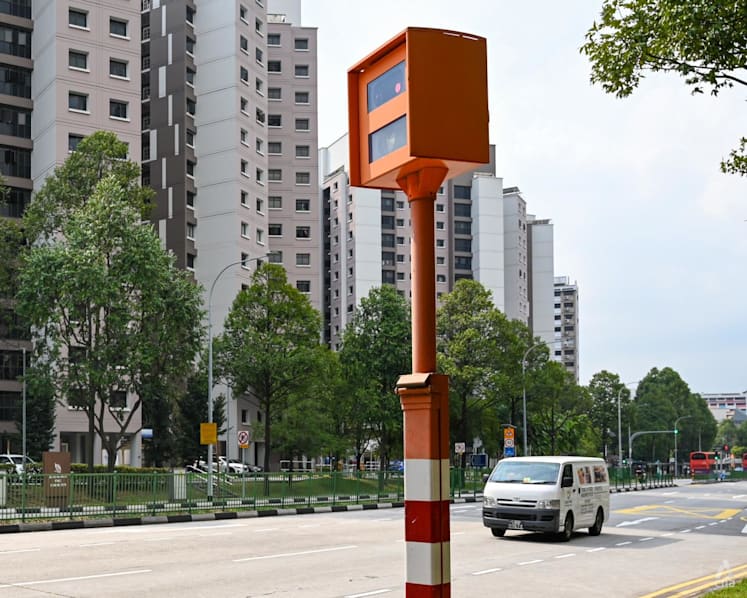
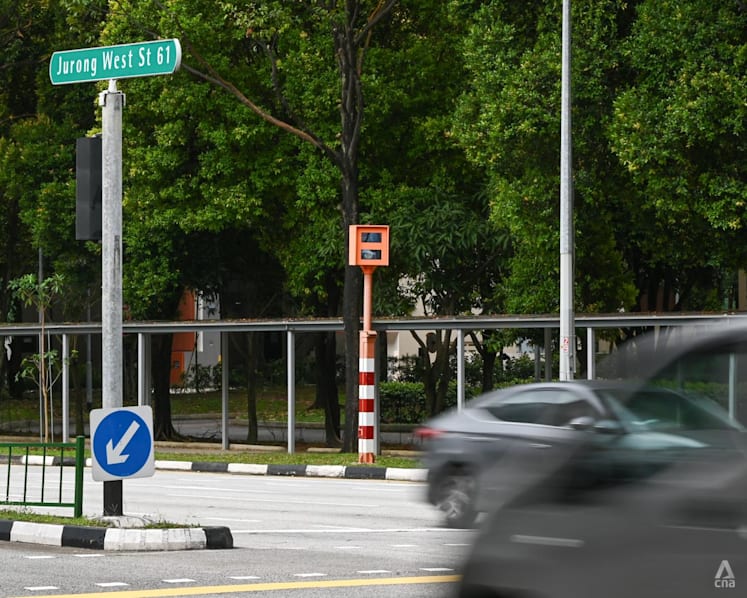
A red-light camera deployed along Jurong West Street 61 on Feb 22, 2024. It is used to detect vehicles that commit red-light running offences. (Photo: CNA/Eugene Goh)

This audio is generated by an AI tool.


SINGAPORE: In January 2024, with road accidents and fatalities rising, the traffic police were looking for a way to use more cameras to catch speeding vehicles on Singapore’s roads.
While their own vendor was already building a permanent, integrated solution, the need was urgent: the traffic police's mid-year update in September 2023 showed a rise in deaths from red-light running and speeding.
Enter a four-person team from Open Government Products (OGP), an experimental division under the Government Technology Agency of Singapore that builds digital products to solve everyday public sector problems.
In three months, the team built Roadbuster, a fix that allowed speeding violations captured by red-light cameras to be processed and logged as cases. They rolled it out and fine-tuned it along the way.





“What people might not know is that red-light cameras also inherently have a speeding enforcement functionality, but this couldn't be operationalised by traffic police because the legacy system was really old, and their vendor couldn't enhance the system to be able to process speeding cases on red-light cameras,” said Mr Darren Lau, a senior product manager in the OGP department that handles traffic police-related projects.
At the OGP’s annual hackathon, Mr Lau's colleagues set out to solve that problem.
Speeding violations at locations where the system was activated fell by 66 per cent, OGP director Li Hongyi said in a LinkedIn post last month.
“We’re sure this is not a coincidence because the trend follows for cameras we turned on later,” he said.
Two years on, the traffic police have upgraded their systems to take on the capability, and Roadbuster is being retired. It processed 120,000 speeding cases and helped to prevent an unknowable number of accidents, said Mr Li.
The Singapore Police Force (SPF) told CNA that Roadbuster automated time-consuming steps, such as extracting vehicle registration numbers and speed data and creating cases in the case management system.
“This has enabled officers to process cases more efficiently and devote more time to other operational work,” it said.

FROM CAMERA IMAGE TO CASE FILE
Roadbuster made it possible to take the images and information generated by the red-light cameras and turn them into cases that traffic police officers can actually process, said Mr Lau.
“Red-light cameras actually have the ability to capture speeding images. The issue for traffic police is they didn't have a way of processing these images in bulk, and being able to lodge these cases so that people who actually committed speeding offences can be notified with a letter on where you committed the offence and what was the offence you committed,” said the 36-year-old.
Speeding cases take more effort to analyse than red-light violations. A red-light camera captures a static image, but a speeding case needs more metadata, he said.
“You need the location and the speed of the car. Potentially for speeding cameras, the cases will be much higher versus red-light violations, so the volume of images that you might be processing is a lot higher.”
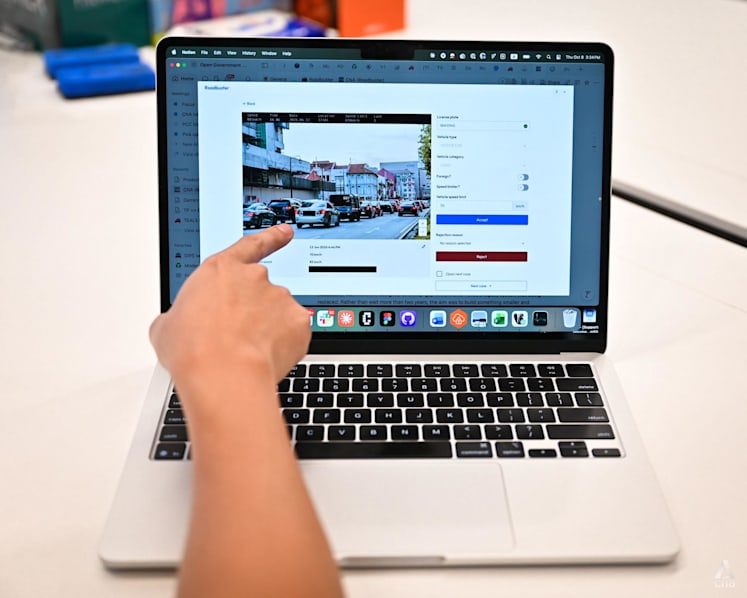
Roadbuster processed and consolidated metadata – such as car plate numbers, vehicle speed and location – into a format that could be uploaded easily into the case management system. Motorists who committed offences then received letters.
“We handled the most tedious part of the process, which is how do we gather images in a central location and how do we use OCR (optical character recognition) technology to quickly convert the information from images into usable information,” Mr Lau said.
WORKING ACROSS AGENCIES AND VENDORS
The project involved OGP, the traffic police, the Home Team Science and Technology Agency (HTX) and its vendor NCS, and red-light camera vendor Jenoptik, said Mr Lau.
Asked about overlaps or clashes, he said the team worked through obstacles through constant communication.
“There will always be some kind of friction, but really, we are trying to solve a common problem and then being able to come to the table and discuss,” he said.
Jenoptik and HTX had to adapt their systems to ingest the new table format into which the team consolidated the data.
“So it's just a lot of communication and liaising together to make sure that the systems work together well,” he said. Roles were "clearly scoped out" and testing was conducted together to make sure things work, he added.
Such situations are common for teams like theirs, he said.
“The way OGP works is we are kind of an experimental division under GovTech, so we do enter pretty thorny situations to try and figure out what the problem is, and try to make sense of where we are,” he said.
He added that the traffic police were a “great partner” that was willing to bet on the agency and put the policy change into operation within three months.
BUILDING WHILE RUNNING
Roadbuster went live on Apr 1, 2024, but the work did not end there.
“Even after that, there were about six months of continuous refinements,” said Mr Lau.
The refinements improved the fidelity of captured images so that details were more accurate and errors fewer, he said. His team ran Roadbuster for two more years, until April this year.
The traffic police worked closely with OGP from the start of the project, providing operational requirements and jointly developing the workflow and user interface, SPF said.
“They continued refining Roadbuster based on feedback from officers who would use the system. This ensured that the system reflected actual enforcement processes that could be effectively adopted by officers eventually,” said the SPF.
This partnership enabled Roadbuster to deliver meaningful productivity gains while remaining user-centric and operationally practical, it added.
The project also taught the OGP team about fairness to the public versus speed.
“These are things that we wouldn't have known because for us, the faster I can do this (task), the better it is for traffic police. You can log more cases and I don't really care if people are penalised wrongly. They could just submit an appeal and try to handle the process that way as well,” said Mr Lau.
To avoid penalising people who did not speed or were misidentified by image recognition, the team had a police officer review each image before an offence was recorded.
Case volume rose after Roadbuster began operating, said Mr Lau. The time officers took to process a case fell from 10 minutes to three, freeing them to handle more cases or other enforcement work, he added.
When the data was consolidated and confirmed, the scale surprised the team.
“When we looked back as we handed over the project and decommissioned it, the numbers were quite staggering, because we didn’t know it would be this number of cases when we first started out,” he said.
SAME SCREEN, NEW SYSTEM
OGP did not hand Roadbuster over to the traffic police. Instead, the new traffic police system adopted the interface the team had developed, said Mr Lau.
“At the end of the day, traffic police still funded the vendor to build an integrated system directly tying the red-light cameras to the case lodging system,” he said.
“So in terms of handover, we didn't specifically hand over Roadbuster … we maintained a similar user interface between Roadbuster and the new system that was being developed.”
Because the design stayed consistent, officers needed no downtime for training, he said.
“Roadbuster was influenced by the legacy system as well, so we kind of tried to carry the consistent design language across all systems,” said Mr Lau.
On the 120,000 cases Roadbuster logged, he said handling public data safely was an utmost priority.
“Apart from passing it back to traffic police, we also store a copy of that data securely, so that if they need to reference it in the future, we are able to re-access that data and pass it back to them,” he said.
Mr Lau sees Roadbuster as an example of what OGP does best.
“We go in, we find where the biggest bottleneck is, and try to land impact with as limited resources as we can,” he said.
Editor's Note: An earlier version of this article stated that Darren Lau was part of the four-member team that created Roadbuster. Open Government Products has since clarified that he was not part of that team, but is in the OGP department that handles traffic police-related projects.