







Singapore must develop robotics, AI talent pipeline to stay competitive: National Robotics Programme
This push comes as the country positions itself to secure a share of the global robotics landscape.
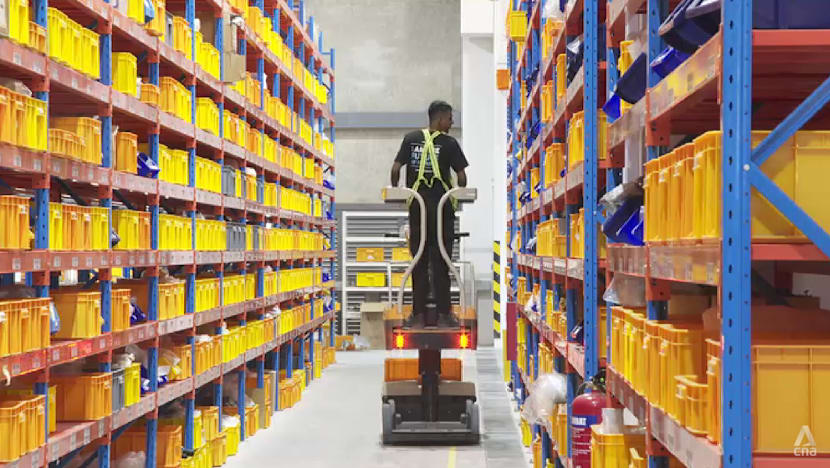
Singapore must cultivate a new generation of robotics and artificial intelligence talent to stay ahead in an increasingly automated world.

This audio is generated by an AI tool.




SINGAPORE: Singapore must cultivate a new generation of robotics and artificial intelligence talent to stay ahead in an increasingly automated world, said National Robotics Programme (NRP) executive director Tung Meng Fai.
This push comes as the country positions itself to secure a share of the global robotics landscape, where engineers, researchers and creators will play critical roles.
“There's a strong demand now for robotics expertise,” Mr Tung told CNA last Thursday (Nov 27).
“Increasingly with AI in robotics, we also need cross-disciplinary talent, so this talent pipeline is important to fuel the growth of our ecosystem here in Singapore.”
The International Federation of Robotics estimates that the global installation of industrial robots will reach 708,000 by 2028 – a 30 per cent increase from 542,000 last year.
ROBOTICS DEMAND RISING
These robots are entering factories, hospitals and retail spaces, and becoming more capable as they take on tasks that once required human judgment and coordination.
As a result, demand is rising for workers skilled in both robotics and AI, which increasingly determines what robots can do.
“Robots have become a lot more capable,” said Mr Tung.
“Now they can better sense the environment. They can actually not just operate on the pre-programmed structured algorithms, but are able to think, make a certain decision and then act upon that decision.”
However, challenges remain with some companies struggling to hire.
Some positions can stay vacant for more than six months, and firms often have to look overseas to fill these gaps.
“This challenge with talent is a global phenomenon,” said Mr Tung, adding that the rapid growth of robotics and embodied AI has sparked strong interest and excitement worldwide.
Companies everywhere are racing to secure workers with the right skills, and those who are well-trained are usually quickly snapped up, he noted.
In Singapore, institutions are stepping up by expanding robotics programmes to meet demand, while industry partners are exploring new ways to build and sustain a strong talent pool.
On what more can be done to help local talent compete with larger economies such as the United States and China, Mr Tung noted: “We have a lot of good local talent in robotics and embodied AI.
“If you compare Singapore … to all these larger economies (where the) population size (is) much bigger, in some ways, statistically, you always find less. But we always do quite well on a per capita basis.”
He added that many capable Singaporeans are contributing meaningfully to the field – not only those based in Singapore, but also those working overseas.
“What NRP is trying to do is basically try to build this network with our overseas Singaporeans as well as our local talent, and also with international talent, and bring them together to foster this exchange of ideas, views (and) perspectives,” he said.
ANXIETY AMID TECH SHIFTS
However, headlines about layoffs have created uncertainty, with entry-level roles shrinking by more than a quarter and some worrying that advanced technologies could replace them.
“The sci-fi movies sometimes, unfortunately, create this misperception that the robots are going to be like Terminators,” said Mr Tung, referring to the cyborg assassins from the popular Terminator movie series.
He added: “But in actual fact, the technology to make a robot as capable as a human is still quite far off. There's still lots to be done.”
He also noted growing global recognition of the need for proper guardrails to ensure that robots are designed to complement and support people, not replace them.


“As with any technology, there will of course be transformation of industries,” said Mr Tung.
In tandem, people should be able to move to higher-value positions “where they can really contribute”, he added.
As Singapore’s population ages, observers believe automation will become essential to closing manpower gaps across industries.
“There's also a limit to how much migrant labour we can tap on, given the size,” noted Mr Tung.
“If we want to continue to grow as a country (and) continue to take care of our society, robotics and automation, together with AI, must come in to help tackle some of these very challenging issues.”




