







RSAF aerial display possible cause of dislodged ceiling panels, lights at Marina Bay Cruise Centre: Experts
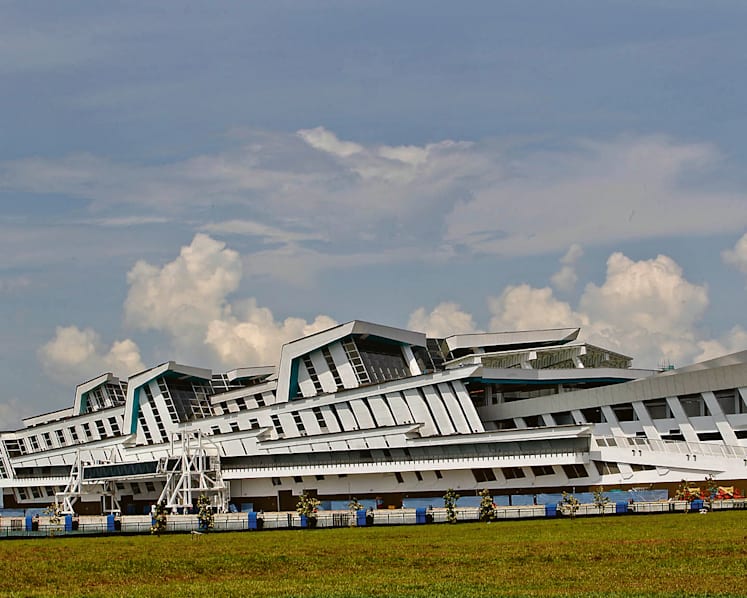


SINGAPORE — Air pressure and vibrations from the Republic of Singapore Air Force's (RSAF) aerial display could possibly have caused false-ceiling panels and lights to dislodge at the nearby Marina Bay Cruise Centre Singapore at the weekend, experts said.
TODAY reported earlier this week that some panels in the centre's departure area and car park had come loose and fallen on Saturday morning (Aug 11), after the RSAF's aerial display at the Marina Barrage. No one was hurt.
The RSAF was performing as part of the RSAF50@Marina Barrage event to mark its golden jubilee. At the aerial show — which was conducted twice daily over the weekend — aircraft performed manoeuvres at altitudes of between 500ft and 2,000ft, which were lower than their usual operating altitudes.
Twenty-five RSAF aircraft — including the F-15SG fighter jet and the AH-64D Apache helicopter — and four Singapore Youth Flying Club trainer aircraft were involved in the display.





After Saturday's incident, the RSAF adjusted the flight path for subsequent displays as a precautionary measure.
Associate Professor Li Bing, from the Nanyang Technological University's (NTU) School of Civil and Environmental Engineering, said Apache helicopters generate a lot of "sucking force" and air to push the aircraft so as to maintain stability at a low altitude.
Their high-speed turbines could have produced unexpected wind movements and pressure, which could possibly have led to the panels coming loose, he said.
Experts TODAY spoke to said the false-ceiling panels could have fallen because of the sudden vibrations from the aerial display.
"Vibrations can cause such fittings to drop off," said Mr Rajan Krishnan, chief executive of KTC Construction.
While experts said that buildings in Singapore are built to withstand vibrations and pressure, such as those from normal wind conditions or tremors, they are not designed for complex wind movements — such as how buildings in Hong Kong are constructed to withstand typhoons — or strong vibrations generated by aerial displays, for instance.
AH-64D Apache pilot Ingkiriwang Reeve, who took part in the display, had earlier identified "obstacles", and factors such as crowds and infrastructure — which have to be taken into account in the event of an emergency — as some of the challenges of flying around the Marina Barrage.
"We have our safety altitudes, and we have to do a very good recce of all these obstacles," Captain Reeve had told reporters.
Nevertheless, the experts acknowledged that it was rare for false-ceiling panels to become dislodged because of an aerial flypast.
Leaks from water pipes are largely the cause of dislodged ceiling panels, said Mr Krishnan.
Building science expert Steve Kardinal Jusuf, an assistant professor at the Singapore Institute of Technology's engineering cluster, said defective or corroded components could also lead to such incidents. But he pointed out that the latter was probably not the case as the cruise centre, which opened in 2012, is relatively new.
Still, precautions can be taken to prevent a recurrence, said the experts.
Mr Krishnan said extra "supports" could be added to the false ceiling to enable it to withstand greater vibrations.
Buildings close to such events should "take extra caution" as their canopy design may also not account for unexpected air flows generated by a flypast, added Assoc Prof Li.
Sign up for TODAY's WhatsApp service. Click here:




