Singapore records 27.6% drop in scam cases in 2025
Government officials impersonation scam cases jumped 123.6 per cent last year, however.
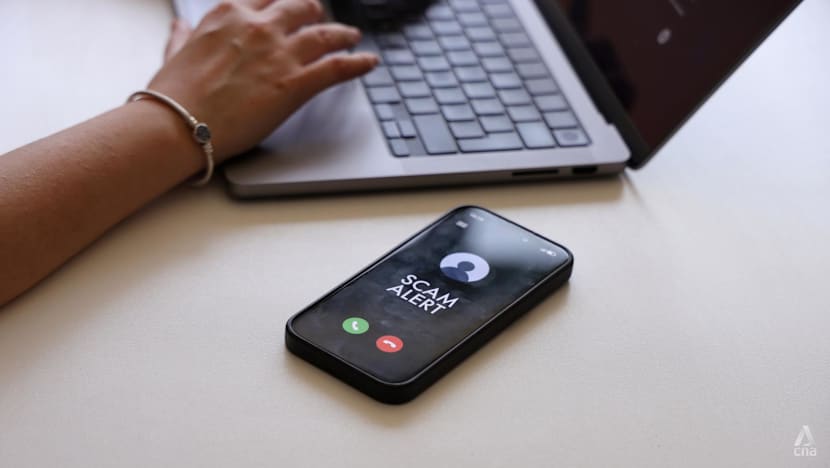
There were 37,308 scam cases in 2025, a 27.6 per cent drop from the 51,501 cases recorded in 2024. (Photo: iStock/tolgart)

This audio is generated by an AI tool.


SINGAPORE: The number of scam cases in Singapore fell 27.6 per cent in 2025, after increases in the past few years.
There were 37,308 such cases last year, down from the 51,501 cases recorded in 2024, the Singapore Police Force (SPF) said in its annual statistics on scams and cybercrime released on Wednesday (Feb 25).
This is the first time SPF has seen a decrease in the total number of scam cases since it began reporting scam statistics separately in 2023, the police said in response to queries from CNA.
Scams accounted for the majority of the total scam and cybercrime cases last year (88.9 per cent), which also saw a drop by 24.8 per cent to 41,974.
The total amount lost to scams also decreased by 17.9 per cent from about S$1.124 billion (US$889 million) in 2024 to around S$913.1 million in 2025.
Cryptocurrency losses continue to form a "considerable" percentage of scam losses – around 20 per cent – accounting for about S$182.2 million, said the police.
Significant decreases were also seen in the number of cases reported for e-commerce scams, job scams and fake friend call scams. Meanwhile, the number of government officials impersonation scams jumped.
The total amount lost to fraudsters also dipped significantly for malware-enabled scams, business email compromise scams, job scams and fake friend call scams.
The police attributed the decrease in scam cases and scam losses to anti-scam strategies and public education efforts that made it "more challenging for scammers to succeed".
SPF noted that its Anti-Scam Command (ASCom) managed to recover about S$140.5 million of scam losses in 2025. Together with its partners, ASCom also helped victims avert at least S$348 million in potential losses, the police added.
They, however, also highlighted that self-effected transfers – where individuals willingly transfer money to scammers – made up 81.8 per cent of total reported scam cases last year.
In these cases, scammers did not gain direct control of the victims' accounts, but manipulated them into performing monetary transactions through deception and social engineering.
In 2025 alone, more than 7,000 money mules and scammers suspected of involvement in scam cases were investigated. Over 940 of them have been charged by the police to date, said SPF.
The police added that the situation is still "very concerning" despite the drop in numbers, and tackling scams remains a key priority for the government.
Minister of State for Home Affairs Goh Pei Ming similarly noted that the "fight is far from over".
"Scams remain the most prevalent crime type in Singapore, and the overall numbers remain high," he said, adding that scammers continue to adapt their techniques and exploit new vulnerabilities.
Mr Goh said that the government will "double down" on efforts to combat scams and "continue to rally both international and local partners to disrupt the scam lifecycle".
SCAMS OF CONCERN
The police flagged the top five scam types of concern in 2025, with e-commerce scams topping the list. They were followed by phishing scams, job scams, investment scams and government officials impersonation scams.
Of these, government officials impersonation scam numbers saw a spike, while figures fell for the rest.
The number of government officials impersonation scams reported last year more than doubled – by 123.6 per cent to 3,363 cases in 2025, from 1,504 in 2024.
The police observed new trends in how victims transferred money to scammers in this scam type. These include transferring funds from their bank accounts to accounts with payment service providers such as YouTrip, which are controlled by the scammers, via PayNow.
In another method, scammers requested victims to open cryptocurrency accounts, fund them through fiat money transfers from the victims' bank accounts, buy cryptocurrency, and then transfer the cryptocurrency to accounts controlled by the scammers.
Meanwhile, e-commerce scams, despite having the highest number of cases, recorded a 42.5 per cent drop in cases from 11,665 in 2024 to 6,703 in 2025.
Pokemon trading cards were highlighted as the item most commonly involved in e-commerce scams, making up 13.6 per cent of related cases. In comparison, these cards accounted for just 1 per cent of e-commerce scams in 2024.
Victims typically come across listings of Pokemon trading cards on Carousell. After expressing interest in the product or pre-order, they are instructed to make payment or an initial deposit via PayNow or bank transfers.
The victims only realise they have been scammed when they fail to receive the items, or when the sellers become uncontactable.
Apart from Carousell, Facebook Marketplace was also commonly used by scammers to perpetrate such scams.
As for the amounts lost to scammers, investment scams took the top spot, with about S$336.2 million lost – a 4.8 per cent increase from 2024.
Government officials impersonation scams came in second, with losses surging 60.5 per cent to about S$242.9 million in 2025.
But losses from other scams, such as e-commerce, phishing and business email compromise scams, declined. Business email compromise scams recorded the steepest fall, dropping by 60.1 per cent.


SCAM VICTIMS
On the profiles of scam victims, the police noted that the elderly, aged 65 and above, formed the second-smallest proportion – after youths – with 14.8 per cent.
But the average amount lost by the elderly was more than S$37,000 per victim – the highest across all age groups.
About 22.5 per cent of elderly victims fell prey to investment scams; 21 per cent to government officials impersonation scams; and 17.2 per cent to phishing scams.
Adults aged 30 to 49 made up the highest proportion of scam victims, accounting for 36.1 per cent of victims. More than 20 per cent were victims of e-commerce scams. This age group also fell prey to phishing and job scams.
Overall, 85.2 per cent of the scam victims in 2025 were made up of youths, young adults and adults aged below 65.
TOP CONTACT METHODS
Social media, messaging platforms, phone calls and online shopping platforms were found to be the top methods scammers use to reach victims.
In particular, while social media, messaging platforms and online shopping platforms have remained the top contact methods for scammers, there has been a decrease in reported scam cases involving these avenues, said the police.
Cases where scammers contacted victims through social media declined by 30.3 per cent, and those involving messaging platforms fell by 38.2 per cent.
Among online shopping platforms, Shopee saw the most substantial decline in scams, with cases dropping 60.4 per cent.
Carousell saw a 24.6 per cent reduction in cases, while cases on Facebook Marketplace fell 23.5 per cent.
"Notably, scam cases involving designated online service providers under the Online Criminal Harms Act (OCHA), which came into effect in 2024, have declined significantly by 36.5 per cent," SPF said.
OCHA allows the government to order the takedown of websites, apps and online accounts suspected to be used for criminal activities.
Two codes of practice were issued to online communication services and e-commerce services, requiring platforms such as Meta, Telegram, WeChat and Carousell to put in place appropriate systems or measures to proactively disrupt scams and malicious cyber activities affecting people in Singapore.
Still, the scam situation on these platforms "remains worrying", said the police. Online platforms were used by scammers to reach out to victims in 84.1 per cent of all scam cases.
Meta platforms were involved in 35.4 per cent of all scam cases, with Facebook alone accounting for 18 per cent of cases.
Phone calls too are a contact method of concern for the police, though there was an 18.7 per cent decrease in scams involving this platform last year.
From January to December 2025, SPF disrupted more than 105,000 mobile lines that were scam-related across all telecommunication operators.
"This was more than double the number of lines disrupted in 2024," said the police. The telco with the largest number of disrupted local mobile lines was SIMBA, with more than 39,300 lines, they added.
The police, Infocomm Media Development Authority (IMDA) and telcos will continue to build stronger safeguards and anti-scam measures to prevent the misuse of SIM cards for criminal activities, said SPF.
IMDA announced last month that individuals will only be able to register up to 10 postpaid SIM cards across all telcos from the end of February to prevent illicit use.
The new rules will be applied to new subscriptions to minimise the impact on the legitimate use of such SIM cards.
The agency, in collaboration with the Government Technology Agency of Singapore, will launch a self-help postpaid SIM card checker as part of a trial for the public to check on the number of postpaid SIM cards that are counted as part of the 10-card limit.
The beta version of the self-help tool will be launched on Feb 26 at https://go.gov.sg/simcardhowmany and can be accessed by logging into Singpass.