







Singapore and Indonesia hold first counter-terrorism table-top exercise
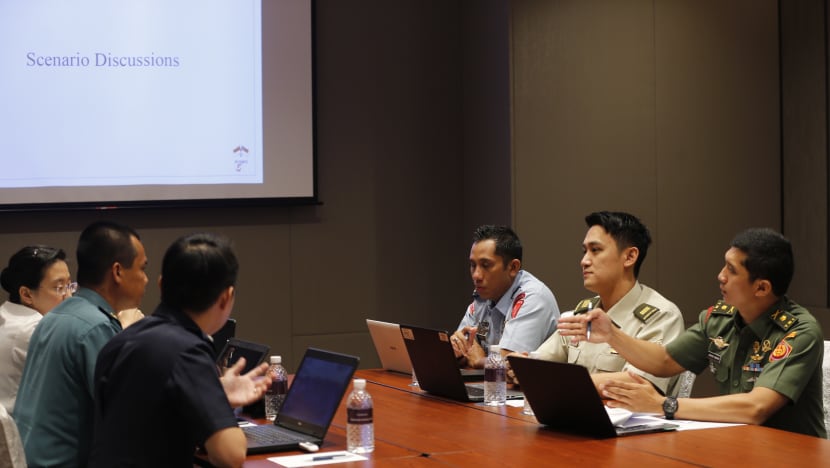
Exercise participants are seen in discussion during the inaugural SAF-TNI Joint Counter-Terrorism Table-top Exercise on Nov 29, 2017. Photo by Najeer Yusof/TODAY


SINGAPORE – The Singapore and Indonesian armies held a table-top exercise to combat terror threats over Tuesday and Wednesday (Nov 29), where operational responses to scenarios such as bomb threats in public areas, vehicles ramming into pedestrians and gunmen attacks in shopping malls were discussed.
This is the first bilateral counter-terrorism table-top exercise Singapore is involved in. Held at Sheraton Towers Singapore, 27 personnel from the Singapore Armed Forces (SAF) and the Indonesian National Defence Forces (TNI), as well as officers from both countries' homeland security agencies were involved.
The respective delegations were led by the Head of SAF Current Operations Group, Colonel (COL) Lim Kok Hong and Senior Staff Officer for Joint Exercise Office of TNI Headquarters, COL Achmad Budi Handoyo. The delegations were made up of members from their respective operations and intelligence departments, and personnel from their Special Operations and Maritime Security Task Forces. The exercise also involved the homeland security forces from the Singapore Police Force and the Indonesian National Agency for Combating Terrorism (Badan Nasional Penanggulangan Terorisme).
Speaking to the media before the closing ceremony for the exercise on Wednesday, COL Lim said both countries were concerned about the need to respond quickly when faced with a terrorist threat, and to ensure safety of their citizens. Foreign fighters returning to the region was another concern, he added.





"The more information we share ... we are better able to understand where they are likely to go to and then the agencies from both countries can be more alert and make sure they don't come in," COL Lim said.
Key findings from the exercise include the need for government agencies and armed forces to sharpen their coordination and enhance processes, given their different areas of responsibilities, he added.
Bilaterally, there could be better coordination when it comes to dealing with the terrorist threat in the maritime area given that both countries are only separated by sea, COL Lim noted. For instance, if a known terrorist is operating in the straits around Singapore and Batam, information could be shared between the two countries to counter such threats, he added.
There are plans to conduct more regular exercises with Indonesia to counter terrorism in the future, such as in the areas of maritime co-operation, the sharing of more information, best practices, professional knowledge and tactics, added COL Lim.
COL Lim said the exercise has been useful and allowed armed forces from both sides to work through and understand operational challenges and responses when dealing with the common threat of terrorism.
"I am very heartened to see the camaraderie and the high level of professionalism between the two forces and participants throughout the exercise," he added.
A spokesperson of Singapore's Ministry of Defence said the exercise highlights the close and long-standing bilateral relationship between Singapore and Indonesia in the last 50 years, and is "a strong testament to the commitment of both sides to combat the threat of terrorism in the region".




