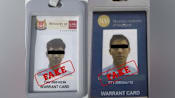
Singapore Customs warns of two new parcel scam variants
Victims of the scams were duped into making payments or revealing bank details for the release of parcels supposedly being withheld by Customs.
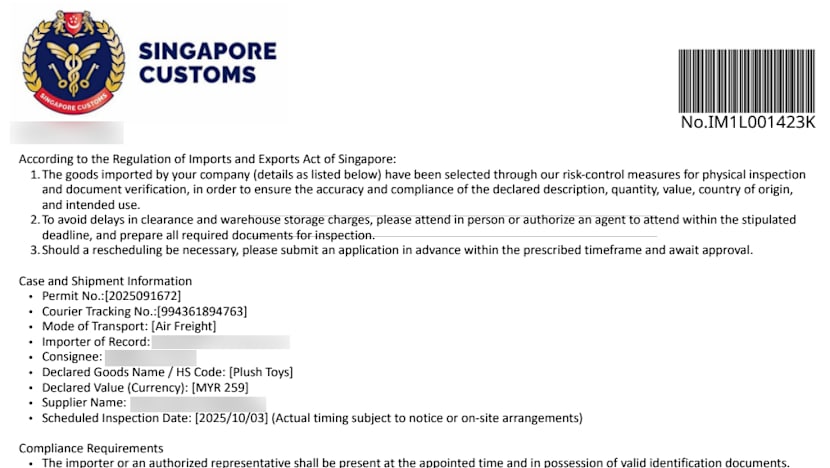
A falsified document used by scammers in a new parcel scam variant. (Image: Singapore Customs)

This audio is generated by an AI tool.


SINGAPORE: Singapore Customs warned on Wednesday (Dec 3) of two new parcel scam variants that have surfaced in recent months.
The variants involve scammers impersonating Customs or its officers to deceive victims into making payments or revealing banking details.
In the first variant, scammers impersonating Singapore Customs would send an email to a victim from a Gmail account, informing them that a parcel of theirs was being withheld for compliance reasons.
A fake inspection notice would accompany the email, requesting that the recipient be present for an on-site inspection of goods scheduled for a few days from the date of the email.





The notice would be falsely attributed to a member of Customs' senior management.
The recipient would then be offered an alternative to physically attending the inspection. This was to pay a "verification fee" to a Malaysian bank account with a promise that the parcel would be released following payment, and that a full refund would be issued afterwards.
The victim would also be asked to fill out a forged "Singapore Customs Inspection Agreement" form with their bank account details for the supposed refund.
Closer to the payment deadline, the scammers would then send follow-up emails threatening to "notify the Malaysian police and initiate arrest proceedings" over "contraband" should victims fail to pay the fee.
"Several victims of the scam who contacted Customs to verify the authenticity of the emails and documents have Malaysia-registered phone numbers," the agency said.
In the second scam variant, scammers posing as Customs officers would send WhatsApp messages to victims, claiming that gold bars registered under the victims' names were being held by Customs.
The scammers would then send victims photographs of the supposed gold bars and a forged document bearing the old Customs logo and falsified shipping details.
Victims were then asked to make payments for the release of the gold bars or face the immediate seizure of the gold bars, legal action for "customs evasion" and "blacklisting from all future shipments".
"We take a serious view of such scams as they undermine public trust in Singapore Customs," the agency said.
Customs said that it will never ask for payment to release parcels, and that its official correspondence is sent from email addresses containing the @customs.gov.sg domain.
Government officials will also never ask for money or bank details via phone call, text message or email, the agency added.
"Customs does not send official (correspondence) via personal email accounts, WhatsApp and other messaging platforms, or social media," the agency stressed.