







Singapore factory activity contracts for 4th straight month
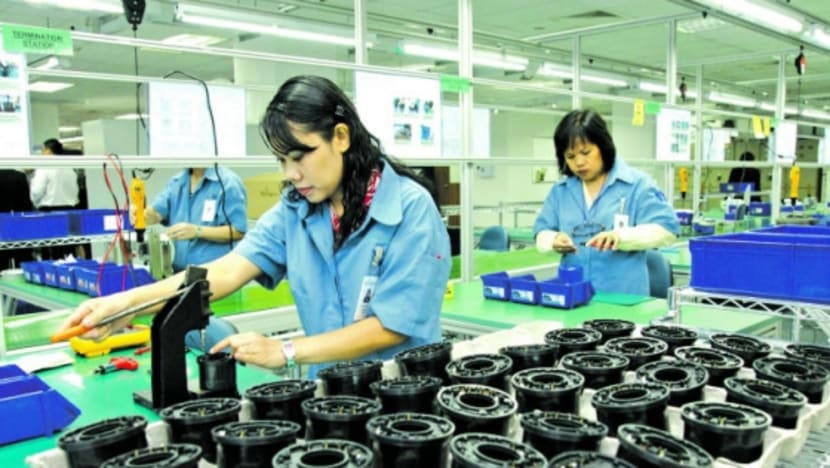
TODAY file photo


SINGAPORE — Manufacturing activity in Singapore contracted in March for the fourth straight month even while the key electronics sector rebounded into expansion territory, raising bets that the Monetary Authority of Singapore (MAS) will ease its exchange rate policy in about two weeks’ time at its semi-annual meeting.
The Purchasing Managers’ Index (PMI) dipped 0.1 point to 49.6 points last month from 49.7 points in February, undermined by a further decline in new orders and new export orders, the Singapore Institute of Purchasing & Materials Management said today (April 2_. A score above the 50-point mark indicates expansion while a reading below that reflects a contraction.
The March weakness was troubling as it showed that activity had not recovered after the Chinese New Year lull in February.
“New orders and new export orders dived deeper into contraction territory, suggesting that the underlying demand picture for Singapore’s domestic manufacturing sector remains lacklustre after the Chinese New Year holidays,” said Ms Selena Ling, Head of Treasury Research & Strategy at OCBC Bank.





Economists said the latest PMI mirrored the overall mixed performance in the region and the global manufacturing landscape.
“Asian PMIs remain a mixed bag, with China showing some tentative signs of an improvement, but Taiwan and South Korea softening. If you look at the global manufacturing PMIs, the picture has remained choppy. The US’ manufacturing Institute for Supply Management (ISM) index has softened but is still at a five-month high, while euro zone PMIs came in better than initially estimated.” said Ms Ling.
Mr Michael Wan, economist at Credit Suisse, said: “The figures fit in with PMI numbers in the region. There was no real bounce in export activity. The first quarter of the year saw a slowdown in the US due to lower production activity and also in China.”
Regional PMI readings for March showed Australia, China, Indonesia, South Korea in contractionary mode, while those in India, Japan, Taiwan and Vietnam reflected expansion.
“The Singapore PMI figures will likely affect the MAS’ policy decision making …We see a possible attempt to provide flexibility to counter the slowdown in growth,” Mr Wan added.
The MAS had surprised the market in an off-cycle move in January to allow the Singapore dollar to appreciate at a slower pace, sending the local currency tumbling to its lowest since 2010 against the United States dollar.
A bright spot in the latest PMI reading came in the electronics segment. Electronics, which contribute to one-third of industrial production, rebounded to expansion following the first decline in two years, but analysts were mixed over whether an immediate recovery is in sight.
“The Singapore electronics sector saw an improvement in its new orders, new export orders and production indices, although new export orders stayed in contraction territory,” said Ms Ling.
She noted that imports had moderated while inventory and finished goods contracted. “This suggests that the domestic electronics industry recovery is still tentative and progress in the second quarter for the year may be sluggish as well.”
However, Mr Leong Wai Ho, economist at Barclays felt the electronics sector would improve in the next few months.
“As we are approaching summer, this will be the season where electronics will pick up in North Asia. This will certainly be a boost to production figures,” he said.




