







Singapore, Malaysia to begin talks on delimiting maritime boundaries in a month: PM Lee
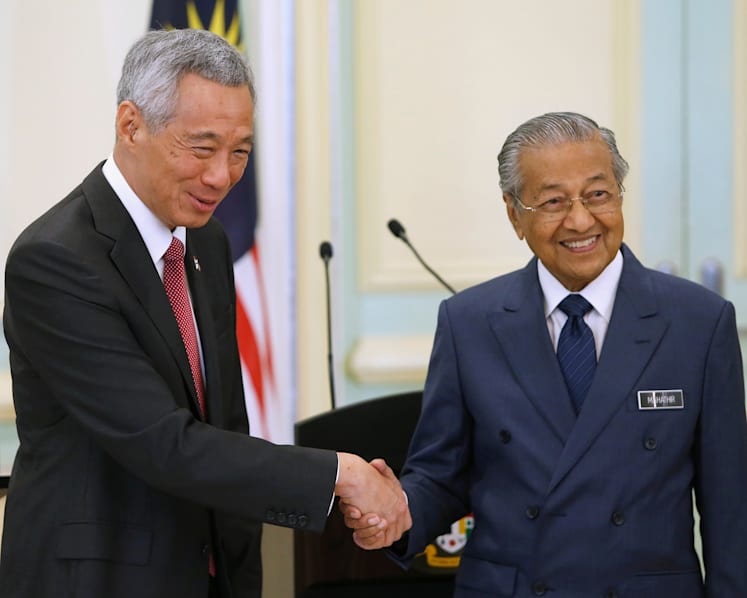
Singapore's Prime Minister Lee Hsien Loong shakes hands with Malaysia's Prime Minister Mahathir Mohamad after a joint news conference in Putrajaya, Malaysia April 9, 2019.


PUTRAJAYA — Singapore and Malaysia will begin negotiations on delimiting their maritime boundaries within a month, Prime Minister Lee Hsien Loong said on Tuesday (April 9), a day after the two countries mutually suspended their overlapping port limits.
“We have made progress to de-escalate the situation at sea and avoid further incidents,” he told reporters at a joint press conference with his Malaysian counterpart Mahathir Mohamad, held in the latter’s office in Putrajaya near Kuala Lumpur.
Mr Lee is in Malaysia to attend an annual leaders’ retreat hosted by Dr Mahathir.
With the suspension of the overlapping port limits — which took effect after midnight on Monday — Malaysia and Singapore have reverted to their port limits before Oct 25 and Dec 6 last year, respectively.





As of midnight on Tuesday, no Malaysian government vessels were found to be anchored in the area previously covered by the overlapping Johor Baru port limits off Tanjung Piai and Singapore's port limits off Tuas, Singapore’s Foreign Affairs Ministry said.
The maritime-boundary standoff began when Malaysia extended its Johor Baru port limits unilaterally into Singapore’s territorial waters off Tuas on Oct 25 last year.
Several weeks later, Singapore responded by extending its own port limits off Tuas, after Malaysian vessels intruded into its waters repeatedly for weeks.
The move to suspend the overlapping port limits was among five recommendations from a bilateral working group set up to look into the maritime dispute.
Mr Lee and Dr Mahathir also gave an update on other bilateral issues that they discussed, including:
AIRSPACE
Dr Mahathir said Malaysia hopes to take back control of airspace over southern peninsular Malaysia in stages, between the end of this year and 2023.
Singapore now oversees this airspace.
Mr Lee noted Malaysia’s wish, and said this was a “complex” matter that would entail consulting many stakeholders, including airlines and the International Civil Aviation Organisation (ICAO), and “cannot be rushed”.
A high-level committee has been established to look into the existing airspace arrangements — which were brokered by the ICAO in 1973 — and Mr Lee said the two countries are now ready to discuss the matter.
“The key considerations are the safety and efficiency of air-traffic operations, and the needs and interests of both countries,” he added.
Mr Lee noted that civil aviation is growing rapidly for both countries.
Kuala Lumpur International Airport and Changi Airport are major regional airports, each serving more than 60 million passengers a year, and the volume will grow, Mr Lee noted.
“It is important for both countries that this growth be facilitated and be enabled to take place safely,” he said.
Last Saturday, the two countries announced that Singapore has withdrawn the Instrument Landing System (ILS) for Seletar Airport and Malaysia has suspended indefinitely its permanent Restricted Area over Pasir Gudang town in Johor Baru.
The move paves the way for Malaysian airline Firefly to start services to Seletar Airport on April 21.
Malaysia had protested that Seletar’s ILS, which guides aircraft on a descent path, will encroach into its airspace and hamper development in Pasir Gudang town.
JOHOR-SINGAPORE RAPID TRANSIT SYSTEM
Mr Lee said that he understood Malaysia’s position in wanting to suspend the Johor-Singapore Rapid Transit System to reassess their options.
On Monday, Transport Minister Khaw Boon Wan said that the two countries’ attorneys-general (AGs) and officials are working out a supplementary agreement that would allow for the rail project to be suspended for six months.
“We have tasked our AGs to work out a supplemental agreement quickly to give effect to the suspension, similar to what we did for the High-Speed Rail (project) suspension last year,” Mr Lee said.
In September last year, both countries signed an agreement to postpone the high-speed rail (HSR) project linking Singapore and Kuala Lumpur for two years.
Dr Mahathir said Malaysia is exploring proposals with the aim of reducing costs and will discuss the matter with Singapore before the end of the suspension period.
Mr Lee added: “For the HSR, the suspension agreement runs until May next year.”
He said Singapore continues to see it as a good project.
“But we understand why Malaysia needs time to review the cost and the alternative options,” said Mr Lee.
“We look forward to receiving a proposal from Malaysia soon, so as to be able to work with them to find a way forward that will work for both countries.”




