







Singapore signs defence pacts with UK, Germany
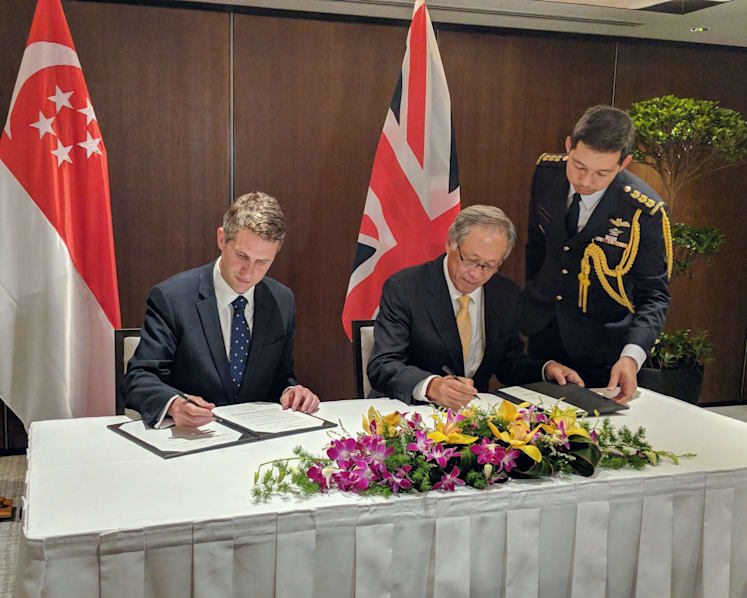
Singapore’s Defence Minister Ng Eng Hen (right) and the United Kingdom (UK) Secretary of State for Defence Gavin Williamson signed a Defence Cooperation Memorandum of Understanding (MOU) between both countries.


SINGAPORE – The Republic signed two separate defence agreements with the United Kingdom and Germany on Saturday (June 02) to work together on a range of areas, including cybersecurity.
Inked on the sidelines of the annual Shangri-La Dialogue, Singapore’s Defence Minister Ng Eng Hen and the United Kingdom (UK) Secretary of State for Defence Gavin Williamson signed a Defence Cooperation Memorandum of Understanding (MOU) between both countries.
The agreement – the first MOU on defence between the two countries – will cover the existing defence relationship and areas of cooperation between the two countries, as well as provide a foundation for future defence cooperation in more specific areas.
It will also involve cooperation on several fronts, from cyber defence technology, non-conventional warfare to counter-terrorism, well as maritime security and disaster relief.





Noting the warm and longstanding bilateral defence relationship between Singapore and the UK, Dr Ng also stressed the importance of engaging capable partners to build a stake in the region, for regional security and stability.
“The Five Power Defence Arrangements (FPDA) in 1971 was the originator of multilateralism in this region. The UK’s commitment to the security in this region has been continuing,” he added.
But there are also new security challenges today, as Dr Ng noted how the MOU would signal both the UK’s and Singapore’s desire to deepen the defence ties bilaterally.
Mr Williamson added: “(We are) blending the talents of our nations so we are able to have cutting edge capability needed to tackle tomorrow’s threats… This is a partnership that will keep our fighting power, defence arrangements as the beating heart of our defence.”
Asked about the importance of the UK’s involvement in the security in the region, Dr Ng said while it is not for Singapore to comment on UK’s foreign or defence policies, there needs to be collaborations between countries to deal with transboundary threats.
“No single nation has wherewithal to deal with these threats, we can’t be isolated, it’s just ineffective and indeed shortsighted,” he said.
“And if the UK has decided it wants to increase its collaboration with Singapore, we are very happy to do so, because we believe the presence of UK in this part of the world will add stability too,” he added.
During their meeting before the signing, Dr Ng and Mr Williamson discussed a wide range of geopolitical developments, including the FPDA and the UK’s plans to step up defence engagements in the Asia-Pacific.
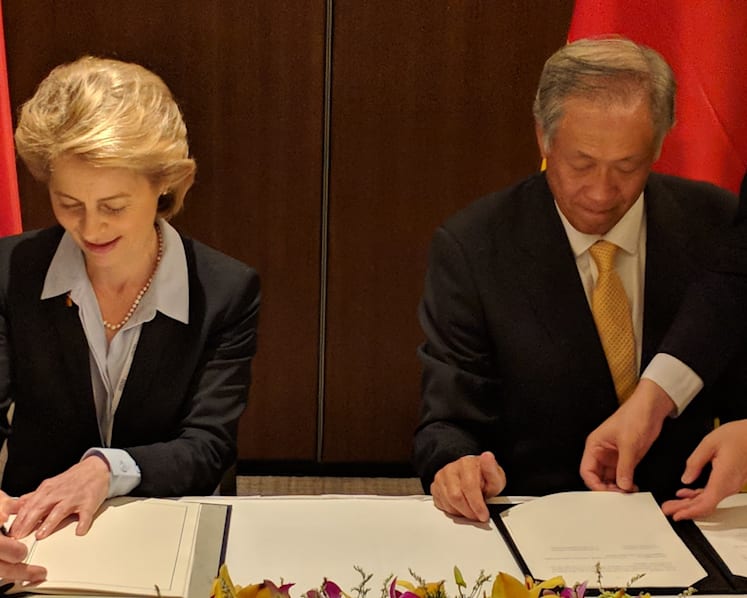
(Above) Dr Ng and German Federal Minister of Defence Ursula von der Leyen signing an enhanced Defence Cooperation Agreement. Photo: Ng Eng Hen/Facebook
Dr Ng and German Federal Minister of Defence Ursula von der Leyen also signed an enhanced Defence Cooperation Agreement between the nations.
This agreement builds on the first one signed in 2005 and consolidates key areas of existing cooperation, and paves the way for future cooperation in non-conventional security areas, such as cybersecurity.
Likewise, Dr Ng also noted the new threats faced by both countries today. Both countries may be thousands of kilometres apart, but they both face cyber threats on a daily basis, he said.
This enhanced agreement is timely and significant, and this places both countries in much better positions for the future, he added.
Noting that this is a “modern agreement” that takes into account current challenges and places emphasis on cyber security and hybrid threats, Dr von der Leyen said the MOU will intensify the cooperation between two countries. It will also focus on areas of mutual excellence, such as training and education.
Dr Ng noted that Singapore and Germany “share warm and friendly defence relations”, which include bilateral cooperations across many areas, such as high-level visits, dialogues, and military exchanges.
At the bilateral meeting prior to the signing, Dr Ng and Dr von der Leyen discussed wide-ranging geopolitical and security issues, including military modernisation and counterterrorism.




