







Some in embattled aviation, hospitality industries now working in supermarkets to help deal with demand surge

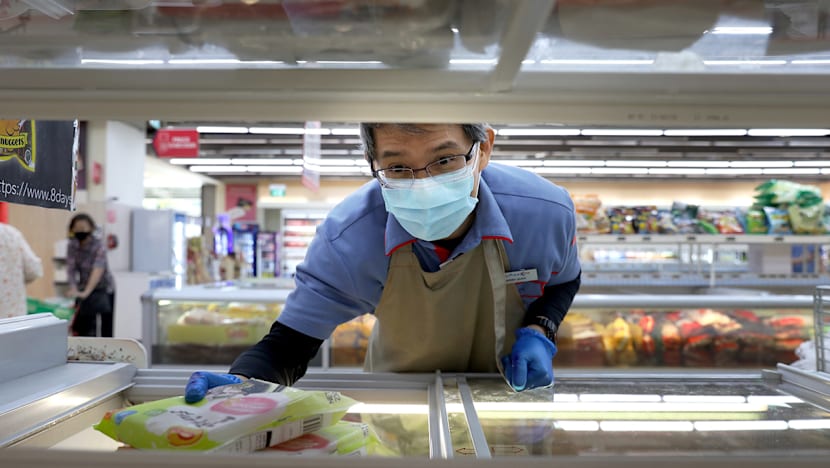
Mr Alvin Eliseo Florentes Valencia updating the prices of fresh food at NTUC FairPrice in Tiong Bahru Plaza on June 5, 2020.


SINGAPORE — Since he was a teenager, Mr Alvin Eliseo Florentes Valencia has had an obsession with supermarkets, taking his time to browse through shelves and being able to locate most items in the outlets he frequents.
This long-time interest has been serving the 46-year-old well in the past two months when he was working as a part-time retail assistant at the FairPrice Finest outlet in Tiong Bahru Plaza.
“During my first day (on the job), somebody asked me where I could find the cinnamon. I only had to quickly scan (the shelves) to find the spices and condiments (section),” he said.
Mr Valencia spent the last 10 years working in a travel firm before the Covid-19 pandemic and the ensuing travel restrictions caused a drastic fall in demand. He decided in February to leave his job as he was not making sales, and took up the role at FairPrice in April after coming across an advertisement for it.





He is one of 4,000 extra workers that supermarket chain FairPrice has hired, to support the increase in demand for groceries over this period.
The outlet at Tiong Bahru has had 30 new hires since February, bringing the total manpower strength to 113.
Likewise, Dairy Farm Group — which counts Cold Storage, Giant as well as Jasons Deli and Market Place among its brands — have also hired more workers during the past few months, although it did not reveal the total number.
The increase in manpower was to “meet the significant increase in customer demand since the start of Covid-19, as well as the additional requirements in the implementation of health and safety measures”, a Dairy Farm spokesperson said.
Supermarket chain Sheng Siong declined to comment on whether it has hired extra workers.
DRIVEN OUT OF AFFECTED INDUSTRIES
Another new FairPrice employee is 57-year-old Jerry Quek, who left his job as a customer operations manager at ground-handling firm Dnata at the end of January, hoping to find a new stint in the same industry.
But as the Covid-19 pandemic ravaged the demand for air travel, Mr Quek realised that he was not going to re-enter the industry anytime soon.
Since late March, he has been one of nine new workers in the 144-strong team at FairPrice Xtra located in Changi Business Park.
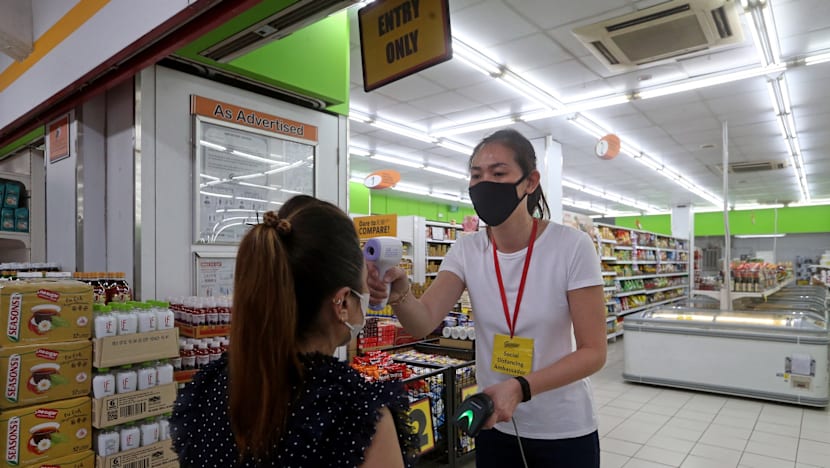
Ms Lafone Ching, who is an assistant sales manager at Four Seasons Hotel Singapore, has been redeployed as a temperature checker at Giant supermarket since June 2. The branch is located at 418 Yishun Avenue 11.
The 34-year-old is one of 370 hotel employees who have been redeployed under an initiative by Dairy Farm and the Food, Drinks and Allied Workers’ Union.
On a three-month contract, Ms Ching works eight-hour shifts, six days a week — including weekends — and like the others under this initiative, her salary remains the same. Dairy Farm pays Four Seasons for Ms Ching's work while the hotel continues to pay her current salary.
Not everyone retained the same pay after switching jobs though. Mr Valencia, for instance, is no longer earning commissions as he did in his previous job.
For Ms Ching, the biggest adjustment was having to work on weekends and spending less time with her 13-year-old daughter, with only a day off on either Monday or Tuesday.
“My daughter knows as well that for the next three months, there are definitely no weekends,” she said. “But luckily, she is grown up and she understands.”
NOT SMOOTH SAILING FOR EVERYONE
While Mr Valencia, Mr Quek and Ms Ching have found ways to earn a living and tide through this difficult time, it has not been as smooth sailing for others in impacted industries.
An air steward for a regional airline, who wants to be known only as James, said that at the start of the year, his salary fell from about S$3,500 to S$1,000 — which is his basic salary — when he was no longer rostered for any flights.
In March, the 29-year-old began working at a retail store along Orchard Road, earning about S$400 a month. He did this for about five weeks, but when the circuit breaker put a halt to non-essential business operations in early April, he could no longer go to work as the store was not providing an essential service.
However, the retail store still pays him S$300 a month to attend training classes.
This sum, coupled with the basic pay from his airlines as well as government payouts from the various national budgets, is enough for him to get by.
An employee at a travel and holiday company, who wanted to be known only as Lorraine, said that she was retrenched in early April due to a plunge in demand.
The 42-year-old’s former role as head of expansion means that her skillset — primed towards business development — is not sought after as most companies are trying to cut on spending.
Instead, Lorraine said that she will be launching a consultancy business with her husband over the coming month aimed at helping travel companies cut costs.
“The Covid-19 situation will accelerate the need for people to acquire new skills,” she said. “Even though Covid-19 will go away, it will change the (travel) industry so much that it will not be the same.”




