







South Korea has big target in sight for its bullet trains: The Singapore-KL high-speed rail
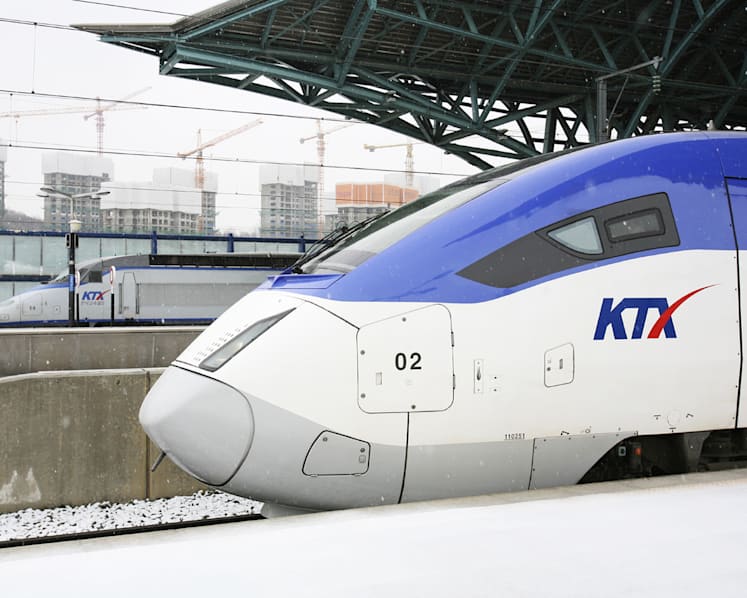
This handout photo released by Korean state rail operator KORAIL shows its homegrown bullet train KTX-II (front) and the existing KTX (background) at a railway station in Seoul on March 2, 2010. AFP file photo
SEOUL — South Korea is looking to enter the global high-speed rail market dominated by Japan and China, with its sights set on the upcoming deal to link Malaysia with Singapore, as the manufacturing-driven economy seeks new ways to offset stalling growth in its traditional smokestack industries.
Although it is a latecomer in north-east Asia to the highly competitive market, South Korea, which adopted French systems for its first-generation bullet trains in 2004, says it is ready to export its homegrown high-speed rail technology and operational know-how.
It rolled out its first made-in-Korea bullet trains at home in 2010 and now ranks fourth in the world in terms of high-speed train technologies, after France, Germany and Japan. The country is pushing hard to win a US$15 billion (S$21.7 billion) contract to connect Singapore and Malaysia’s capital Kuala Lumpur, with international bids due in the final quarter of next year, by sweetening its offer with the promise of technology transfer.
“It is a high-growth area that requires manufacturing expertise and cutting-edge technologies,” says Mr Park Jin-ho, a deputy director at the transport ministry’s railway policy division, who adds that South Korea “now stands on par with Japan and China in terms of technology, although we are lagging behind them in financing”.





Mr Park acknowledges that the country “lacks a track record in overseas markets, but we plan to make up for it with attractive terms for technology transfer because we are well aware what is needed for these emerging countries”. Analysts say Korea can transfer technology to other countries for better terms as it is done at the state level, while Japan and China focus on offering better financing packages.
The government says the country’s high-speed train system — Korea Train Express (KTX), linking the capital Seoul with the southern cities of Busan and Gwangju — is highly profitable despite its low fares. Boasting a top speed of 300km per hour, it attracts 176,000 passengers a day and reported a net profit of about 700 billion won (S$848.6 million)) last year on sales of 2 trillion won.
However, the country has yet to secure an overseas deal for high-speed trains. Like China, South Korea is targeting emerging markets in South-east Asia and Latin America for rail-related orders. Hyundai Rotem, the country’s sole train manufacturer with overseas factories in the United States, Turkey and Brazil, has been exporting traditional trains and subway cars to 36 countries, with its overseas orders quadrupling to about 2 trillion won over the past two years.
The prize eyed by the South Korean consortium, which includes Hyundai Rotem and state-run Korea Railway, is the new 350km high-speed rail line that would trim the land journey between Singapore and Kuala Lumpur to 90 minutes, from about four hours. The two South-east Asian countries last week sealed an agreement to complete the costly project by 2026.
“We’re zeroing in on the deal, which will hopefully become our first overseas venture for high-speed trains,” says Mr Lee Jong-yun, director of overseas projects at Korea Rail Network Authority. “But it is likely to be a tough battle.”
The Korean group is expected to face fierce competition from Chinese, Japanese and European rivals, and analysts are less optimistic than the government about its strength and chances of winning international bids.
China, home to the world’s biggest high-speed rail network, has become an aggressive bidder, winning large-scale projects in many countries. It is seen as holding an advantage, with Beijing having invested heavily in several large-scale Malaysian government projects including a US$12 billion East Coast Rail Line.
But Japan, which has been running bullet trains for more than five decades, is also stepping up efforts to export its “Shinkansen” technology, with Prime Minister Shinzo Abe having vowed to triple infrastructure exports to 30 trillion yen by 2020.
International companies such as Bombardier of Canada, France’s Alstom and Siemens of Germany are also eyeing the deal.
“China has merits on the cost side while Japan has advanced technologies. Korea is in between, struggling to find a way to match the huge loan offers of its neighbours,” says Mr Sagong Myung, researcher at Korea Railroad Research Institute.
Mr Sagong reckons Korea’s edge is its advanced operational know-how and its cutting-edge wireless train control system and in-train communications networks — technology pioneered by the country and slated for use on a new east-coast KTX line scheduled to be operational by the end of next year, ahead of the 2018 Winter Olympics.
However, analysts caution that politics plays a key role, with final decisions on contracts for big infrastructure projects often swayed by diplomatic ties and promises of financial assistance.
“There is no big technological difference between the three countries. In the end, it is a political game, where diplomatic influence plays a big role behind the scenes,” says Mr Sagong. FINANCIAL TIMES




