







S’pore has to ‘value-add’ to ties with US, China to remain relevant: Chan Chun Sing
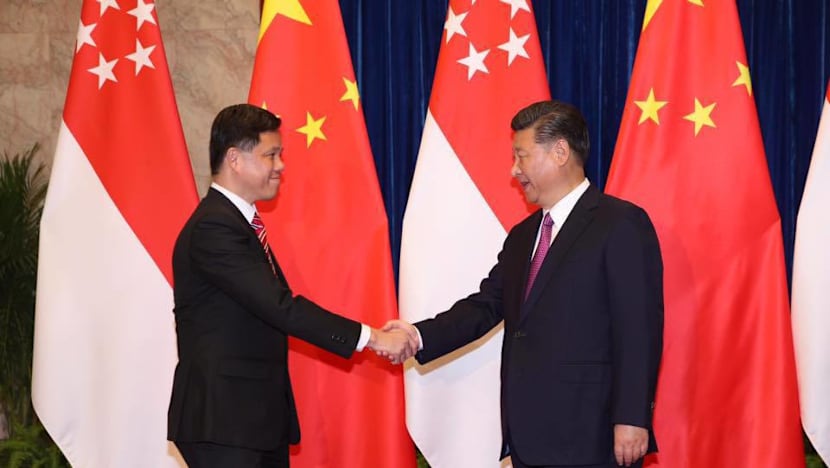
Singapore’s bilateral ties with China and with the United States are not a zero-sum game, and it has to constantly find ways to add value to these relationships to remain relevant, Mr Chan Chun Sing said on Monday. Photo: Chan Chun Sing/Facebook


SINGAPORE — Singapore’s bilateral ties with China and with the United States are not a zero-sum game, and it has to constantly find ways to add value to these relationships to remain relevant, Mr Chan Chun Sing said on Monday (Oct 30).
The Minister in the Prime Minister’s Office was responding to a question asked at a lunch forum organised by the Foreign Correspondents Association (Singapore), about Singapore’s decision if the country was forced to choose between the two superpowers.
Mr Chan made the point that this is not how Singapore, as a small state, approaches its foreign policies though. The country considers the interests on both sides, the common ground to work out a mutually beneficial relationship, and how to manage any differences.
Singapore never overplays its part, is aware of its strengths and weaknesses, and how it may add value to the relationships, he added.





For instance, Singapore has been supporting China’s evolving development priorities. There was the building of an industrial park in Suzhou, and then an eco-city in Tianjin, and now, Singapore is working with Chongqing to improve connectivity in the areas of finance, aviation, transport and logistics, and info-communication technology.
Likewise, Singapore opened up Changi Naval Base to the United States because it believes that the continued presence of the US in the region, and its engagement with the region, would provide a stable platform for the Asia-Pacific region to grow together.
“It is not a zero-sum game and it’s not about making a choice as to whether we will choose one or the other,” Mr Chan said. “Our real question is to constantly ask ourselves, as the US and the Chinese political systems and personalities evolve, how can we in Singapore constantly value-add to the relationship so that we maintain our relevance.”
While Singapore has been called an “interlocutor” between China and the US, Mr Chan did not agree that it is an appropriate term to describe its role. “We value-add to the relationship bilaterally, and where we can, we value-add to the relationship multilaterally,” he said.
“Over time, beyond personalities, the institutions in China and US, they do appreciate Singapore for the role that we play in the region, that we are an honest broker, that we are principled... (and) are not fair-weathered friends. We say what we mean and we mean what we say. That’s how a small country like us navigate the global shifts in the geo-political space,” he added.
Singapore faces two evergreen challenges ahead: Its limited resources and how it can survive without being circumscribed by larger countries, Mr Chan told the forum participants.
It needs to combine its strong foundation in basic education with a “rapid, just-in-time system for continuing education”. “We need to have what we call the necessary speed to market... knowledge for our people,” he added.
Likewise, Singapore needs to keep up with developments in the areas of data, finance, technology and talent.
“The size of our economy and the rate of our economic growth is not just dependent on the size of (the domestic) economy, the physical 700 square kilometres that we have... It’s our ability to connect and transcend our geography. Once we transcend our geography... frankly speaking, there is literally very little limit to what we can do,” Mr Chan said.




