







S’pore hopes to advance negotiations for stalled Asean-EU free-trade deal
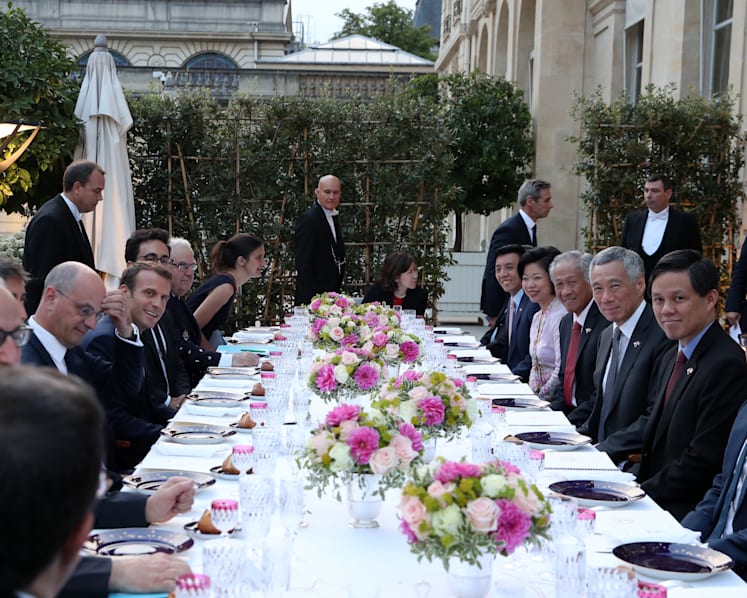
President Emmanual Macron hosted the Singapore delegation to an al fresco dinner on July 13, 2018.


PARIS — As incoming coordinator for relations between the Association of South-east Asian Nations (Asean) and the European Union, Singapore hopes to establish a framework to identify areas of consensus for a free-trade agreement, Prime Minister Lee Hsien Loong said on Saturday (July 14).
Speaking to Singapore media after attending the French National Day parade as guest of honour, Mr Lee noted that Asean and the EU had talked about a free-trade deal some time ago, and a series of discussions had taken place. However, things petered out because there were “so many conflicting requirements to reconcile”.
Going ahead, the Republic hopes to establish a framework to identify areas with potential to work out deals.
“Working out the deals will probably take longer than the end of this year almost certainly,” he said.





“But if we can identify what the shape of the deal can be like, where the major win-win opportunities are or trade-offs are, then I hope we will have better success this time.”
Negotiations for an Asean-EU free-trade agreement began in 2007 but were halted two years later, giving way to bilateral negotiations which are seen as building blocks towards an eventual multilateral agreement.
Last year, Asean and the EU agreed to revive negotiations. Singapore, which chairs Asean this year, takes over as coordinator for Asean-EU relations in August for three years.
A free-trade agreement between the EU and Singapore is presently in the final stages of ratification. The aim is to have the agreement come into force by next year.
Trade and Industry Minister Chan Chun Sing, who joined Mr Lee in Paris from Brussels where he met key EU officials and representatives to reaffirm Singapore’s interest in the speedy ratification of the bilateral deal, had said the pact could pave the way for similar agreements to be drawn up between the EU and other Asian countries.
The EU-Singapore free-trade agreement will be the bloc’s first such agreement in South-east Asia.
When it comes into force, the agreement is expected to contribute 2.7 billion euros (S$4.32 billion) to Singapore’s gross domestic product in real terms and 550 million euros to the EU’s economy.
Describing bilateral ties with France as “very good”, Mr Lee said that beyond the traditional areas of co-operation, such as in defence and the economy, cyber-security has emerged as a new area both sides are joining forces on. France, he noted, has “a lot of expertise” on this front.
At its presidential election last May, then-presidential candidate and the current French President Emmanuel Macron was said to have been the subject of a coordinated hacking attack in which tens of thousands of internal e-mail messages and documents, some believed to be false, were published online.
“They (the French) had a very effective counter-operation which neutralised and prevented it from interfering with their domestic political processes,” said Mr Lee.
On the home front, Mr Lee noted that Singapore was also developing its own cyber-security capabilities in line with the country’s goal to become a Smart Nation and to have all its systems go digital.
“You must have your defences up. Otherwise, you are naked, so it’s an area where we can both work together and the cyber-security roadmap spells out how we can further this co-operation and it reflects the intent on both sides to do a lot more together on this issue,” he said.
Mr Lee’s remarks came a day after Singapore and France unveiled a digital roadmap, under which they pledged to beef up co-operation on cyber-security and exchange ideas on regulatory approaches to safeguard user data in the digital sphere, among other things.
For instance, the two countries’ cyber-security agencies agreed to step up existing co-operation covered under a memorandum of understanding signed in May 2015, amid concerns over increasingly sophisticated cyber-attacks around the world.
France is not the only country Singapore is teaming up with on cyber-security. In June last year, for instance, Singapore signed a memorandum of understanding with Australia, covering cyber-security co-operation in areas such as training and joint cyber-security exercises.
On Friday, Mr Macron hosted Mr Lee and the Singapore delegation to dinner at the Elysee Palace, where the two leaders spoke about economic co-operation. Mr Lee noted on Saturday that both sides are doing much together in the areas of trade and investment, with 2,000 or so French companies operating in the Republic.
Both countries are also pursuing new areas of economic co-operation, including efforts to tie up Singapore’s research-and-development ecosystem with France’s, and to carry out research projects of mutual interest, such as on environmental issues, Mr Lee said.
As part of Mr Lee’s visit, both countries concluded eight agreements in areas like innovation and energy.
He departs for Singapore on Sunday.




