







S’pore must not leave older workers behind: Chan Chun Sing
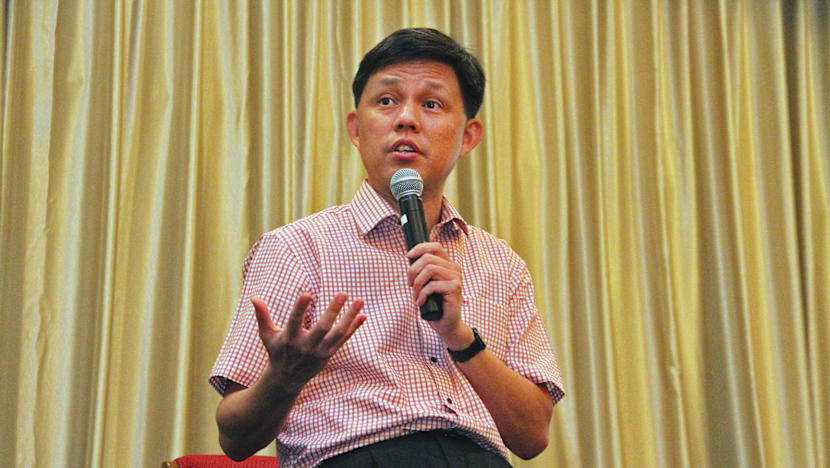
Mr Chan Chun Sing, Minister for Social and Family Development at the Social Workers' Day 2015 Symposium. Photo: Robin Choo


SINGAPORE — With challenges brought on by an ageing population, the Republic has little choice but to accelerate the transformation of its workforce and economy, said new labour chief Chan Chun Sing.
Yet, at the same time, it must not “run ahead” of its labour supply in its bid to transform the economy, as the livelihoods of an older generation that is less educated at stake. “It’s a fine balance that we constantly have to shift over time,” said Mr Chan, who took over from Mr Lim Swee Say this week as secretary-general of the National Trades Union Congress (NTUC).
About half of younger workers are university graduates, but only about one in 20 of the older generation possess a degree. “As we bring in many of the new, higher value-add industries, high value-add jobs, it’s not a given that the (older generation that is less educated) can all take on the new jobs,” he said. “On the other hand, you also don’t want to (go for only) lower-tech, lower value-add ones when your stock of workers has progressed.”
Speaking in a media interview last week on his new role, Mr Chan reiterated that the national SkillsFuture initiative will play an important role in continuing education, with workers needing to upgrade their skills in tandem with shorter product life cycles. It will allow individuals to take ownership of skills they can apply across different companies or jobs, said Mr Chan.





And aside from rank-and-file workers, the NTUC will help the growing ranks of professionals, managers, executives and technicians (PMETs), he said. The Progressive Wage Model concept, which has involved sectors such as cleaning, landscaping and security, is also applicable to PMETs, through a structured development path or progressive skills ladder, for instance, he added.
Mr Chan said that with a citizen workforce set to shrink in about five years’ time, Singapore will have to keep innovating and compete based on the quality of its ideas. He pointed out that facing off against competitors with more abundant and cheaper labour is not a new problem for Singapore.
“We always compete on the quality of our ideas, the speed of our innovation and the trust that people have (in us). These are the three fundamental ingredients,” he said.
Pointing to economies such as Switzerland and Germany, Mr Chan said prices of what they produce might be higher, but companies could still remain highly competitive. His challenge as labour chief is an “evergreen” one — for the workers of tomorrow to continue having good jobs and salaries that allow them to fulfil aspirations and take care of their families, said Mr Chan, who was previously Minister for Social and Family Development and Second Defence Minister.
The tripartite relationship of the Government, businesses and the labour movement has to remain strong, he said. It is Singapore’s unique advantage and future tripartite leaders must forge similarly robust relationships, said Mr Chan.
Inducted into the NTUC only four months ago, Mr Chan said every day had been an “intensive programme” of meetings with unions and companies. He meets up to four unions or companies each day, and has so far met about half of the 60-odd unions under the NTUC.
Asked about his leadership style and whether it would be different from his predecessor, who was known for his colourful catchphrases, Mr Chan said it was too early to tell. On leading the NTUC in the next General Election, which must be held by January 2017, he said prospective labour Members of Parliament (MP) must be close to the ground and add value to workers’ lives. “If you take care of workers, if you’re fair to workers, if you help workers grow, then being a good labour MP is inevitable,” he said.




