







S’pore must remain open, even as others turn inwards: PM Lee
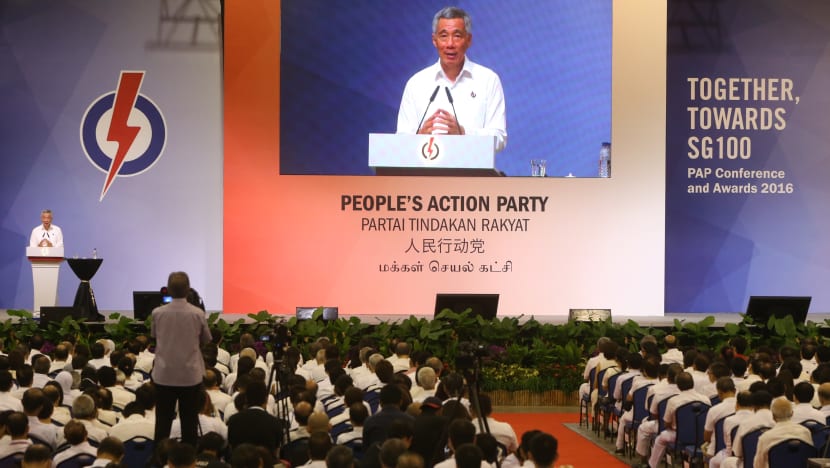
Prime Minister Lee Hsien Loong speaking at the PAP conference on Dec 4, 2016. PHOTO: Ooi Boon Keong



SINGAPORE — The trend of developed countries turning inwards and adopting a more “protectionist, nativist” approach would have an impact not only on economics and trade. Security and the international order will be affected as well, and there will be major consequences, especially for small and open countries like Singapore, Prime Minister Lee Hsien Loong warned on Sunday (Dec 4).
“I do not know how far this trend will go, but I do not like the direction the trend is going. Because if more countries turn this way, the world is going to change, and it’s going to change for the worse,” said Mr Lee, who was speaking in his capacity as People’s Action Party (PAP) secretary-general to party activists and union leaders at the biennial PAP Conference.
Amid the global upheavals — in particular, Mr Lee expressed concerns about elections in several European countries next year — Singapore will continue to pursue trade liberalisation with others in the region and cooperate with major trade partners, said Mr Lee.
“We ourselves in Singapore must stay open, because if we close up like other countries, our people will be finished,” he told the 2,500-strong audience at the Singapore Expo.





For more than half a century – at least since the 1960s – all developed countries have shared “the same broad objective of prosperity and (had) a shared perspective on international cooperation”, he said.
Despite competition and rivalry including the Cold War, the prevailing ethos was “to open up, cooperate, trade, prosper together”, he added.
But that looks to be changing. “Nationalism has turned on its head. Instead of being open and self-confident, proud of their own countries, seeking win-win opportunities with other countries, now voters have become insecure, inward-looking and anxious about their future,” said Mr Lee. “When others succeed, they don’t see win-win opportunities, they think of it as a win-lose outcome… and so they try to shut themselves off from the rest of the world.”
Mr Lee stressed that Singapore has always depended on open trade and made friends around the world, looking for opportunities for cooperation. It has relied on a peaceful and secure Asia, as well as an international order where countries, big and small, cooperate and compete according to rules that are fair to all. Singapore worked hard for its success, but was “lucky” to enjoy a favourable international environment that enabled it to attract foreign investments and negotiate free-trade agreements, he noted.
Now, countries are “flexing their muscles and becoming increasingly assertive”, and nobody can tell how relations between the major powers will develop. “If United States-China relations grow tense, Singapore is going to be in a very difficult spot, because we regard both the US and China as our friends and do not... want to have to choose between them. At the same time, world trade is flat, obstacles to trade are increasing, our exports are not growing very much,” said Mr Lee, noting that it is getting harder for countries to “prosper together, to achieve win-win outcomes”.
The Trans-Pacific Partnership, for example, is in danger of collapsing after six years of talks among a dozen countries. US President-elect Donald Trump has announced that he will pull his country out of the trade pact. “Without the US, there is no TPP,” said Mr Lee. Adding that Singapore would make the best of other trade deals such as the Regional Comprehensive Economic Partnership, he said: “We have to accept the world as it is, not as we wish it to be.” Singapore still hopes that a trade deal including the US, Japan and others will happen one day, he added.
Citing the United Kingdom’s Brexit vote and the recent United States Presidential Election, Mr Lee noted that the mood of voters fed up with mainstream political parties and voting for change is growing in many developed countries. “Worryingly, next year is going to be election season (in Europe),” Mr Lee said.
The Netherlands will be going to the polls in March, France in May and Germany in September. Italy had a referendum on Sunday on constitutional reforms which could decide the fate of its Prime Minister Matteo Renzi, whom Mr Lee described as a “reformist”. Mr Renzi has said he would resign if the outcome goes against him. Meanwhile, Austria voted for its President on Sunday, with the far-right candidate, Mr Norbert Hofer, having a “good chance of winning”, Mr Lee said. If Mr Hofer wins, he will be the “first extreme-right head of state in the European Union”, Mr Lee noted.
The political tide in Europe will reverberate thousands of miles away, with Singapore particularly vulnerable given its dependence on external trade and globalisation.
Singapore workers are already feeling some impact of disruption to jobs and industries, alongside the economy going through restructuring. Unionists on Sunday spoke of the need to embrace change, urging workers to stay nimble to take advantage of emerging opportunities.
National Trades Union Congress president Mary Liew said Singapore workers are aware of how changes can come “at a much faster pace than before” with disruptive technology. Leaders need to “continue and preempt our workers to stay relevant, to keep on upgrading their skills, to not just look at the jobs of today but really look at the jobs of tomorrow”, she added.
Singapore has proved it is quick in transforming itself and has dealt with adversities before, added NTUC Central Committee member K Thanaletchimi, noting how the country is perservering in looking outwards, even as others are turning inwards. “You look at how we started and how we are now... what we have done so far is to be very quick in transforming ourselves,” she said. “Eventually those people who are looking inward will realise that they can’t survive in that kind of model.”




