







S’poreans raise money, pool their savings to help victims
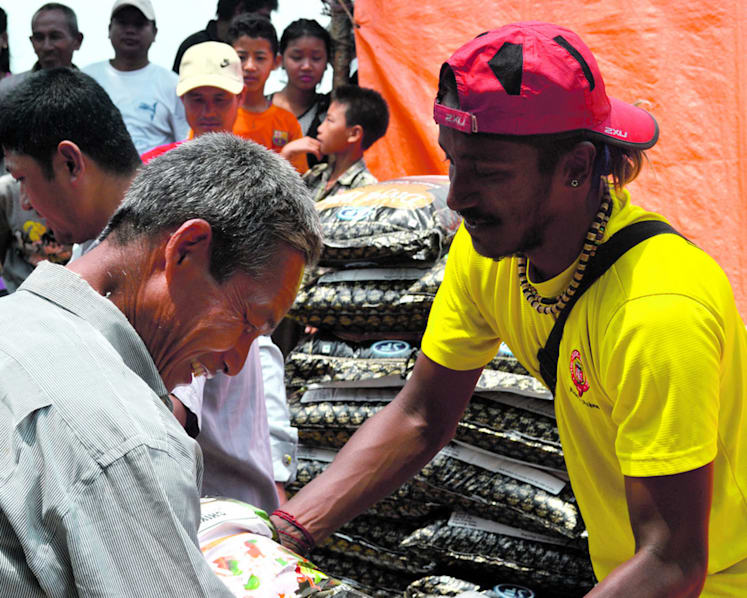
Mr Radakrishna distributing supplies he bought with funds he raised in Ghorka, the epicentre of the earthquake that struck Nepal on April 25. Photo: Sanjay Radakrishna


KATHMANDU — Making their way back to Kathmandu after co mpleting the eight-day Annapurna Base Camp Trek near Pokhara last month, the vehicle transporting undergraduate Sanjay Radakrishna and his friends were caught in a landslide caused by the first major earthquake to hit Nepal in 80 years.
After scrambling to get his team-mate’s head injury attended to, Mr Sanjay could have caught one of the Republic of Singapore Air Force C-130 planes home, but he decided to stay back in the Himalayan nation, even though many were trying to get out.
“To me, it wasn’t something about running back to Singapore safely, but (rather) help those who are nearer to me first,” said the 26-year-old outdoor enthusiast. “There was no rush to go back, from my point of view, because the people here need more help.”
Mr Sanjay is among the handful of Singaporeans who, undaunted by challenges that frustrated even large, experienced and well-resourced relief organisations, stayed on to help raise funds, distribute food supplies and build temporary shelters.





The undergraduate, who has visited Nepal nine times in five years and felt comfortable travelling around the country, decided the best way he could help was to raise funds from Singaporeans, as he had no “official skills” such as medical qualifications.
Within 25 days, he managed to raised more than S$25,000 and has since used the money to buy emergency supplies such as rice, oil and tarpaulin sheets. He also delivered them personally to the villagers in Gorkha, the epicentre of the 7.8-magnitude earthquake, tapping his network of local friends who identified where he could go and arranged for transport.
Mr Sanjay was also with the locals in Maskichhap, a village in Gorkha, when a second earthquake struck on May 12. Not wanting to disrupt the supplies to the villagers, he carried on with his plan. After spending 39 days in Nepal, he finally returned to Singapore on Friday. “I had no regrets, as I genuinely wanted to stay back and help the survivors. Being on the ground allowed me to help the locals on behalf of many other Singaporeans,” he added.
Another Singaporean in Nepal was teacher Caroline Wong, 35, who is currently living there with her husband. Frustrated at how aid was not reaching the villagers after the first quake, the couple decided to pool their savings and personally deliver emergency supplies to affected places, such as Sindhupalchok, north-east of Kathmandu. “Now, food may not be the most urgent (thing) … For some of them, they said they needed more long-term kind of shelters, so that’s what we did to respond to their needs,” said Ms Wong, who has been trying to build tunnel shelters, fashioned out of metal sheets, for the homeless locals.
The couple managed to raise some funds from Singaporeans, but the budget remains a constraint — a fact sometimes overlooked by some Nepalese seeking help who assume that Ms Wong, being a foreigner, was from a well-funded non-governmental organisation.
The pair has raised about US$11,000 (S$14,700) through a crowdfunding site her brother set up, and will continue to collect funds to help rebuild community facilities after the monsoon season.
Dr Joshua Chua, 28, who was with 12 other Singaporeans on a separate mission trip in Chalnakhel when the first earthquake hit, meanwhile, found his medical skills of little use. When they offered their medical expertise at a nearby hospital, they were turned away as the hospital did not recognise their Singapore medical licence and there was also a shortage of translators. Instead, they stayed on and pooled their money on hand to buy rice, dhal (lentils) and water for the local villagers. “I think we did our best ... Intrinsically, we want to help people, be it based on our medical expertise or not,” he said.
SIAU MING EN




