







Spotlight on Muslim community in recent years 'uncomfortable' but message ‘sinking in’: Shanmugam
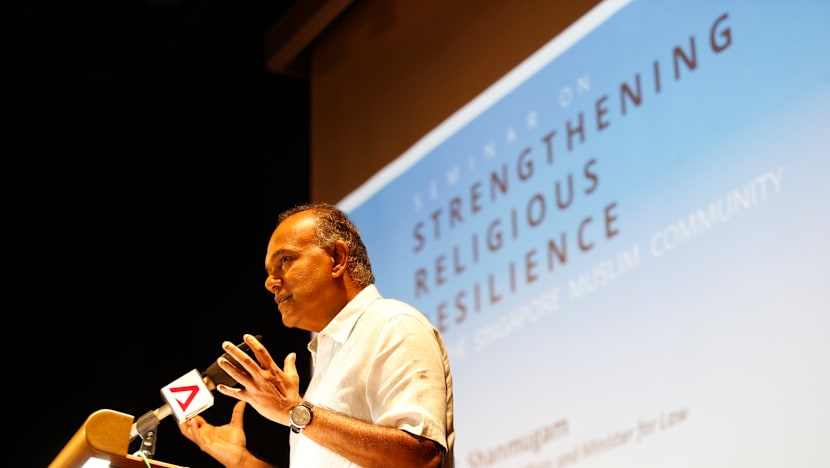
Home Affairs Minister K Shanmugam who was speaking at a seminar at the Islamic Religious Council of Singapore’s (Muis) headquarters acknowledged that it has been "uncomfortable" at times for the Malay-Muslim community in recent years as they have been under the spotlight amid repeated calls to counter extremist ideologies. Photo: Najeer Yusof


SINGAPORE – Home Affairs and Law Minister K Shanmugam has said it has been “uncomfortable” for the Malay-Muslim community at times in the past couple of years to be put under the spotlight amid repeated calls by the Government to counter extremist ideologies.
But it was necessary in order to entrench the idea that Singaporeans cannot accept extremism and the need to adopt an inclusive approach, he added, noting that the message was sinking in.
“Over the last two years, many including myself, I’ve made many speeches (on terrorism). Sometimes it has been uncomfortable because it has put the spotlight on the community and most of our Muslims are peaceful. Most of our Muslims are moderate,” said Mr Shanmugam on Saturday (Oct 7).
He was speaking at a seminar called ‘Strengthening Religious Resilience of The Singapore Muslim Community’ held at the Islamic Religious Council of Singapore’s (Muis) headquarters.





“So, sometimes they’re thinking why do you keep talking about this, because we are not extremists, we are not people who support any of these ISIS ideology. Why do you keep talking about terrorism?”
His comments came a few days after Parliament discussed a motion on staying united against the terrorism threat.
In total, 17 Members of Parliament rose to speak in the debate, including Mr Shanmugam, who touched on aspects such as the types of terror threats and that protecting multiracialism is critical in the fight against terror.
Pointing out that the Government’s messaging has “had an impact”, Mr Shanmugam said: “Because if you talk to an average Muslim on the street, they will tell you what is and what is not acceptable. It is sinking in, it is being accepted.
“And the small groups of people who advocate a more extreme view are also keeping quiet, maybe for a while, but at least they are keeping quiet now, at least for the time being," he added.
This reflected that the community has achieved a “certain level of psychological resilience”, said Mr Shanmugam, and it is timely to focus less on the issue of terrorism and place more emphasis on values and the Singaporean identity.
This means assessing social and religious practices such as whether or not there is greater interaction and the need to forge friendships across various communities.
“So, I think we can spotlight – unless events change – we can spotlight a little bit less on terrorism and a little bit more on values and the Singaporean identity which I think is more comfortable for everybody as well. And that’s the journey I hope to kick off from next year.”
Highlighting the success achieved by Malay-Muslim Singaporeans in terms of education and jobs, he also reiterated that the community can be a shining example for other Muslim communities in other parts of the world.
The average Muslim child here is performing better in their education, compared to their peers in America and Europe, he added. “Our Muslim children are now world class,” he said.
And with 90 per cent of Muslim students moving on to post-secondary institutions such as the Institute of Technical Education and polytechnics, Mr Shanmugam said that children in the community are “no longer falling out of schools”.
The Government, he added, will continue to assist students in skills upgrading and placing them in jobs.
“Our muslim community can be a beacon and a model for Muslim communities around the world on how you can be strong, confident Muslims, practicing your faith, being happy about your faith and at the same time being strong and confident in the external world and being successful,” he noted.
Dr Nazirudin Mohd Nasir, who is Muis’ director of religious and policy development, acknowledged that when Muis rolled out sermons calling on Muslims here to combat terrorism, there have been a sense of unease among some over the perception that the community was associated with acts carried out by terrorists.
But the community has come to understand the need to raise awareness about the issue, and when radical messages are spread online, they are able to respond to it “in the right way” and be the first line of protection to their family members, he added.
As much as terrorism is a concern, local asatizah Mr Fizar Zainal said that “we should not harp on it every single time”, as it might give the impression that “we’re afraid of terrorists".
“I agree with Mr Shanmugam’s comments that it is time for the narrative to change, to be more positive,” said the 29-year-old, who works at non-profit social organisation called Bapa, which conducts religious classes among other activities.
Mr Fizar pointed out that the Malay-Muslim community has “long been invested” in maintaining harmony and forging close ties with their brethren from other communities. “We should focus more on the ties that bind us and how united we are regardless of our different races and religions,” he added.




