







Technological revolution a boon and bane, new NTU institute to study its impact on society
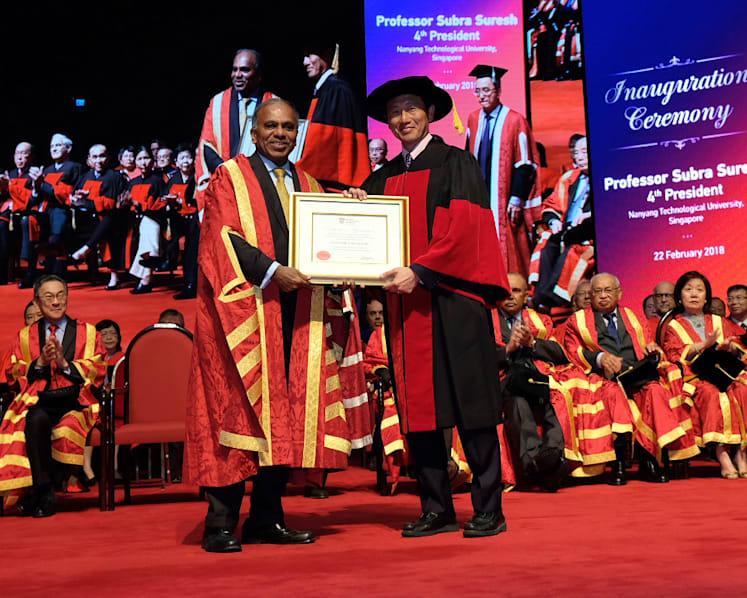
Professor Subra Suresh receiving a certificate of appointment from Minister for Education (Higher Education and Skills) Ong Ye Kung during his inauguration ceremony as NTU's fourth president on Thursday (Feb 22). Photo: NTU


SINGAPORE — To achieve its vision as a “great global research university” and prepare its students for a “hyper-globalised” world, the Nanyang Technological University (NTU) will set up new institute to study the impact of the technological revolution on society, announced its newly-appointed president Subra Suresh on Thursday (Feb 22).
For a start, the NTU Institute of Science and Technology for Humanity will focus on the ethical implications of innovations, responsible innovation and governance in the technological age, among others, said Prof Suresh in his inauguration ceremony speech on Thursday.
The institute will adopt a thematic approach that cuts across broad subject areas such as artificial intelligence, big data and life sciences.
It will be helmed by a panel of international advisors, who will work closely with NTU’s colleges and schools to organise academic conferences, sponsor thesis projects and provide grants for research teams. NTU will announce the full group of advisors for the institute in the next few months.





Referring to the technological revolution, known as Industry 4.0, Prof Suresh said that it is “projecting a pace of technological and societal change that is unprecedented.”
He added: “While the technological revolution we are witnessing today will reshape the 21st century human condition in many positive ways, there is also understandable nervousness about its potential downsides.”
Proj Suresh highlighted a potential fault line that could emerge in society as a result of the technological revolution. He said: “Given the unprecedented pace of change, the concern this time around is that any significant time delay between job destruction and job creation will result in social unrest.
“It is also likely to exacerbate inequality in income, opportunity and education in many societies around the world.”
The creation of the institute is part of NTU’s plan to address these issues, as Prof Suresh said that an understanding of how humans interact with technology is important to help graduates navigate a world where individual citizens can “send and receive real-time data and information using mobile technology”.
He added: “How do we prepare our students, alumni and fellow citizens for a lifetime of re-skilling and skills development and improvement, so that appropriate, relevant and continually changing employment opportunities are realised?”
At Thursday’s inauguration ceremony, Prof Suresh received a certificate of appointment from Minister for Education (Higher Education and Skills) Ong Ye Kung, and he was also conferred the title of Distinguished University Professor, NTU’s highest academic appointment.
Formerly president of Carnegie Mellon University and the director of the National Science Foundation, Prof Suresh took over from his NTU predecessor Bertil Andersson on Jan 1 this year. He is NTU’s fourth president.
In his speech, Prof Suresh told the audience of about 2,000 students and faculty members at the Nanyang Auditorium that he was grateful to the institutions and governments that provided him with opportunities to pursue an education, “despite coming from a background where neither of his parents had the choice to attend university”.
They provided support that emphasised “potential, performance and pure merit over privilege, preference of politics,” said Prof Suresh, who is an accomplished scientist and educator. He also paid tribute to his late mother for making “enormous personal sacrifices” that allowed him to pursue higher education.
After completing his undergraduate degree on a merit scholarship by the Government of India, he then went on to pursue a Master’s degree with a full scholarship at Iowa State University. He completed his doctorate degree in mechanical engineering at the Massachusetts Institute of Technology (MIT).
The University of California at Berkeley then sponsored his permanent residency, and the India-born scientist eventually became an American citizen.
Later, he was chosen by Former United States President Barack Obama to serve as Director of the National Science Foundation from 2010 to 2013.
In addition to the new institute, Prof Suresh also unveiled on Thursday two new initiatives, a postdoctoral fellowship and a digital arts prize.
The NTU Presidential Postdoctoral Fellowship is offered to early career scientists and researchers in any discipline to conduct research in their chosen fields of study.
The fellowship, which is open to all nationalities and targeted at PhD holders, includes a two-year tenure with a salary of S$80,000 a year, and an annual research grant of up to S$100,000. Twelve individuals will be awarded the fellowship each year.
As part of NTU’s move to attract and retain talent, successful candidates will also have the opportunity to take on an academic appointment as an assistant professor.
From 2018, a new digital arts prize to recognise artists and technologists with extraordinary creativity will also be handed out biennially. Open to entries from around the world, the awardees will be selected by a panel of distinguished judges, with prize money in the “tens of thousands”, said Prof Suresh.




