







Tharman wins MIT prize for global financial leadership, warns over high debt levels in advanced economies
The Miriam Pozen prize, awarded by the Massachusetts Institute of Technology’s Golub Center for Finance and Policy is awarded every two years. Past recipients include the late American and Israeli economist Stanley Fischer in 2021 and former prime minister of Italy Mario Draghi in 2023.
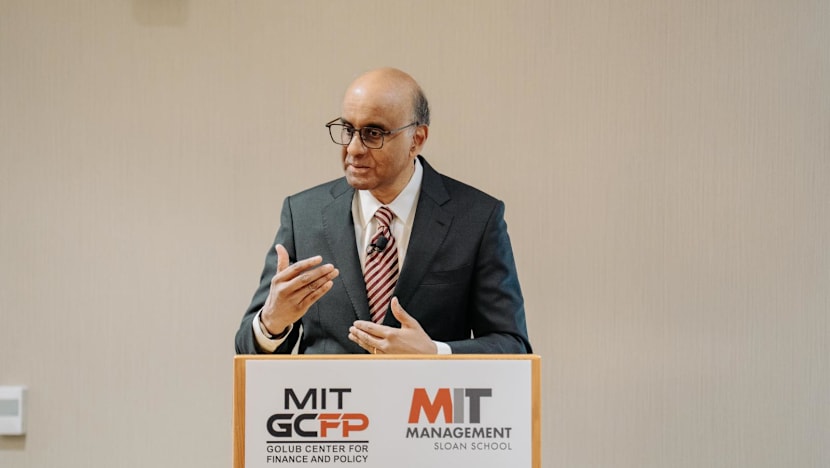
Singapore President Tharman Shanmugaratnam received the Miriam Pozen Prize from the MIT Golub Center for Finance and Policy on Dec 9, 2025. (Photo: Office of the President)

This audio is generated by an AI tool.


SINGAPORE: President Tharman Shanmugaratnam has been awarded the prestigious Miriam Pozen Prize in recognition of his leadership in international financial policy.
The prize, awarded by the Massachusetts Institute of Technology’s Golub Center for Finance and Policy (GCFP), is given out every two years.
It is named for the late mother of a senior lecturer at the MIT Sloan School of Management. The same award was previously given to the late American and Israeli economist Stanley Fischer in 2021 and former prime minister of Italy Mario Draghi in 2023.
Before he became the president of Singapore in 2023, Mr Tharman was deputy prime minister and minister for finance over several years, as well as education minister earlier.





He was chairman of the Monetary Authority of Singapore for 12 years. Before entering politics in 2001, he was its managing director.
Internationally, he currently chairs the board of the Group of Thirty, an independent global council of economic and financial leaders from the public and private sectors. He also co-chairs the High-Level Advisory Council on Jobs, which was established by the World Bank Group in 2024.
Mr Tharman will receive a US$200,000 (S$259,000) prize, and a fellowship named in his honour will also be awarded to an incoming MIT Sloan Master of Business Administration student, to be selected in 2026. The President’s Office said Mr Tharman will be donating the prize money to charity.

Giving a lecture at an award ceremony at MIT Sloan on Tuesday (Dec 9), Mr Tharman cautioned against the “systemic risk” present when multiple advanced economies accumulate “higher and higher debts because the markets give them the leeway to do so”.
He said this will lead to "systemic risk", that is, “a risk of global financial instability, because we know it can’t last indefinitely”, he added, noting that private companies that lend to governments are also often highly leveraged.
“No one knows exactly where the limits will be, but it is clear that the debts cannot keep rising indefinitely without creating significant risks of financial instability,” he said.
Even if it does not end in “a sudden collapse” of confidence in the system, it is “reasonable to assume” that ever-increasing debts as a percentage of GDP will lead to an erosion of long-term growth and a gradual loss of trust in reserve currencies. Even if this does not trigger a major crisis, this will pose chronic global financial instability, Mr Tharman added.
The largest challenges have yet to come, he said, noting the costs associated with ageing societies and climate change, as well as more advanced economies spending more on defence due to geopolitical fracturing and increased conflicts.
The closest historical precedent to this situation is the period after World War II, when most advanced countries - apart from the United States - started with very high debt-to-GDP ratios. The solutions those countries adopted then are no longer feasible today, said Mr Tharman.
There is no realistic solution to putting government debts back on a sustainable track without adjustments to taxes and spending, he added, noting that both are “very likely”.
“This should not be simply a call for fiscal austerity. The challenge is to make these adjustments while repurposing fiscal policy more fundamentally: so that people can see that the adjustments are fairly distributed across society, can see the value in government spending that their taxes support, and so that the adjustments do not permanently reduce growth,” he said.
“Because a sustained reduction in growth will make any form of social solidarity very difficult to achieve.”
REPURPOSING FISCAL POLICY
Mr Tharman highlighted three “reorientations” needed in this repurposing of fiscal policy, which will make them more sustainable while addressing the needs of the poor and the middle class.
Spending must be refocused on public goods, not just on individual benefits like public education, public healthcare systems and public transport, he said.
This is important because those who gain the most from access to high-quality public services and systems are the poor and middle-income groups, he added. This is also progressive and does not rely only on explicit transfers to individuals.
Research also shows that this breeds interaction across income groups and ethnic groups, which in turn promotes social mobility, Mr Tharman noted.
“It is how you create a sense of community, how you create the social glue among people from very different backgrounds.”
The focus should also be shifted from transfers aimed “mainly at reducing inequality”, toward public schemes and forms of risk sharing that relieve economic insecurities, or what the poor and broad middle class perceive as major concerns in their lives, he added.
Surveys show that people are more concerned about insecurities in their lives – jobs, housing, major health setbacks and retirement savings – than about inequality per se, said Mr Tharman.
Helping the public deal with these insecurities was “at the heart” of the original social democratic vision, he noted, adding that this original purpose has to be refreshed.
Focusing on economic insecurities and not just inequality is also a progressive agenda because the people who will benefit the most from being relieved of these insecurities tend to be poorer, he added.
“They are the ones whose jobs are most precarious. They are the ones who, if they fall a step, can easily fall off the ladder of opportunity.”
The third shift is to move away from a very heavy focus on managing the regular business cycle toward preserving the fiscal space needed to address major crises, said Mr Tharman.
In the last 20 years, the world has faced one major global financial crisis, two pandemics and several wars, he said, noting that more will come.
The economic news on “any given day” tends to focus on the latest small changes in GDP, inflation or unemployment, which reflects that treasuries, finance ministries and central banks are focused on “smoothing the business cycle”, said Mr Tharman.
“But there is a growing asymmetry. They try their best to prevent a downturn by engaging in stimulative macroeconomic policies. But when things recover, do not make up for it by consolidating policy,” he added.
“So what we increasingly see is perpetually large budget deficits, and prolonged ease in monetary policy, that leaves very little space to address the major crises when they come.”
It also leaves very little space to address longer-term challenges, including climate change, said Mr Tharman.
“These are inherently collective risks that must be addressed globally. They will require fiscal resources from every nation, with richer nations contributing their fair share,” he added.
Co-director of MIT’s GCFP and School of Management Professor Robert C Merton said Mr Tharman combines “a blend of remarkable expertise and profound empathy”.
“He has served in an incomparable array of senior governmental positions as an extraordinary leader with global influence,” said Prof Merton in a press release when the award was announced last month.
“As president of Singapore, he carries not just the badge of the office, but a trust that comes from decades of service and a demonstrated concern for both the economy and the people. His journey shows that leadership can be about both structural vision and human connection.”




