







Timely for next PM to be identified by Sept, say analysts
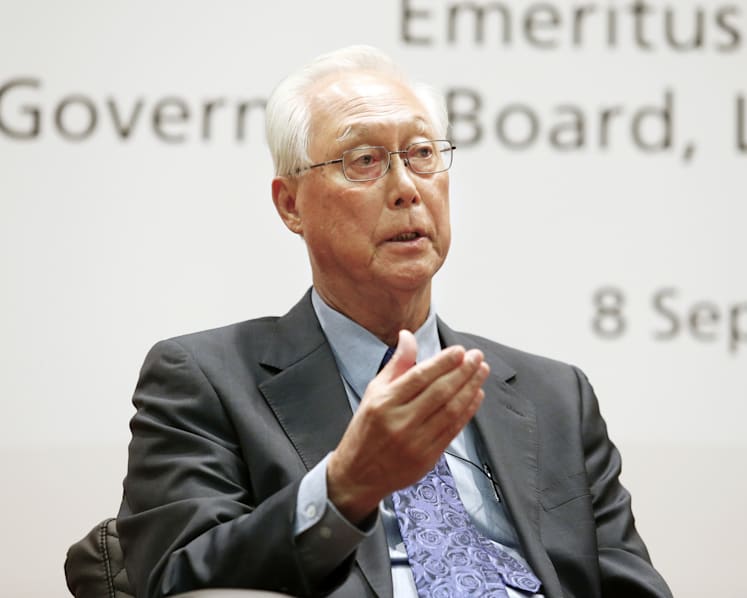
ESM Goh Chok Tong speaking at the 13th anniversary dialogue session at auditorium of the LKY School of Public Policy on 8th September 2017. Photo: Najeer Yusof/TODAY


SINGAPORE — Following recent comments by Emeritus Senior Minister (ESM) Goh Chok Tong, political analysts believe the identity of Singapore’s next Prime Minister will be made known latest by September, in time for the Republic to showcase its next leader when global statesmen — including those from the Association of South-east Asian Nations (Asean), the United States and China — come to town for meetings towards the end of the year.
They also expect Prime Minister Lee Hsien Loong to lead the ruling People’s Action Party (PAP) in the next General Election (GE), due by January 2021, and remain in power for one to two years after the polls — giving his successor a runway of up to five years before assuming the top job.
In a Facebook post on Dec 31, Mr Goh — who was Singapore’s second PM — expressed his hope for PM Lee’s successor to be chosen by his peers in the fourth generation leadership in the next six to nine months, and formally designated “before 2018 ends”.
Calling the succession an “urgent challenge”, Mr Goh said that whoever is chosen, the team will have to “work together, bring in others, and gel to form a cohesive fourth generation Cabinet”. In response to TODAY’s queries, Mr Goh’s press secretary Heng Aik Yeow said the former PM declined to elaborate on his comments.





The experts pointed out that Mr Goh’s post was likely to be made purposefully — and with the knowledge and blessings of the Cabinet — to float the succession timeline publicly.
Mr Inderjit Singh, a former long-serving People’s Action Party Member of Parliament (MP), said: “Given the timeline PM himself had indicated… then the potential (successor) should be appointed as a Deputy Prime Minister in the next few months. So ESM Goh is just pointing out the timeline needed for PM to execute the plans as PM had indicated.”
The “delay” in identifying a successor raises questions on whether the fourth generation leadership is “shaping up well”, said Singapore Management University law lecturer Eugene Tan. “Is there no one who is, by now and by consensus, the first among equals…The extended timeline thus far raises questions and speculation. ESM Goh’s Facebook post could be perceived in that light as well,” said Assoc Prof Tan, a former Nominated MP.
Observers have narrowed down the shortlist to three potential successors: Finance Minister Heng Swee Keat, Minister in the Prime Minister’s Office Chan Chun Sing and Education Minister (Higher Education and Skills) Ong Ye Kung.
A major Cabinet reshuffle is on the cards early this year. Going by precedents, the potential successor is expected to be appointed DPM in order to give him exposure and prepare him for the top job, as well as signal to the public that he is next in line.
Dr Felix Tan, an associate lecturer with SIM Global Education, reiterated: “Even though the names of potential candidates have been bandied about for some time, there is an urgency for Singaporeans to know who the PM-designate is with some certainty.”
Singapore takes over the Asean chairmanship this year. In November, it will host the 33rd Asean Summit and related meetings which will be attended by global leaders including US President Donald Trump and Chinese Premier Li Keqiang. The occasion provides an ideal opportunity to showcase PM Lee’s successor on the international stage, Dr Felix Tan said.
A SHORT RUNWAY
PM Lee has said on several occasions that he intends to step down some time after the next GE. When asked during a CNBC interview last year if the polls could be held this year or in 2019, PM Lee said “yes, of course, any time”, and added that “we always need to be prepared”.
The analysts estimate that PM Lee’s successor could serve three to five years as the second-in-command. In comparison, PM Lee himself was DPM for 14 years, while his predecessor, Mr Goh, held the position for almost six years.
Mr Singh said the relatively short runway for the next PM to gain relevant experience before taking up the reins could be “mitigated” by also keeping the incumbent DPMs — Mr Tharman Shanmugaratnum and Mr Teo Chee Hean — in the Cabinet after the next GE.
Both Dr Felix Tan and Nanyang Technological University political scientist Woo Jun Jie pointed out that short runways are not uncommon for leaders in other jurisdictions under the Westminster system which the Singapore government is modelled after, such as the United Kingdom.
Asst Prof Woo said: “Moving forward, it may no longer be necessary for someone to be second-in-command for eight to 10 years before taking over as PM… Whether the candidate has experience beyond the political realm would also be closely watched.”
Veteran PAP MP Charles Chong said it boils down to the calibre of the successor. “Yes, it is a little late compared to previous handovers… But different aircraft require different runway lengths for take-off. Some, but not all, have vertical take-off and landing ability,” he quipped.
Political analyst Mustafa Izzuddin felt that any anxiety over the short runway may be exaggerated. “It is not that big a cause for concern as the PM-designate would already have had ample political exposure and experience in helming ministries and running electoral campaigns,” he said.
Institute of Policy Studies deputy director for research Gillian Koh reiterated that the impact of the potential successor on the country’s governance should have already been felt before he takes over the top post. “PM Lee (had said) that fresh policy initiatives will start to be driven by the fourth generation leaders and by implication, the front-runner or key contenders to the post of premier,” she said.
Dr Koh would not rule out the possibility of two potential successors to be appointed as DPMs. “It is important to allow for time, exposure and experience to throw up the person with the best fit for the role,” she said.




