







Tough lift standards include rules on rope maintenance, sounds
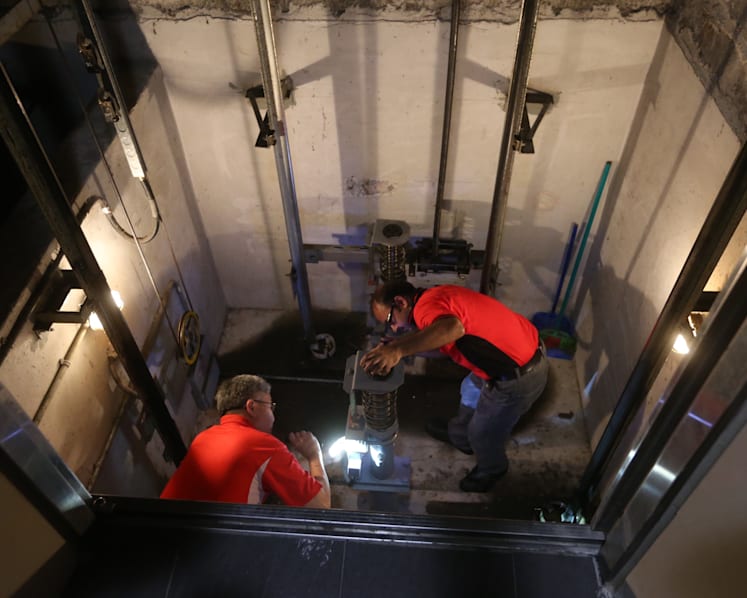
BCA engineers inspecting a lift pit. The BCA has set out 20 outcomes for contractors to check off during monthly lift inspections. Photo: Ooi Boon Keong/TODAY


SINGAPORE — More details of the outcomes that lift owners and contractors will be held to were spelt out by the authorities on Friday (July 8), down to the millimetre: For example, the distance between the lift car door panels must be 12mm before a lift can move.
And as these tougher maintenance standards kick in from July 25, some practitioners have voiced concerns on the shortage of manpower providing this labour-intensive service.
After announcing last month that lift upkeep standards would be tightened, the Building and Construction Authority (BCA) on Friday set out the 20 outcomes that lift contractors must check off during monthly inspections. The current standards list components to be maintained, but are silent on the standards to which maintenance is considered acceptable, the authority said.
It specifies, for instance, maximum distances allowed between lift car door panels, and between lift car doors and landing platforms.





Also, contractors must ensure that emergency stops are initiated immediately when lift landing doors are left opened or unlocked while lifts are moving. They must also ensure that abnormal sounds and vibrations do not occur when lifts move, ropes are properly and equally tensioned, and brakes or lift parts are not contaminated by oil or grease.
“Today, there are standards ... What we are doing is making it very clear, so they know exactly what to look (out) for,” said BCA chief executive officer John Keung in a media briefing on Friday.
The stricter maintenance regime comes after a spate of high-profile accidents in public housing estates. In May, a man died after he fell backwards and hit his head on the ground while reversing his motorised scooter out of a lift car that had stopped 15cm above ground level.
In response to TODAY’s queries, the BCA said that in the past five years, it has issued 93 notices to either maintain or suspend lifts. Since December 2013, it has received reports on 12 lift accidents resulting in injuries.
Dr Keung said the BCA has not identified specific suppliers or lift models that tend to compromise on safety, stressing that maintenance is “critical” even for “the best piece of machine in the world”.
The BCA has also doubled the number of lift audits — from 20 to 40 a month — to ensure that lift contractors are held accountable to the maintenance outcomes.
The authority will issue notices against unsatisfactory parties if minor rectifications are required, and suspend operations if safety of the lifts are compromised. In more severe cases, non-complying parties may also be prosecuted and fined up to S$5,000 if convicted of an offence.
From July 25, lift owners and contractors will have to notify the BCA of any incident involving death or injuries to passengers, or when critical components malfunction. Contractors must also set up adequate barriers when a lift is not operational.
Before lifts can be operated, owners must obtain a permit from the BCA after the lifts are examined, inspected and tested by an authorised examiner independent of the lift owner or contractor. From September next year, these renewable-yearly permits must be displayed prominently in the lifts.
Industry practitioners interviewed said the new regulations will hold contractors accountable to a benchmark, but Ken-Jo Industries managing director Kenneth Lim noted that a larger pool of practitioners is necessary to boost safety standards.
“Manpower is a big issue ... A lot of people think of lift maintenance as a dirty job ... If we have more manpower, you can have time to train people before they go into the field,” he said.
The firm’s maintenance team is about 20-men strong, said Mr Lim, with each technician examining up to five lifts a day, depending on the height of the buildings they serve.
Mr Ng Wee Keong, head of Operations and Technical Services at Mistubishi Elevator, agreed that the manpower crunch in the industry will intensify in coming years, noting that under current manpower regulations, only Singaporeans and Malaysians are allowed to take up the role of lift maintenance technicians.
“This resource pool is limited and will dry up ... We hope the authorities can open up other avenues (to recruit technicians),“ he said.
Training standards must also be enhanced, said Mr Ng, to ensure that maintenance is carried out properly and efficiently.
The BCA told TODAY that eight lift contractors here handle about 70 per cent of all the lift maintenance work.
In the second phase of its review on lift safety regulations — initiated more than a year ago — the BCA will look at building industry capability, such as by standardising basic training requirements for technicians and engineers.




