







Victims cheated of S$74,000 in phone scams, man jailed 2.5 years for role in operations
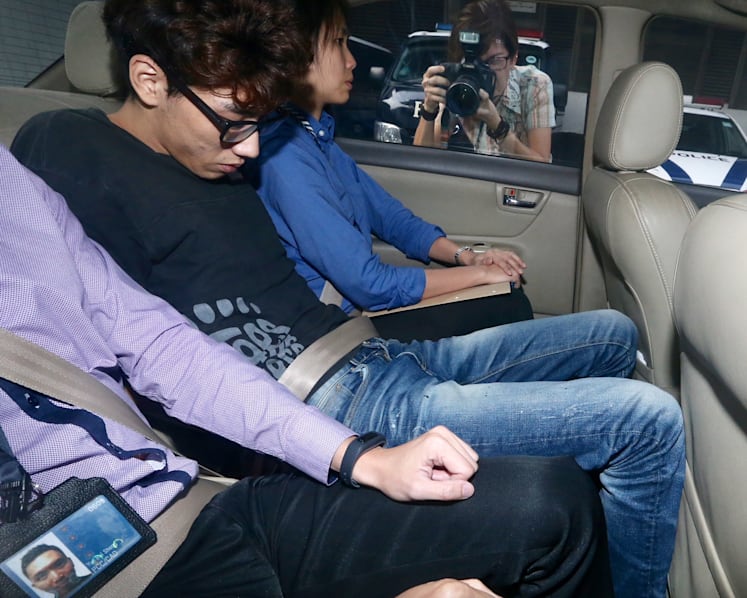
Huang Hsiang-Wei took instructions from his acquaintance, stood in as a lookout during the collection of money from the scam operation, and was promised cash for every transaction made.


SINGAPORE — A Taiwanese man came to Singapore in December last year to grab a “money-making opportunity” offered by an online gaming acquaintance, and ended up becoming a middleman in a series of impersonation scams here.
Huang Hsiang-Wei took instructions from his acquaintance, stood in as a lookout during the collection of money from the scam operation, and was promised cash for every transaction made.
For working as part of the syndicate, Huang was jailed 2.5 years on Thursday (Dec 27). He was convicted of abetting the commission of the offence, by collecting S$74,000 in scam proceeds on behalf of the acquaintance, referred to in court as Gao Fu Shuai.
Huang was caught at about 7pm on Jan 8 by police officers on foot patrol. He was waiting around People’s Park Complex in Chinatown to hand over the S$74,000 to a man called Jin Cheng Wu.





Investigations later found that the money was part of the amount taken from three victims.
Ms Truong Thi Trang, 31, a Vietnamese facial therapist, was cheated of S$43,900. Technical support specialist Lin Bing, 31, a Chinese national, was swindled of S$20,200, while Mr Wang Zhitian, 29, a student from China, was cheated of S$10,200.
The three victims were duped by the same method: An unknown caller would pretend to be a police officer from either China or Singapore, who told them that they were being investigated for money laundering or other offences. The caller told them that their bank accounts or bank cards were implicated in investigations and they should hand over the log-in data to their Internet banking accounts. Money transfers were then made from the accounts after access was given.
Huang entered the picture when he needed money and agreed to Gao’s invitation to take up a “profitable opportunity” to make some cash.
Gao booked him a flight to arrive in Singapore on Dec 25, 2017, and told him that he would be working with a Taiwanese named Hsu Lai-De, then 21. The two met at Taoyuan International Airport in Taiwan for the first time just before they flew to Singapore.
Huang was told that he and Hsu were supposed to collect cash from a designated location, and he would be paid S$300 to S$500 for each transaction.
On the morning of Jan 8, Gao gave instructions to Huang to say that the first collection would happen at around noon.
Huang’s role was to keep a lookout when Hsu collected the money from two victims-turned-mules, who were instructed by Gao to utter a Chinese code word “Chang Jiang San Xia”. Huang also forwarded pictures of these two persons to Hsu after he received them from Gao.
The victims-turned-mules were Ms Tan Guek Sim, a 47-year-old Singaporean who works as a mobile phone salesperson, and Ms Wu Jixin, a 27-year-old Chinese national who works as a childcare teacher.
The money from the three victims were transferred into the accounts of these victims-turned-mules, who were dishonestly induced by the callers to withdraw the money and hand them over to Hsu.
Hsu met Ms Tan twice at Sri Mariamman Temple along South Bridge Road at about 11.45am and 5pm to receive the cash. After Ms Tan said the code word, she was led to the back alley of Pagoda Street where she handed over the money which she received from two of the victims.
Hsu received the third victim’s money from Ms Wu at about 6pm.
Hsu absconded from Singapore that day, before police investigations began.
The identity and whereabouts of Gao are also not known.
In sentencing Huang, District Judge Shaiffudin Saruwan was not convinced by the arguments that he did not know what he did was illegal.
Huang’s lawyer Leon Koh argued that all the three money transfers were made on the same day, which happened to be the day his client found out that he was involved in an illegal undertaking.
However, Deputy Public Prosecutor (DPP) Alfie Lim told the court to consider Huang as a “pivotal conduit” in a fairly sophisticated criminal enterprise, in that he passed instructions from the scam syndicate to an accomplice, Hsu.
DPP Lim also pointed to the serious nature of the offence — it being a police impersonation scam, which he called “an egregious form of cheating”. He further noted that “confidence in public administration” was harmed in the process.




