







Vigilant staff key to preventing terrorist attacks: DPM Teo
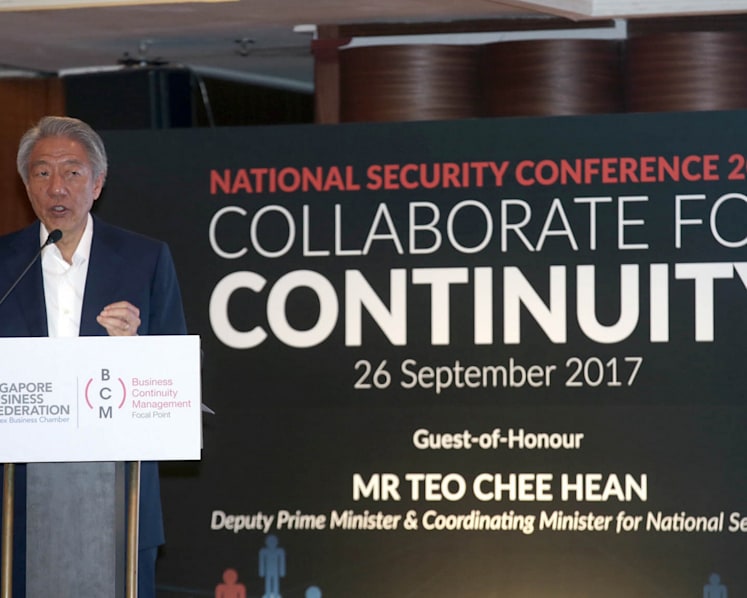
DPM Teo Chee Hean, who is also Coordinating Minister for National Security, launching a new SGSecure programme to expand outreach to businesses. He stressed the importance of employees who know how to react to a terror attack. Photo: Wee Teck Hian


SINGAPORE — Noting how Morgan Stanley’s contingency plans saved most of its 2,600 employees during the Sept 11, 2001, terror attacks in New York City, Deputy Prime Minister Teo Chee Hean yesterday stressed the key role that businesses can play in such scenarios.
Vigilant security officers and employees, as well as effective security systems and cameras, could prevent an attack, since would-be attackers often check a place out before striking.
If employees are “slack, your security guards are not paying attention, looking at (their) handphones”, businesses would make for easier targets, Mr Teo said at the National Security Conference.
Launching a new programme under the SGSecure movement to expand outreach to businesses, Mr Teo noted the importance of employees who know how to react to attacks.





“Deterrence is important because it may affect, in (a) terrorist’s mind, which target he chooses,” said Mr Teo, who is also Coordinating Minister for National Security.
The new SGSecure at Workplaces initiative will first focus on five sectors that handle high human traffic, such as retail and transport.
Workers will undergo training, simulation exercises and seminars, and the target is to have 57,000 companies on board by 2020.
Effective contingency plans can make a real difference. During the 9/11 attacks, financial services giant Morgan Stanley’s security director had urged colleagues in the World Trade Centre’s South Tower to immediately evacuate after the North Tower was hit.
The firm had been carrying out drills to ensure employees knew how to evacuate fast. As a result, most of its 2,600 employees left the building safely, said Mr Teo.
The casualty toll of the attack near Jakarta’s Sarinah mall last January could also have been worse, if not for alert personnel who stopped the perpetrators from entering the building.
“Therefore, the shootout occurred on the street outside … we may not be able to prevent an attack, but we can mitigate the injuries, the casualties, consequences,” said Mr Teo.
Businesses must also prepare workers to protect themselves and their colleagues in an attack.
The public service is taking the lead to train public officers in emergency preparedness.
It aims to familiarise all 145,000 public officers with improvised “press, tie, tell” first-aid skills, and with SGSecure’s “run, hide, tell” advisory, the Ministry of Home Affairs (MHA) told TODAY.
Three hundred public service “SGSecure mobilisers” have been trained, and they will brief and train their colleagues.
Agencies are also training employees in cardiopulmonary resuscitation and the use of automated external defibrillators, the MHA said. Mr Teo urged firms to register an appointed SGSecure representative with the Manpower Ministry, who will be the company’s point of contact in an incident.
Firms can team up with the community to raise vigilance and boost response to a crisis.
Mr Teo encouraged trade associations and companies experienced in business continuity planning to take the lead in the various industries. Businesses can help build cohesion and reduce the likelihood of social tension and security threats, he added.
Noting how tensions in the region, such as in south Thailand and Myanmar, have escalated into violence, Mr Teo said racial and religious harmony are Singapore’s key strengths.
Various institutions and laws help prevent conflict and keep communities together, he said, citing recent changes to the Elected Presidency scheme to ensure minority races are represented.
Singapore’s security measures and the alertness of its people can affect where terrorists choose to strike.
The Bangkok bomb blast several years ago was staged from Kuala Lumpur, and the attackers “could easily have chosen to come south (to Singapore), instead of going north”, he said.
“Let’s work together to keep ourselves safe ... and make sure that your company continues to thrive, prosper even in the face of these ... threats,” he said.




