







Told he could die in just months, this 27-year-old is 'more positive about life now'
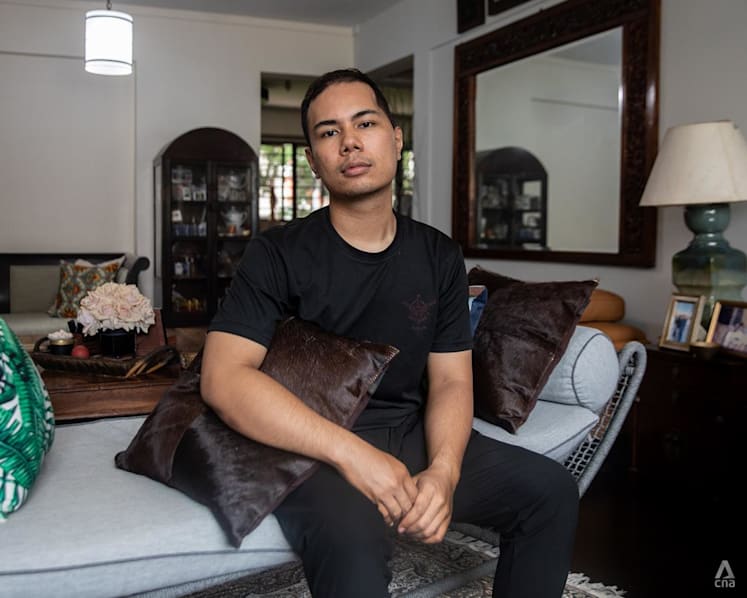
Mr Afif Yusli, 27, at his home on Nov 18, 2024. (Photo: CNA/ Ili Nadhirah Mansor)

This audio is generated by an AI tool.


SINGAPORE: Meeting Afif Yusli for the first time, it's not immediately obvious that he's sick, let alone battling a terminal disease.
The lean 27-year-old moves around nimbly, with no obvious signs of pain or discomfort.
And unlike what some might expect of a cancer patient, he has a full head of hair and is unencumbered by medical devices.
Initially soft-spoken and reserved, he warmed up after a while, revealing a boyish charm and a penchant for wry dashes of humour.
But as the conversation started to flow, it became noticeable how he would often stop mid-sentence and struggle to find the right expression.
“What is that word again? That thing they put you on when they take you out of the ambulance?”
“These days, I’m feeling quite … what’s that word? Not 'happy', it’s more 'okay-ish'.”
The film student was diagnosed with glioblastoma in April. It is a grade four brain tumour - the most aggressive and serious type - and has a poor prognosis.
According to the Glioblastoma Research Organisation, the average length of survival for patients is estimated to be 12 to 18 months after diagnosis.
Mr Afif's doctor gave him 18 to 24 months.
For someone looking death in the face, Mr Afif seemed remarkably accepting of his situation. In interviews, he spoke steadily, with emotion showing only when he spoke of his late grandmother and of leaving behind his aging parents.
“Sometimes, in the middle of the night, when it's quiet, it does come to me that I’m going to die,” he admitted.
“It’s super annoying and I wish I could stop that way of thinking, but I cannot and I feel sad about dying."
He smiled, dolefully, and shrugged.
“The scariest part is how fast and random this disease is … I don’t know when I’m going to have another seizure. It’s like a waiting game.
“I could just drop dead like that and I’m gone. It’s scary.”
"IT JUST FELT SO HEAVY"
Apart from difficulty finding words and occasional seizures, Mr Afif also suffers from vision problems, among other symptoms.
And some of these indications appeared as early as seven years ago, while he was doing National Service.
“I would get head pains and started to experience forgetfulness about a lot of things,” he said.
“It felt like someone was stabbing me in the head with a knife, and my room was always dark because I couldn’t even bear to see any light.
His symptoms worsened to a near-unbearable point, right before he started on a diploma at the Nanyang Academy of Fine Arts (NAFA) in 2021.
Yet Mr Afif still dismissed them as part of a fever or the result of stress.
It was only after suffering his first seizure in December 2023 – around four to five years after his headaches started occurring – that he decided to seek medical attention.
A magnetic resonance imaging (MRI) scan revealed a growth inside his brain.
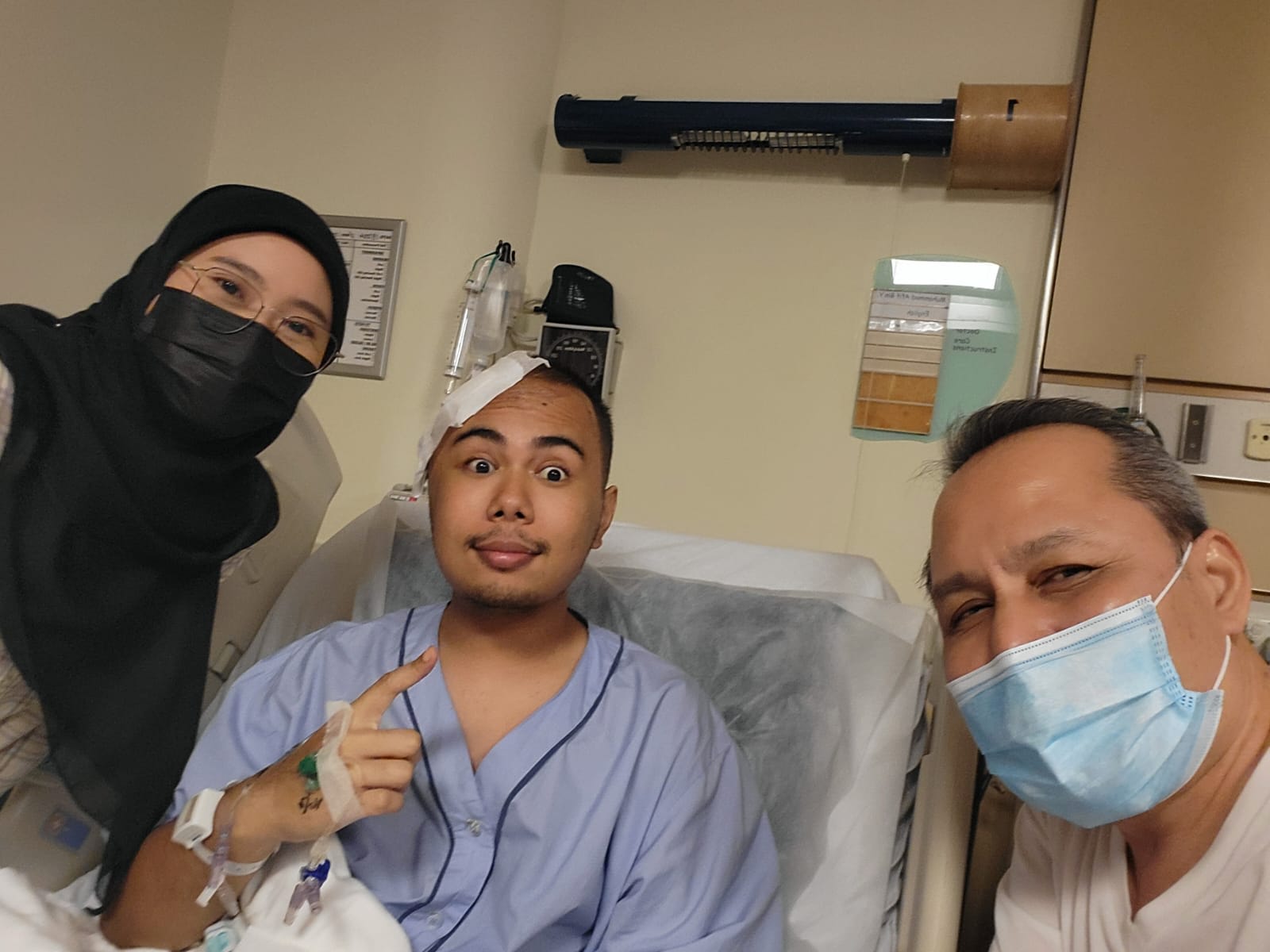
He went through surgery to remove the tumour but when he woke up, he had lost the ability to speak and walk.
A few days later, he underwent another operation to remove a blood clot in his brain, which was suspected to have caused the speech impediment.
With the help of a speech therapist as well as regular physiotherapy, Mr Afif slowly regained his abilities.
But there was bad news: Tests results confirmed he had glioblastoma.
“I couldn’t believe it because I was very active and fit at that point and when I read up about glioblastoma, it seemed like it was mostly old people who would get it,” he said.
Worse was to come when his doctor estimated that he had about 18 to 24 months to live.
“I didn't know how to react so I just said ‘damn’,” said Mr Afif. “I didn’t even look up to see the doctor or my dad, because he was probably crying ... It just felt so heavy.”
It was a trying period: His father had to go for a bypass surgery around the same time – and his grandmother, whom he was very close to, died shortly after.
Here, he wore a look of grief and had to pause to collect himself.
"She knew that I was sick and she was really sad," he said quietly.
"But she didn't really show it, she would just ask me if I was okay and how was I doing.
"I think she just didn't want to pile on to my fear and feelings."
"After she died, there was a day that I cried a lot over her, and that was the first time I got a seizure and the doctors told me it could be because of a build-up of emotions and sadness," said Mr Afif.
"Whenever I'm sad or depressed, I can feel my body starting to tense up, so I try not to cry. But sometimes, the pain of losing her still hits me at night.”
"So I just try to control how much I think about her so that I don't get too overwhelmed. It's hard … but if I let myself get too sad, I might get another seizure."
LETTING "ALL THE BAD FEELINGS GO"
The first two months following his diagnosis were the hardest, and darkest.
Mr Afif fell into depression and lost any hope he might have had of defeating the cancer.
“At first, I was counting down the days I had left,” he said.
“(I) would keep thinking about my cancer and about dying ... I would get scared because thinking about death can be very traumatising."
He also picked up smoking again.
"Because I thought ‘I’m going to die already anyway’,” said Mr Afif.
The continued support of family and friends, along with a renewed embrace of religion, pulled him out of the depths.
“I became more pious, started praying more and just tried to live a normal life even though I don't even know what's normal anymore,” he said.
“Having the support and good vibes from family and friends was like having a light at the end of the tunnel, so I started accepting my diagnosis and just let all the bad feelings go.”
“Instead of worrying about what happens next, I learnt to become more contented about things.
"For example, God gave me a second chance because I didn’t think I would be able to walk after my surgeries, but I can walk now,” he said.
“I'm also more positive about life now.”
Related:
Palliative care nurses give a peek into their work journeying with patients at the last mile
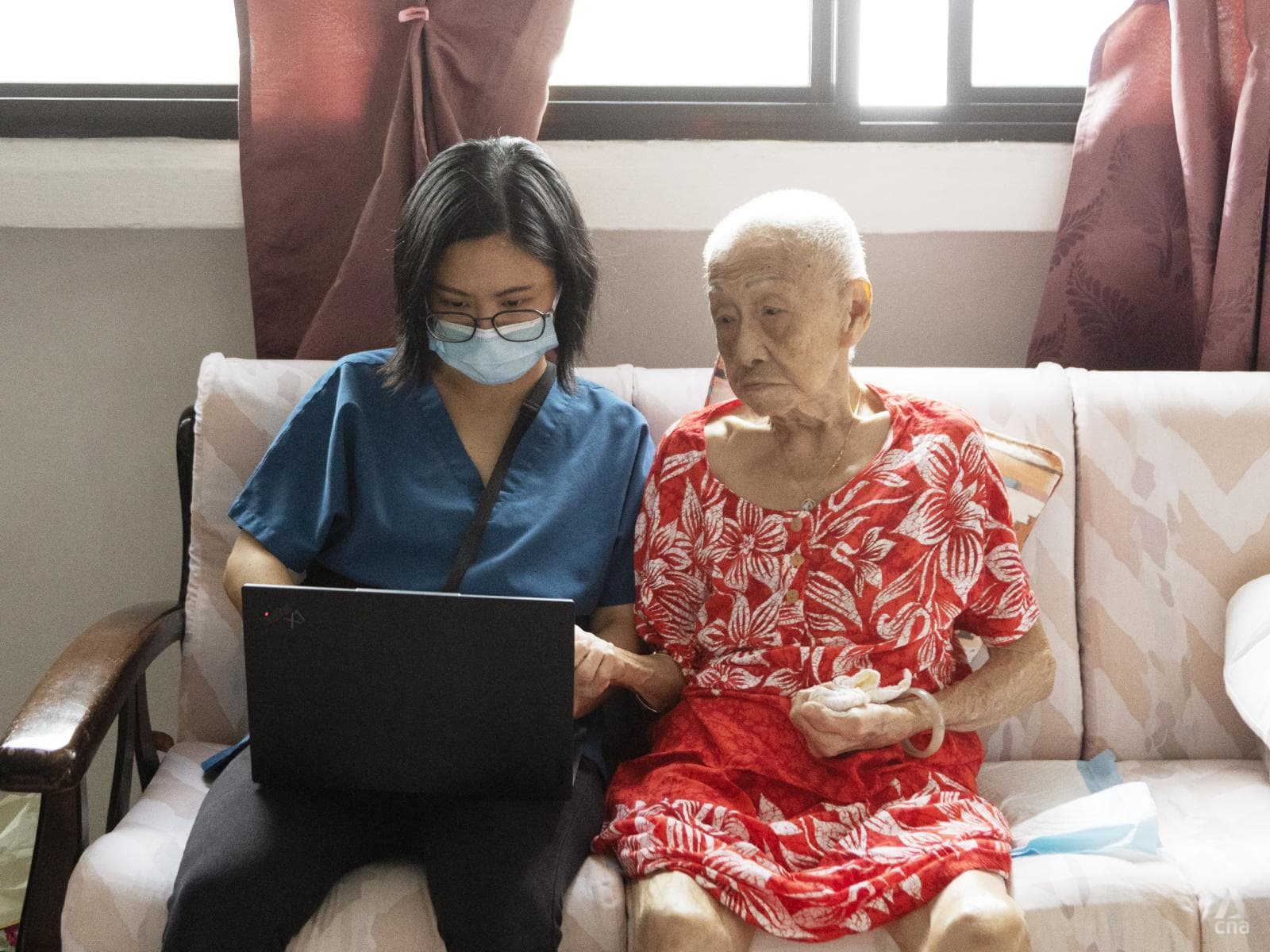
Ms Katherine Lim, a palliative home-care nurse, sitting with Madam Chua Swee Eng. (Photo: CNA/Raj Nadarajan)
The familiar melody of a Teochew opera caught the attention of 95-year-old Chua Swee Eng.
She glanced over at Ms Katherine Lim, 32, her palliative home-care nurse seated next to her, playing the song from her laptop.
The nonagenarian has advanced dementia and typically does not communicate much. Music is one way to make her feel at ease.
A simple nod or smile from Madam Chua would indicate that she is in a “good mood” that day.
In Pixels accompanied three palliative healthcare workers as they went about their task of caring for patients with life-limiting conditions.
They talked about the relationships they have built with their patients and how they support the patients' families as they navigate the difficult and painful journey of end-of-life care.
Palliative care is focused on relieving severe symptoms and it aims to provide as much comfort as possible to patients with terminal illnesses.
'A SENSE OF RELIEF'
Ms Lim has been visiting Mdm Chua one or two times a month for the last seven months.
The nurse from Dover Park Hospice checks on her vitals and the gangrene wound on her right leg.


Her visits provide much relief and reassurance to Mdm Chua’s daughter, who is her primary caregiver with assistance from a domestic worker.
The 64-year-old daughter who did not want to be identified said: “I feel a sense of relief when Katherine is here. I can reach out to her if I have questions."
Over the nine years that Ms Lim has been working in palliative care, she has built close bonds with her patients and their families.
She recalled an elderly patient who treated her 'like a granddaughter" and gave her a monetary gift in a red packet when she got married in September 2019.
She did not keep the money due to company policy, but kept the red packet envelope as a memento for the time she had spent with the patient, who died six months after she got married.
Dealing with death is an inevitable part of palliative care.
“The first death I witnessed when I first started, it was a bit scary because I was just on an outing with the same patient the day before," Ms Lim said.
“Eventually I felt that death itself could be a relief, knowing that the patient is free from suffering.”

PONDERING THE MEANING OF LIFE
Khoo Teck Puat Hospital's senior staff nurse Daniel Sii described one of his former patients Holman Liang as someone who was “stoic” and “wise”.
He was admitted to Yishun Community Hospital recently in August but died earlier this month.
The 90-year-old had gastric cancer and due to his age, the family had declined further invasive treatments and had opted for palliative care.

A railway engineer from China who moved to Singapore 30 years ago, the patient was a man of few words.
There were the occasional moments though, when he was chattier than usual, talking to Mr Sii about politics, history, his love for reading biographies or the meaning of life.
The senior staff nurse said: “When a patient shares a lot of things with me, like the meaning of life, there is definitely a bond. No one will simply blurt out things like that."
And if there was one piece of advice he took from the elderly patient, it was to never stop learning.
“I was impressed that someone his age would continue learning ... I admire that.”


It is not just the physical pains that Mr Sii has to tend to when minding the patients.
“The hardest part of my work is managing the emotions of the patients and their families. It is not uncommon for patients to say, ‘Give me a pill to die’,” Mr Sii said.
“Our role is to journey with them by offering physical and emotional support,” he added.
And sometimes, that means going out of the way to help patients be a part of important life events.
For instance, Mr Sii has helped arranged several marriage solemnisations at the hospital. Patients would otherwise not be able to leave the hospital and attend these events with their families due to their conditions.

WORDS TO A DYING MOTHER
Ms Hazeena Banu Shaik Alaudeen, 41, an assistant nurse clinician from Khoo Teck Puat Hospital, remembered caring for Mary (not her real name), a mother of three who had an advanced-stage cancer last year.
The patient was in a lot of pain and her husband was concerned about how their youngest child, a seven-year-old boy, would react after seeing his mother in such a frail state.
With the help of a social worker, Ms Hazeena encouraged the soft-spoken boy to pen down what he had said to his mother.

In the letter, the boy expressed how much he loved his mum, how he would be strong and that his aspiration is to be a policeman.
Ms Hazeena, who has three children similar in ages to Mary's children, said: “The ‘I love you’ in the note was important and I felt it was a closure for Mary."
The mother later died.
Having been in palliative care for 14 years, Ms Hazeena said that this is what she has learnt from her patients: “We don't know if we are around the next day, so we live each day and appreciate the people around us.”

"I'M ACTUALLY QUITE CONTENTED"
The fear of death, and how the odds are seemingly stacked against him, still creeps in every now and then for Mr Afif.
It's prompted him to start thinking about end-of-life practicalities.
“I did tell my mother that if my cancer worsens, and the doctor says there’s no way surgery can happen, I wanted to go to hospice because it’ll be easier on everyone,” he said.
“That way, the family can do their own things too. I just don’t want to disturb their peace.
“But to be honest ... you don’t know when you’re going to die, it could take months or just a few days.”
With his mother quitting her job to care for him and his younger brother still studying, his father and younger sister are the breadwinners of the family, earning a total of around S$3,000 (US$2,200) a month.
To raise money for future hospital bills, medical treatment - including chemotherapy and radiotherapy - as well as general living expenses, Mr Afif set up a crowdfunding page in August.
As of Nov 21, he has raised about S$4,000 out of a S$35,000 goal.
Mr Afif meanwhile has busied himself by setting out to finish his film diploma course, which was put on a year-long hold so that he could focus on his cancer treatment.
He will resume studies in January and is due to graduate in April.
On the side, he's also working on a film loosely based on his life, with the aim of raising awareness of the challenges faced by young cancer patients - and to give them hope.
But the priority remains family, and to spend as much time as he can with them. They recently holidayed together in Malacca and Kuala Lumpur.
“We’ve definitely grown closer,” said Mr Afif.
“Last time, before I got sick, we all used to be so busy and I would come home late so I wouldn’t really spend much time with them.
"But now we all talk more, and we sit down to have meals together. It’s nice.”
What clearly pains him most is the prospect of leaving his aging parents behind.
“I am quite worried about them, especially my dad, who is also sick,” said the eldest of three children, citing his father's heart condition.
He went quiet for a few seconds, deep in thought.
“I told my younger brother and sister that if I were to go, they have to take care of Mama and Papa," he said.
“My parents did so much for us, they worked hard, gave us food every day and a bed for us to sleep in.
"I want them to be looked after, even if I die first.”
His mother, who had been sitting nearby and using her phone, reached for a tissue.
Visibly overcome, she silently wiped the tears welling in her eyes and took a breath.
With his back to her, Mr Afif never saw any of that.
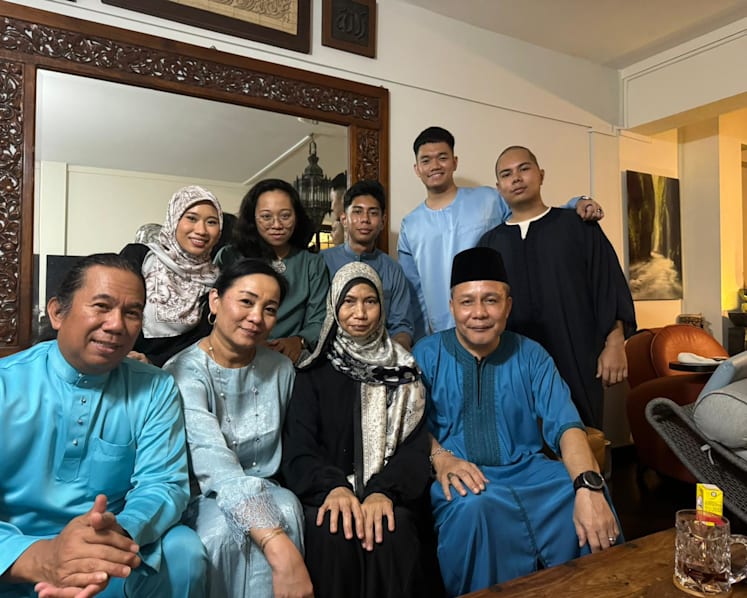
Sitting on the sofa at his family home, he’s relaxed and smiles when asked if he was angry about the card he's been dealt.
“No, I’m not. I’m actually quite contented with what I have, looking around in the world, what's going on, and me being able to do the things I want to do, and having my family," said Mr Afif.
“Whatever happens, happens. If God wants me earlier, he’ll take me. If he wants to give me more tests, I’ll take the tests.
“Even if I go off fast and early, I don’t think I’ve been robbed of time. I think I have been given time."
In the next parts of the series, Mr Afif's mother tells CNA what it's like to take care of someone with a terminal illness; before Vanessa Lim speaks to people helping such patients live meaningfully.




