







Worse Covid-19 economic fallout ahead despite S’pore’s better-than-expected Q1: MTI, economists
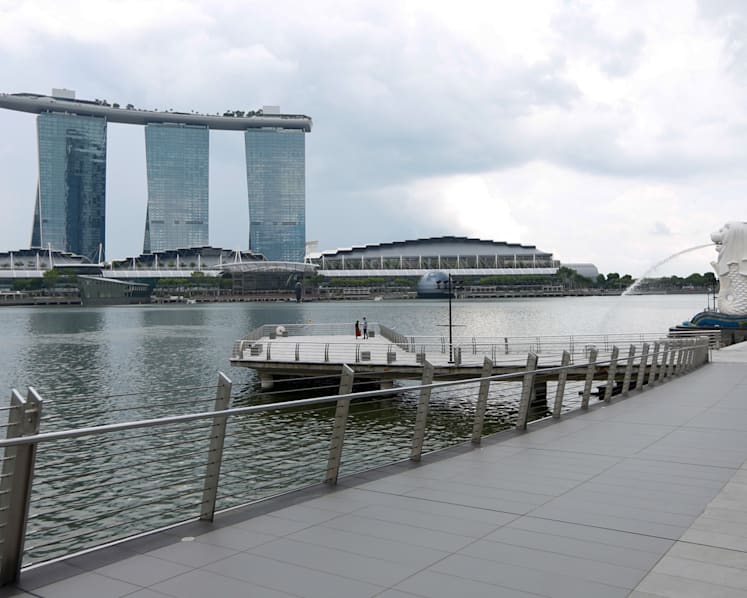
Economists believe Singapore's economy will shrink quite dramatically in the second quarter of 2020 ending June 30, when measured against the first quarter.


SINGAPORE — Singapore is not in a recession for now, clocking a better-than-expected 0.7 per cent contraction in the first quarter compared with the same period a year earlier. The Ministry of Trade and Industry (MTI) had earlier expected a 2.2 per cent slide in the first quarter — the three months ended March 31.
However, both the authorities and economists said that the worst is yet to come as the full economic impact of the Covid-19 pandemic will be felt only in the present second quarter, which takes in the temporary halt of non-essential economic activities in April and May during the circuit breaker period. The second quarter ends June 30.
The circuit breaker, which started on April 7 and is expected to ease from June 2, saw schools and most workplaces closed as part of the Government’s efforts to curb the spread of the coronavirus.
Addressing the media upon the release of Singapore’s first-quarter economic performance figures delivered via teleconferencing platform Zoom on Tuesday (May 26), MTI’s economics division director Yong Yik Wei said that the ministry expects the impact of Covid-19 to be the most severe in the second quarter.





At the same conference, Mr Terrence Ho, divisional director of manpower planning and policy at the Ministry of Manpower, said that despite unprecedented sums being spent by the Government to support the jobs of Singaporeans, more retrenchments are likely on the way.
On a quarter-on-quarter basis, adjusted for seasonal factors and so forth, the economy shrank a hefty 4.7 per cent in the first quarter, though that was less than half the 10.6 per cent nosedive MTI had anticipated in an earlier forecast.
The economy expanded 0.6 per cent in quarter-on-quarter terms in the three months ended Dec 31, 2019.
This means that Singapore is not in a “technical recession” yet as economists generally regard that as having occurred when a country records two consecutive quarters of contraction in quarter-on-quarter terms.
Ms Selena Ling, OCBC bank’s head of treasury research and strategy, said that the better-than-expected performance, which was partly due to the manufacturing numbers in March, is “mostly water under the bridge” though.
“(The first quarter’s improved performance) doesn’t change the picture that the second quarter will be bad because of the circuit breaker. That was when most of the lockdown around the world also happened. Growth momentum is going to get a lot worse.”
She projects that the economy will contract by between 15 and 20 per cent in the second quarter compared with the same period last year, while Mr Irvin Seah, senior economist with DBS bank, is less downbeat, saying in a research note on Tuesday that he expects a contraction of about 8 per cent — still grim but not nearly as bad.
Ms Ling predicts an eye-watering 50 per cent plunge in economic output, in quarter-on-quarter terms, in the second quarter. That is the figure that is consistent with a 15 per cent year-on-year fall.
Given Mr Seah’s less pessimistic view of the year-on-year figure, he expects Singapore’s economy to contract 27 per cent — still a very large number — in the second quarter, when compared with the first quarter, that is, in quarter-on-quarter terms.
If those forecasts prove correct, and indeed if Singapore’s economy contracts at all in the second quarter as compared with the first quarter, it would officially be in recession when the official MTI second-quarter figures are made public.
However, most economists would have little doubt that the economy is already in recession, for all practical purposes, leaving aside the conventional definitions and so forth.
“Significantly weaker global demand, a labour shortage in the construction sector, supply-chain disruptions and restrictive measures imposed during the circuit breaker will inflict a severe blow to the economy,” Mr Seah said.
On Tuesday, the Ministry of Trade and Industry (MTI) further downgraded its growth forecast for Singapore despite the improved numbers, with the economy expected to contract between 4 and 7 per cent — the worst recession on record if it comes to pass.
This downgrade is the second in two months. In March, the ministry projected a contraction of between 1 and 4 per cent.
MTI said that significant uncertainties remain in the global economy owing to risks of new waves of infection that could disrupt economic activity further. Circuit breaker measures in Singapore have further dampened the domestic economy and buying by consumers, it added.
Mr Brian Tan, an economist at global banking giant Barclays, said that the better-than-expected first quarter is not going to offset the worsening outlook since MTI’s earlier projections issued in March.
Ms Yong from MTI said that the ministry expects the economy to gradually recover in the second half of the year, although this relies on other countries bouncing back as well.
For the purposes of making a forecast, MTI worked with the assumption that there will be no significant spikes in community infections of Covid-19 in Singapore with the planned easing of the circuit breaker, she added. That does not mean that MTI has taken a view on possible spikes but rather that when making forecasts, it is necessary to build in some assumptions.
Although Singapore’s Covid-19 case numbers have surged in recent weeks, the vast majority of cases are contained within migrant workers' dormitories, which have effectively been sealed off from the wider community. The workers have been provided with medical support and enhanced hygiene measures.
“While there is a gradual recovery in the second half, you could still expect to see possibly negative year-on-year growth rates even in the second half of the year,” she said.
Support measures from the national budget and two supplementary ones have so far been able to cushion the impact of Covid-19 on the labour market, but Mr Terrence Ho, divisional director of manpower planning and policy from the Ministry of Manpower (MOM), said that the labour market will worsen, with more retrenchments likely to be on the way.
Deputy Prime Minister Heng Swee Keat, who is also Finance Minister, on Tuesday unveiled fresh job support and other measures in a third supplementary budget so far this year, the Fortitude Budget, with projected extra spending of S$33 billion.
MTI’s permanent secretary Gabriel Lim said: “We want to make sure that even as we save lives, we are also saving likelihoods and making sure that Singaporeans, our workers and everything are looked after.”




