WP introduces manifesto; calls for minimum wage
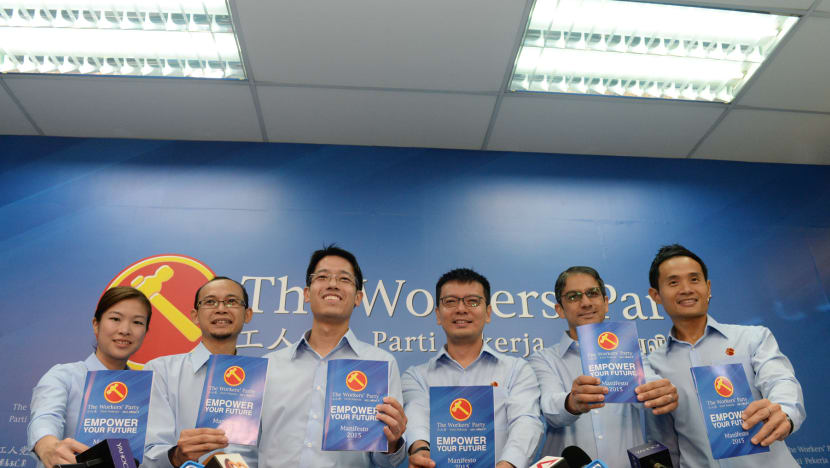
The WP press conference will start at 2.30pm. Photo: Ng Jing Yng/TODAY




SINGAPORE — The Workers' Party (WP) has called for a minimum wage to benefit more low-wage workers, among other proposals put forth it's manifesto released today (Aug 29).
It also launched a mobile app 'WP News' to allow the public to access updates and candidates' information on the go.
During a press conference at the WP headquarters, central executive council member Gerald Giam presented the 48-page manifesto, which contains over 130 policy proposals.
Presenting with him were the party's new potential election candidates, including Ms He Ting Ru, Mr Leon Perera, Mr Mohamed Fairoz Shariff, Dr Daniel Goh and Mr Kenneth Foo. Apart from Ms He and Dr Goh, the rest of the panel has not been formally introduced as candidates.





Explaining why WP thinks it is timely for Singapore to have a minimum wage model, Mr Giam noted that party members deliberated at length and took reference from other countries like Hong Kong, which recently implemented a minimum wage.
While the WP has previously advocated for a minimum wage, and agreed wages must rise in tandem with productivity, Mr Giam noted that productivity levels here have not risen in the last four years.
As such, a minimum wage model will “prevent the lowest income from being exploited” if the low productivity trend continues.
The idea of a minimum wage was hotly debated in 2013. Last year, the Progressive Wage Model for the cleaning sector came into effect, and similar models will take effect for the security and landscaping industries.
When asked about the Progressive Wage Model and possible pitfalls of a minimum wage model, Mr Perera, an Oxford-trained research and consulting firm chief executive explained that the minimum wage would be able to cover more people, beyond the selected industries.
He added that the WP’s proposal is to peg minimum wage at the average household expenditure of basic needs – starting at 20 per cent – before gradually increasing over time and tracking net job creation concurrently.
The model could encourage employers to invest in their workers to raise productivity while also inducing people to return to the workforce, drawn by the higher wages.
Said Mr Perera: “If wages are too low, we could have the perpetuation of a poverty cycle within the family and that will also drain fiscal coffers in terms of social safety nets."
POLICY PROPOSAL IN THE WP MANIFESTO
The over 130 policy ideas in the WP manifesto included a mixture of past and updated policy proposals.
The changes take into account policy and population changes since the 2011 General Election, while some proposals raised previously were retained as they “are still quite relevant”, said Mr Giam.
The manifesto was also a result of four years of research and was approved by the central executive council, he added.
The manifesto is organised by chapters: Focusing on the Singapore Core; Confident Workers and Enterprises; Aspiring Students and Families; Our City, Our Home, Co-created; Governance for Solidarity; Active Diplomacy, Confident Defence.
The WP is proposing a “pro-Singaporean immigration policy” to give foreign spouses of Singaporeans priority for citizenship. It also called for an increase in female labour force participation through targeted training and job-matching schemes.
“This group of women is trying to get back into the market place but lack the confidence and skills," said Dr Goh. “The question is whether we can focus excessively on (bringing women back into the workforce) instead of depending on the easy way out which is immigration."
In terms of wage security, the WP is seeking for a mandatory unemployment insurance scheme similar to other countries and proposed that any increase in GST be a last resort.
To help students and families, policy suggestions a comprehensive study to track the well-being of teachers to reduce attrition rate, and capping the number of casinos here to two.
The WP also reiterated other proposals, including having the Government run the public transport and abolishing the Group Representation Constituency system.
NEW FACES PRESENTING THE MANIFESTO
Unlike past occasions such as the 2011 General Election where chairman Sylvia Lim launched the party’s manifesto, five new faces besides Mr Giam presented the GE2015 manifesto.
Mr Giam said WP operates as a team and allowing new members to present the manifesto provides the opportunities for them to talk about and defend party policies.
When it was pointed out that party leaders launching the manifesto could possibly lend more weight to the policy ideas, Dr Goh told reporters that WP chief Low Thia Khiang has said that younger members have to play their part as well.
“Mr Low tells me all the time, you guys (new members) are the future of the party, you cannot depend on us all the time to do time, we need to empower you to empower the future of the party,” said Dr Goh, in reference to WP’s election slogan “Empower Your Future”.
In a tweet sent by WP during the press conference along with a #EmpowerYourFuture, the party said WP chairman Sylvia Lim was listening to the launch of its manifesto in the headquarters' backroom, who noted that the manifesto was being presented "by a team whose average age is 38".
When asked about the importance of identifying new policy ideas in WP’s manifesto to show its contributions to the Singapore society, Mr Giam also said the party value-adds not just by providing new proposals.
“Policy making is not so simple, such that we just have old ideas and new ideas, and nothing in between,” said Mr Giam. “We are not in the business of wholesale throwing out everything that this current Government is doing and introducing our new set of ideas. I don't think that will be responsible and I don't think that is very wise.”
Adding the one can find “bright new ideas” in many places such as through academic papers, he said the party adds value by understanding the ground and policies, as well as pushing through ideas in Parliament.
“Without a credible (and sizeable) slate of Opposition MPs, I don’t think you can expect a lot of ideas to be pushed through,” said Mr Giam.
The Workers' Party's key proposals
· Increase workers’ incomes through a national minimum wage pegged to average household expenditure on basic needs
· Enhance retirement adequacy by receiving monthly CPF payouts earlier
· Implement a more holistic and equitable education system through measures like a 10-year through-train programme
· Improve public transport quality and affordability by getting the Government to own and manage trains and buses
· Make public housing more affordable and accessible by pegging HDB BTO prices to median monthly household incomes of applicants