







WP’s MPs had reasons for paying S$2.8m more to get costlier architect, their lawyer says
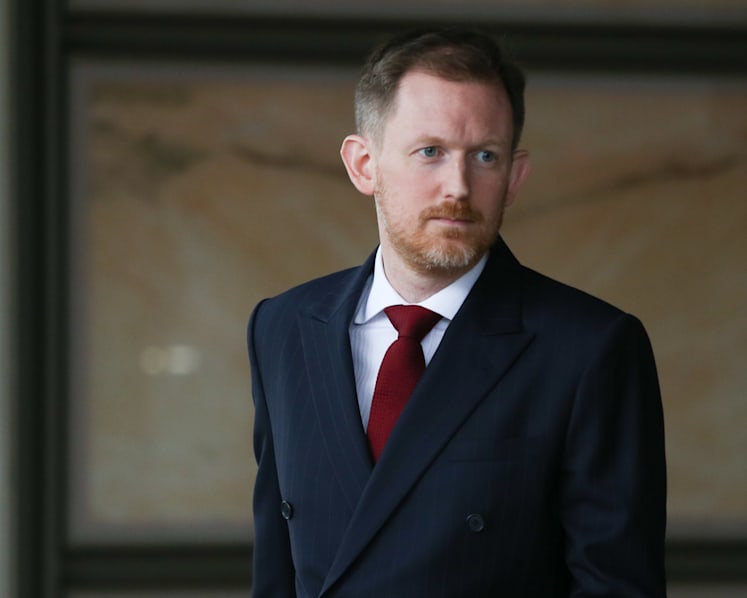
Mr Owen Hawkes, forensic partner with audit firm KPMG, was cross-examined in court on Oct 9, 2018, regarding his report on “improper” payments made by the town councillors of Aljunied-Hougang Town Council.


SINGAPORE — The town councillors of Aljunied-Hougang Town Council (AHTC) chose the more expensive services provided by LST Architects in seven instances and paid close to S$2.8 million more because they had reasons to suspect that a less costly architect was not prepared to carry out works without negotiating for a higher fee later.
Senior Counsel Chelva Rajah said this on Tuesday (Oct 9) when building his case that Members of Parliament (MPs) from the Workers’ Party (WP) did not make “improper” payments to AHTC’s third-party service providers.
MPs Low Thia Khiang, Sylvia Lim and Pritam Singh, who run AHTC, are facing trial to account for wrongful payments allegedly made to the town council’s service providers and then-managing agent between 2011 and 2015. Both AHTC and the Pasir-Ris Punggol Town Council (PRPTC) filed lawsuits against them.
Giving details of what the MPs had to consider, Mr Rajah said that the lower-cost architectural firm Design Metabolists (DM) had asked for “more than double” the amount that was agreed upon in 2010, after winning a tender as part of the S$7.8-million Eunos Spring neighbourhood renewal programme. The tender was awarded was when the town council was run by the ruling People Action’s Party, but payment for the service was made after WP took over.





DM at first quoted a fee equivalent to 3.5 per cent of the works carried out, but later raised it to 7.5 per cent.
“It may well be that DM was not prepared to carry out works at a fixed fee, and (would seek) to renegotiate… it had certainly happened before,” Mr Rajah said when cross-examining Mr Owen Hawkes, forensic partner with audit firm KPMG, who flagged the payments as “improper” in the first place.
The accountant on Tuesday reiterated his point that the payments to LST Architects were improper as the Town Council Financial Rules had required AHTC to choose DM since it was cheaper, unless there were “exceptional circumstances” to justify its choice.
As for Mr Rajah’s latest revelation of DM’s supposed track record, Mr Hawkes did not hear that reasoning when AHTC was told of the criticisms regarding LST Architects’ appointment, before a report was published on Oct 31, 2016 about the improper payments.
Mr Hawkes said he was just told that DM was “being slow” — echoing what he wrote in the KPMG report that AHTC had explained that despite its low price, DM was “busy” with two neighbourhood renewal projects, which were noted to be “slow-moving”.
At this point, Mr David Chan, the lawyer representing an independent panel acting on behalf of AHTC, said that Mr Rajah was not presenting the pleaded defence that he had earlier declared. Mr Chan recalled that Mr Rajah had said he would argue that LST Architects was “significantly more efficient”.
“(And now) he is suggesting that DM will be more expensive than LST if given another chance to tender.”
Questioning Mr Rajah’s assertions as well, Justice Kannan Ramesh said: “You can’t rely on what happened in 2010… as indicative of how (you) would have reacted to a particular transaction.”
Mr Rajah then restated his point that there had been a precedence that DM charged a “much higher fee” than it initially quoted.
PAYMENTS NOT CERTIFIED
Among the payments highlighted by the KPMG’s report was the sum of S$194,759 which was “unsupported by certifications of services received, or contracts” between May and July 2011.
This was during the transition period after WP took over Aljunied Town Council from the PAP after the General Election in May and before its then-managing agent CPG Facilities Management was officially dismissed with a deed of mutual release.
The town council was later renamed AHTC after merging with the WP-run Hougang Town Council. Its new managing agent, FM Solutions and Services (FMSS), was incorporated on May 15 in 2011, and was to manage and oversee the daily operations from July 15, 2011 onwards.
Mr Rajah explained that S$109,559 of the S$194,759 was paid as managing agent fees for the Hougang division of AHTC for the whole month of June.
Again, Mr Chan raised an objection that Mr Rajah’s point was not in his pleaded case, with Senior Counsel Davinder Singh, lawyer for PRPTC, pointing out that documents supporting Mr Rajah’s latest defence should have been disclosed even if he wanted to add it to his pleading.
Mr Singh said: “If (what Mr Rajah said) had happened, then the question (arises) of who gave FMSS the authority to make payment for the first 14 days (before FMSS issued a letter of intent to AHTC on June 15, 2011 to take over all of Hougang Town Council’s employees).
“And this goes to show the complete lack of control systems and checks and balances.”
Mr Rajah, however, said that the invoice for S$109,559 included payment for the first half of June, as they needed to make a “reimbursement" to FMSS for services rendered by Hougang Town Council employees, which was supposed to be paid by the Hougang division of AHTC.
PAYMENTS FOR ESSENTIAL SERVICES
Another set of payments raised in the KPMG report was S$88,200 for three months’ worth of services by the Essential Maintenance Service Unit (EMSU). This is a 24-hour service provided by town councils to attend to residents’ urgent and maintenance requests such as breakdown in water and electricity supply or lift failures.
Mr Rajah pointed out that this sum was a fixed fee payment made under a five-year contract between Hougang Town Council and contractor FM Solution and Integrated Services (FMSI), which had been in effect since 2007.
FMSI was a sole proprietorship registered by the late Danny Loh, the husband of Ms How Weng Fan. The couple, who were owners of FMSS, are also defendants in the lawsuits brought by AHTC and PRPTC.
In court, Mr Hawkes said that notwithstanding the EMSU services carried out, the payments were in breach of Rule 61 of the Town Council Financial Rules, which stated that there shall be “certification” that work done was properly done as in the terms of the agreement.
He said: “If services were (delivered) at contractual rate, (there is) no specific loss to AHTC, but if not satisfactory, we cannot tell, that’s why we raised it as improper payment under definition of improper payment in this report.”
As for another S$80,990 deemed be improper payments to FMSS, they were issued without the co-signatures of either the chairman or vice-chairman of AHTC.
Referring to Section 33 of the Town Council Financial Rules, which stated that cheques not exceeding S$50,000 may be signed by the town council’s secretary and an officer authorised by the town council, Mr Rajah argued that the five payment amounts — ranging between S$620 and S$40,898 — should not require the co-signatures of the chairman or vice-chairman.
Mr Rajah is expected to wrap up his cross-examination of Mr Hawkes when trial resumes on Wednesday. The lawyer of Ms How, Loh and FMSS will cross-examine Mr Hawkes next.
TWO DIFFERENT CASES OF A CONFLICT OF INTEREST
On Tuesday, Senior Counsel Chelva Rajah quizzed Mr Owen Hawkes, forensics partner with audit firm KPMG, on his definition of a “conflicted person” and whether that would cover Mr Jeffrey Chua.
Mr Chua was both secretary and general manager of Aljunied Town Council when it was under the ruling People’s Action Party, and he was also the managing director of CPG Facilities Management — the managing agent of the same town council before the Workers’ Party took over.
Mr Hawkes’ answer? Mr Chua does not fit the definition of a “conflicted person”, or a person whose position and duties would bring on a conflict of interest to the effect that they would be approving payments to themselves.
He stood by his opinion despite Mr Rajah telling the High Court that Mr Chua held hundreds of shares with Downer EDI Ltd, which was “the ultimate shareholder of CPG”, thereby giving him a “profit motive”.
Mr Hawkes said that it is “hard to judge” without knowledge of the proportion of his shareholding, because the “largeness or smallness” of that is important to determine where he falls in the “spectrum” of a conflict of interest.
“Stronger conflicts require stronger controls,” Mr Hawkes told the court.
On the other hand, Mr Hawkes sees the appointment of Ms How Weng Fan and her late husband Danny Loh as problematic. They were owners of FM Solutions and Services (FMSS), which was appointed the managing agent of Aljunied-Hougang Town Council (AHTC). They were also the town council’s deputy secretary and general manager (Ms How), as well as secretary (Loh).
He classified them as “conflicted persons” because they have “direct ownership interests” in FMSS. Loh held 50 per cent of FMSS’ shares and Ms How held 20 per cent when the company took over the management of AHTC on July 15, 2011.
When Mr Rajah charged that he “tailor-made” his definition of “conflicted persons”, Mr Hawkes explained that if Ms How never held shares, and if they were held by Loh, Ms How would still be holding a conflict of interest.
“(In the spectrum of conflicts, the conflict would be) so severe that no control can manage the control involved. If you are a direct shareholder, you are further (up the severity) on the spectrum than others,” Mr Hawkes said.
Mr Rajah then asked him if he would consider Ms How a “conflicted person” if she were just the wife of a shareholder.
Mr Hawkes replied: “It is relevant to raise (that) if Mr Loh owns 100 per cent (of the shares), in a single family unit, the money that goes to him, goes to her.”
He added that the question is not solely on the severity of the conflict of interest, but also how the conflict is being managed.
Mr Rajah then asked again if he would consider a person such as Mr Chua to be a “conflicted person”, since he has a “profit motive” in the managing agent doing well, and is also an officer of a town council.
To this, Mr Hawkes said: “The danger here is that you are trying to create a binary."
He added: “The conflicted person definition (was) to describe individuals who had ownership interest in FMSS or FMSI (FM Solutions and Integrated Services).
“(It is not a matter of) if you are in the bucket, you are conflicted, (and) if out of the bucket, you (have) no conflict… but that there are people who are on the more severe end of the spectrum.”
Sign up for TODAY's WhatsApp service. Click here:




