







With recycling rates dipping, Singapore to review master plan to extend Semakau landfill's lifespan
The review will begin in the coming months and is slated to conclude in 2027.

An aerial view of the south side of Semakau landfill, which is more than half full. (Photo: NEA)

This audio is generated by an AI tool.


SINGAPORE: Amid a decline in overall recycling rates, the government will conduct a review of the Zero Waste Masterplan to seek out new methods to boost recycling outcomes and extend the lifespan of Semakau Landfill beyond 2035.
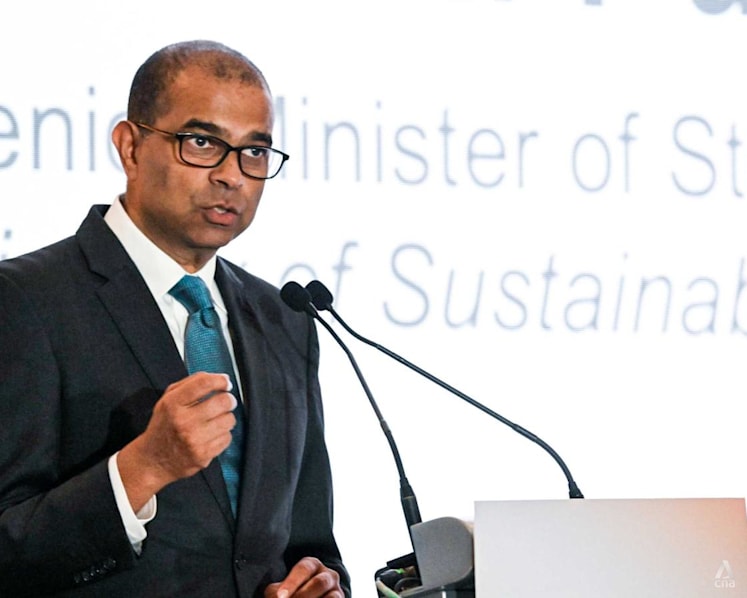
The review will take stock of Singapore's progress since the master plan was launched in 2019 and identify new ways to accelerate the country's shift towards a circular economy, said Senior Minister of State for Sustainability and the Environment Janil Puthucheary on Wednesday (Jun 17).
Expected to be completed in 2027, the work on the review is set to begin in the coming months, with the Ministry of Sustainability and the Environment (MSE) and National Environment Agency (NEA) engaging the public, industry and non-governmental organisations on ideas and proposals, said Dr Puthucheary.
"What I describe as Zero Waste Masterplan review is not simply a government blueprint refresh, it's an invitation for all of us, every Singaporean, to help shape how we live in the decades ahead," he said.





He was speaking at Catalyst 2026, an event organised by NEA that was attended by about 300 industry leaders, experts and policymakers in the environmental services sector.
In his speech, Dr Puthucheary cited how Singapore recycling rates have dipped from their 2019 levels.
Singapore's overall recycling rate in 2025 was 52 per cent, inching upwards from the 50 per cent in 2024, according to a separate NEA press release on Wednesday.
Nevertheless, the 2025 rate remains below the 59 per cent recorded in 2019, when the master plan was first launched with the goal to raise Singapore's overall recycling rate to 70 per cent by 2030.
The 2019 master plan also sought to raise the domestic recycling rate from 17 per cent in 2019 to 30 per cent by 2030, as well as to raise the non-domestic recycling rate from 73 to 80 per cent in the same time period.
However, the 2025 domestic recycling rate is 11 per cent - unchanged from 2024, and the non-domestic recycling rate was 67 per cent in 2025, up from 65 per cent in the previous year, according to NEA's latest data.
Domestic waste refers to waste collected from households and trade premises such as shophouses, hawker centres and educational institutions. Non-domestic waste refers to waste generated at industrial and commercial premises.
Dr Puthucheary said: "We have to have an honest examination of these numbers."
Pointing to significant shifts in the "global economics of recycling", Dr Puthucheary said recycling has become harder to sustain commercially due to disruptions in logistics, volatile commodity prices and tighter import restrictions.
He added that paper prices have been "significantly depressed" while demand for recycled plastics has been "difficult to secure".
"This is precisely why a review of the Zero Waste Masterplan is necessary and timely, and why we are approaching it with fresh eyes," Dr Puthucheary said.
Noting that 2026 has been designated as the year of climate adaptation, Dr Puthucheary said "uncomfortable realities" should be confronted with "ingenuity and resolve".
"Climate change, resource constraints and the need to do more with less — these are not peripheral concerns. They are central to the story, and no single agency or organisation can solve them alone," he said.
WHAT THE REVIEW WILL COVER
In this regard, domestic recycling will be a "priority" in the review, said Dr Puthucheary.
A key part of the review will examine how Singapore can recover "cleaner, less contaminated" recyclables, he added.
As part of this focus, the government will be reviewing the National Recycling Programme to improve the effectiveness and volume of recyclables recovered from households.
The programme was launched in 2001 and involves a network of recycling bins and collection services provided at residential areas under the public waste collection scheme.
The recycling bins, also known as the blue bins, will be part of the review, NEA said during a briefing for reporters.
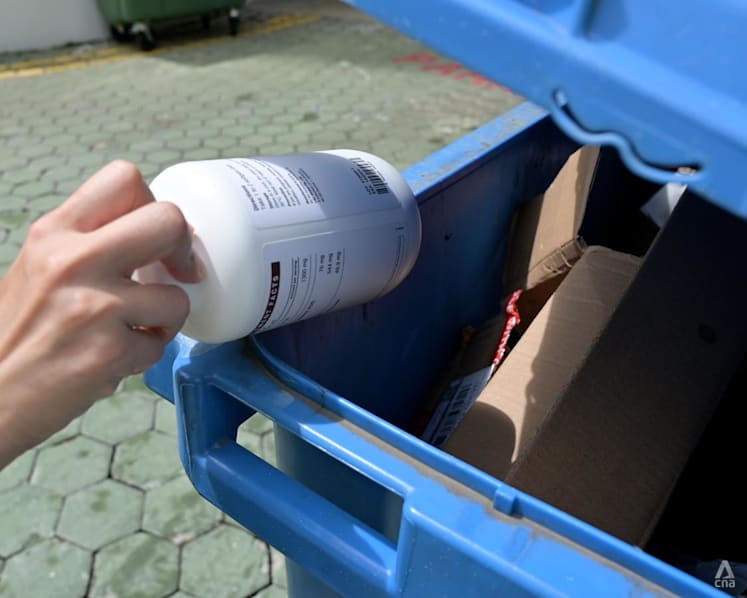
The contamination rate for recycling bins and chutes has remained at around 40 per cent, according to a parliamentary reply in Feb 2026.
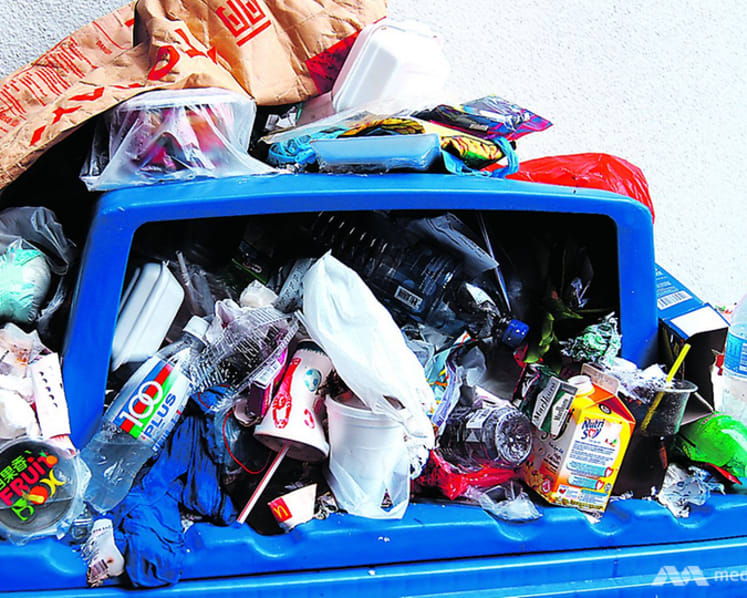
Dr Puthucheary spoke of the familiar sight of blue bins overflowing with cardboard boxes, which he said was "a telling sign that households and businesses are generating significant amounts of cardboard and are eager to recycle responsibly".
He said NEA has been working with public waste collectors to make it easier for households and trade premises to recycle.
Apart from recycling efforts, Dr Puthucheary said the review will also look at how Singapore measures its progress in waste reduction and management.
This includes examining whether annual waste statistics should better reflect efforts in the reducing, reusing, recycling and disposal of waste.
Projections for the lifespan of Semakau Landfill will also be updated, and the review will also include measures needed to ensure sufficient landfill capacity beyond 2035, he added.
A stated goal of the 2019 master plan was to reduce the amount of waste sent to Semakau Landfill by 30 per cent on a per capita, per day basis from a baseline in 2018, which then-Senior Minister of State for the Environment and Water Resources Amy Khor said was an "ambitious target" during the plan's launch.
LESS WASTE GENERATED PER CAPITA IN 2025
Even as Singapore reviews its recycling efforts, reducing waste generation by reducing consumption remains more important, Dr Puthucheary said.
He added that even as recycling rates have declined, the absolute amount of waste recycled has increased.
According to NEA's 2025 household recycling survey, 78 per cent of households recycle, up from 72 per cent in 2023. Awareness of what can and cannot be recycled has also increased, he said.
At the same time, Singaporeans generated less waste than a decade ago.
Each person generated about 0.83kg of waste a day in 2025, a 21 per cent reduction from 2015 levels. Non-domestic waste generated per unit of gross domestic product has also fallen by more than 30 per cent over the past decade.
"These numbers reflect a genuine shift in how Singaporeans and businesses think about consumption," Dr Puthucheary said.
"Everyone has a role to play – individuals to make the necessary changes in lifestyle, entrepreneurs to bring new and viable ideas to encourage reduction and reuse, and industries to continue upstream redesign and waste reduction efforts," he added.
FOCUS ON FOOD, PAPER AND PLASTICS
Apart from the review, NEA said there is still room to improve the quality and volume of recyclables across key waste streams.
To this end, it will focus its recycling efforts on food waste, paper, cardboard and plastics, which make up the largest share of waste that is not recycled.
The recycling rate for paper and cardboard slipped slightly from 32 per cent in 2024 to 31 per cent in 2025.
Plastic recycling, one of Singapore's weakest-performing waste streams, also dipped from 5 per cent to 4 per cent over the same period.
NEA attributed the declines to rising collection and freight costs, as well as the volatile global market conditions that have affected commodity prices.
"Given Singapore’s small market, most of our recyclables are exported overseas for further processing and recycling, making the viability of these exports susceptible to external factors," said NEA.
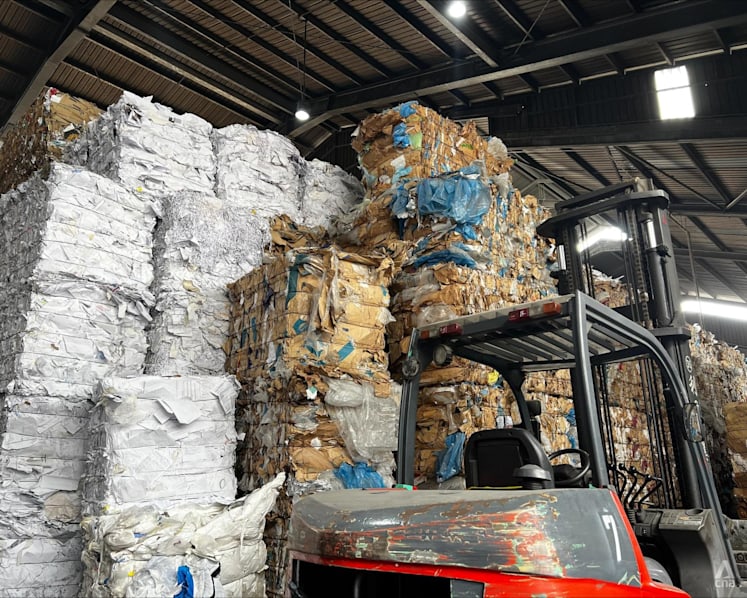
To boost paper and cardboard recycling, NEA is working with public waste collectors to increase collections from households and trade premises.
Since December last year, public waste collectors have been engaging town councils and trade premises to provide dedicated collection channels for paper and cardboard, including metal cages in selected neighbourhoods.
"These efforts aim to improve household recycling participation and address issues such as overflowing blue recycling bins and contamination of recyclables," NEA said.
As for food waste, the recycling rate remained at 18 per cent across 2024 and 2025.
The government will also study how technologies such as artificial intelligence can improve sorting, contamination detection and collection logistics.
TRANSFORMING SEMAKAU
In his speech, Dr Puthucheary also announced the launch of TREASURES, Singapore's first national research centre dedicated to residues and toxic industrial waste management.
Supported with S$35 million (US$27 million) under a research initiative, TREASURES, which stands for Towards Resource Efficiency and Sustainability for Urban Environments, opened its inaugural grant call on Jun 17, running until Aug 17.
It will be jointly led by NEA and the Nanyang Technological University with participation from other institutes of higher learning.
The centre will look at recovering value from difficult-to-recycle waste streams and exploring ways to transform Semakau from a landfill into a resource recovery hub.
"This is an ambitious vision, but it is the right one for Singapore to pursue," Dr Puthucheary said.
The government is also planning a pilot carbon capture project at one of Singapore's waste-to-energy plants as it seeks to reduce the carbon footprint of waste management infrastructure.
Details of this project will be announced at a later date, he said.




