What employers look out for when they google you and see your digital footprints
Jobseekers may worry that their online footprint could cost them opportunities, but recruiters say that recent behaviour and professional presence matter far more than past missteps.
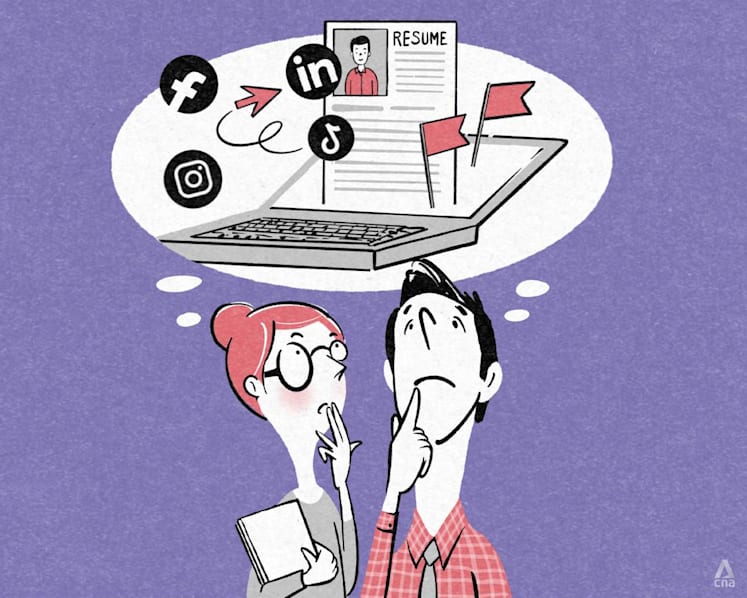
With competition in the job market intensifying, it may be timely for jobseekers to assess if their social media presence is helping or hindering their chances of landing a gig. (Illustration: CNA/Jasper Loh)

This audio is generated by an AI tool.
Adulthood is not just one phase of life but comes in stages. Its many facets can be overwhelming, from managing finances and buying a home to achieving work-life balance and maintaining healthy relationships. In this series, CNA TODAY's journalists help readers deal with the many challenges of being an adult and learn something themselves in the process.


Before I started work as a journalist three years ago, I did something most people have done at some point in their lives: I searched for my name on Google.
I was quite terrified at what the results might yield: Would the questionable takes I posted on Twitter as a polytechnic student turn up? What about the melodramatic rants I wrote on Facebook as a 13-year-old? Let's not forget the WordPress diary entries when I was nine.
Like a surgeon before an emergency procedure, I did a thorough scrub of whatever I could and also did a full scan of my LinkedIn profile to remove any potential risk.
My actions then might sound a little extreme, but a few years earlier in 2018, a "Naomi H" in the United States became a bona fide internet legend.





Naomi had tweeted with excitement – with all caps and a serving of profanity – that she was accepted for an internship at the National Aeronautics and Space Administration (NASA).
Another user, who turned out to be a former NASA engineer and member of the National Space Council, chastised her use of curse words on a public platform, and the two had an exchange. It ended with her losing her internship.
The anecdote encapsulates a very specific dread that many young jobseekers carry: One careless post, one wrong reply and the opportunity of a lifetime might vanish.
I can only imagine that dread is more pronounced in today's job market.
The latest data from Singapore's six autonomous universities found that 83.4 per cent of recent graduates who sought jobs were working within six months of their final examinations. This follows a consistent downward trend since 2021's figure of 94.4 per cent.
With employers becoming more selective and the competition for entry-level roles intensifying, it is natural for graduates to wonder: Do companies search up candidates online and if so, could a questionable social media presence be the thing that tips the scales negatively for jobseekers?
The short answer is yes, of course, and there is nothing in Singapore law stopping them.
DO RECRUITERS LOOK YOU UP ONLINE?
Mr Jonathan Yuen, co-head of employment practice at law firm Rajah & Tann, said that there are no restrictions on employers using a candidate's social media to make a hiring decision.
Since employers need not disclose the reasons for not hiring someone, it is "highly unlikely" that the candidate will ever know the real reason they were not selected, he added.

However, there is a lot more nuance to the process.
Ms Carmen Ho, an associate director at recruitment firm Michael Page, said that recruiters typically review a candidate's profile on LinkedIn, but what they look for goes beyond a record of skills and achievements.
"We look for clues about the 'softer' side of a candidate – how they communicate, what they are interested in, and whether their professional values align with the organisation's culture."
How closely your online presence is scrutinised depends on the seniority and function of the role as well.
Ms Cecelia Koh, executive director and the lead of healthcare and life sciences practice from recruitment firm Kerry Consulting, said that a social media review can be particularly relevant for commercial roles such as sales and marketing.
This is because professionals in those functions are often active online and their digital footprint offers insight into how they position themselves and represent brands publicly.
For senior professionals, the review is more targeted.
"LinkedIn is often the primary reference point and in some cases, YouTube or industry platforms if the individual speaks at conferences or contributes to public forums," Ms Koh added.
"At senior levels, we are looking for consistency between the profile and the CV (curriculum vitae), evidence of thought leadership where relevant, and overall professional credibility."
DO OLD OR EMBARRASSING SOCIAL MEDIA POSTS MATTER TO RECRUITERS?
Here is the reassuring part: Recruiters are generally not trawling through your social media history from yesteryear in their review of jobseekers.
"A post made a decade ago, particularly in one's teenage years, is rarely judged in isolation," Ms Koh said. "What matters more is the pattern of behaviour and whether there is clear evidence of growth and professional maturity since then."
For recent posts, these become problematic only when they reflect poor judgment, especially if they contradict the responsibilities of the role being pursued.
"A contentious post made today by someone in a leadership or client-facing position can raise questions about judgment and awareness of context," Ms Koh said.

Echoing this, Ms Ho said: "Employers today are not judging (candidates) for posts they made as teenagers. What tends to matter more is a candidate's recent online behaviour and whether it reflects professionalism, respect and sound judgment."
Her advice to jobseekers is to treat this period as an opportunity to reset your digital presence anyway.
"Clean up anything outdated, adjust privacy settings and make sure that what remains publicly visible communicates maturity, respect and a readiness for professional life," she added.
"This isn't about hiding who they are – it's about aligning their digital footprint with the kind of working culture they hope to join."
WHAT IF I DON'T HAVE A SOCIAL MEDIA PRESENCE AT ALL?
On the flipside, some jobseekers may be concerned that their lack of presence on social media, especially networking platforms such as LinkedIn, might cause potential employers to sideline them.
To this, the experts said that this is not a dealbreaker, but it is also dependent on what industry the jobseeker is looking to join.
For instance, if you are pursuing a career as an influencer or digital marketer but have no visible online presence, that would be clearly "inconsistent" with what the job entails.
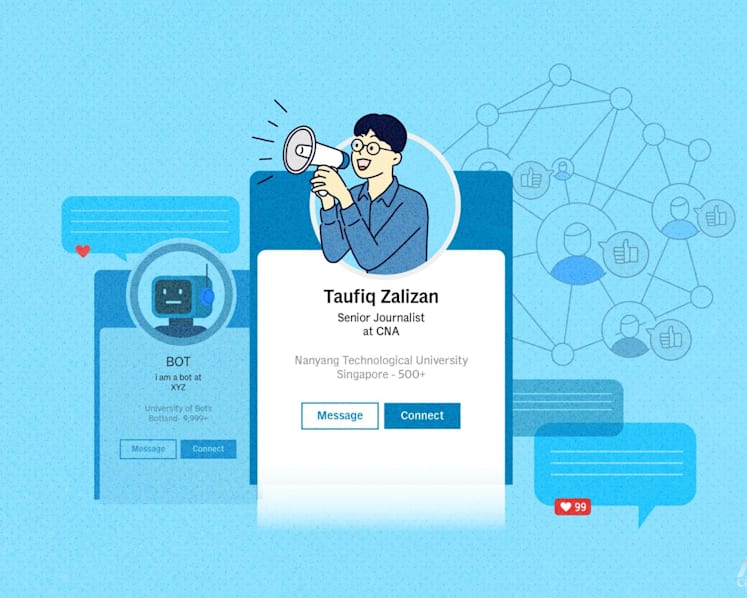
Ms Koh said that the baseline expectation for most professionals is more modest – a credible and complete LinkedIn profile.
"It signals professional engagement and allows others to understand your career trajectory and network."
For middle- to senior-level positions, having a LinkedIn presence can also work in a jobseeker's favour, she added.
"Hiring organisations are interested not only in capability but in the relationships and market access a professional brings – and a LinkedIn presence supports that narrative."
Separately, Ms Ho said: "Even for fresh graduates, a simple LinkedIn profile that includes a professional photo, education background, internships, projects, leadership activities or volunteer work can help recruiters better understand their potential."
She suggested that jobseekers make their LinkedIn headliner work for them by including something aspirational, for example, "Marketing Graduate Interested in Brand and Consumer Insights Roles". This would help recruiters quickly understand their direction.

That said, the two hiring experts are of the view that candidates do not need to have personal accounts that are made public on social media channels such as Instagram or Facebook.
"Private social media accounts are completely acceptable. They can reflect good judgment about personal boundaries," Ms Ho said.
"As long as a candidate maintains a professional presence where it matters, typically LinkedIn, their personal privacy choices do not affect how they’re perceived."
The consensus from the experts I spoke to is clear: You need not scrub your entire digital history or become a LinkedIn thought leader.
You certainly don't need to panic about a cringeworthy tweet from a decade ago.
What you should do is take 10 minutes to Google yourself and see what comes up, review what is publicly visible and make sure your LinkedIn profile is complete and up to date, they advised.
And perhaps most importantly, be mindful of what you post going forward.
The internet has a long memory, and as one NASA hopeful learned, you never quite know who is reading.