AI is not wiping out all entry-level jobs, but it's changing the game and fresh jobseekers need to level up
Experts say AI isn't wiping out all junior roles, but it's forcing fresh grads to level up and prove the one thing machines still can't replace: human judgment.
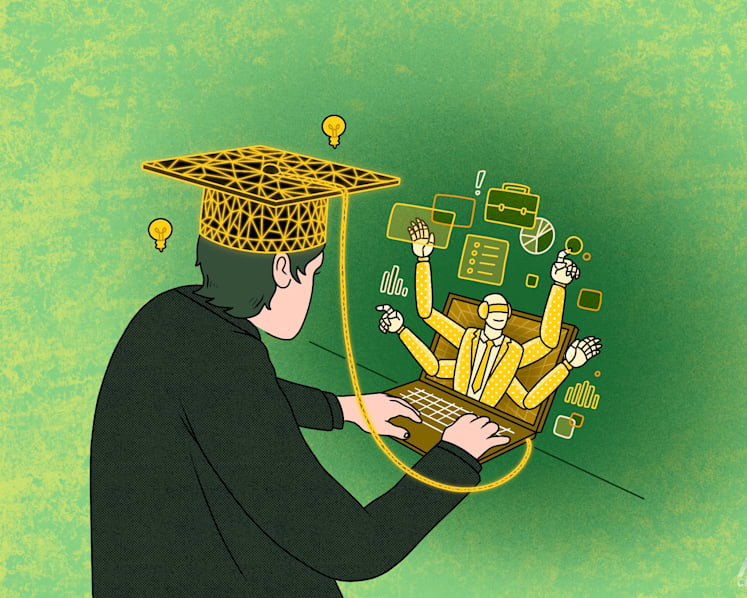
While AI is not wiping out entry-level jobs across the board, its impact is most visible in routine roles. (Illustration: CNA/Nurjannah Suhaimi)

This audio is generated by an AI tool.


When her six-month internship in public relations abruptly ended at the halfway mark, communications graduate K Sudhiksha, 23, wasn't entirely surprised.
Officially, she was told it was due to a company restructuring, but she suspected that it had something to do with how her job could be done by artificial intelligence (AI).
"I was spending most of my time running prompts on ChatGPT," she told CNA TODAY, referring to the popular AI chatbot.
"We were all encouraged to do it. I could do my tasks faster, but it also made me feel creatively stunted."





Ms Sudhiksha, who had joined the PR firm in July hoping to learn how to craft press releases and pitch news stories to the media, found that much of her work revolved around using AI tools to generate first drafts of media releases and summarise weekly news coverage for clients.
While there were warnings to carefully fact-check the output generated by ChatGPT, she said the reliance on AI made the experience feel hollow as she had hoped for a more hands-on, creative process that would let her flex her own brain muscles.
Three months into her internship, her role was made redundant, Ms Sudhiksha said.
Currently between jobs, she admitted that her experience has left her feeling pessimistic and frustrated, as she has to compete with machines: "I wish I had experienced PR before the AI era."

For Mr Mitchell Yap, 25, a customer service specialist at a tech firm, the impact of AI on job security has also been tangible. The company recently introduced a support bot designed to handle as many customer queries as possible before transferring them to a human agent.
"As the bot improves, my team now handles only the more complex or sensitive cases, but we can't ignore that this also means the overall workload is shrinking."
While he is not overly anxious yet, Mr Yap admits that every new update to the bot makes him and his colleagues wonder how long their roles will stay essential.
The experiences of Ms Sudhiksha and Mr Yap reflect a growing concern among young workers and jobseekers, including those who have not even entered the job market yet: Is AI going to take away the first jobs they've worked so hard to qualify for?
For some, that answer is affirmative. In the legal industry, for instance, recruiters like Ms Shulin Lee, managing director of legal executive search firm Aslant Legal, have already seen how automation and AI are impacting entry-level hiring.
"In 2024, law firms prioritised mid-level to senior hires. There were almost no openings for juniors with one to two years' experience," she said. "It was one of the toughest years for junior hiring I've seen in my 15 years in recruitment."
While AI wasn't the only factor behind the decline – cost and competency gaps among Gen Z hires also played a role – Ms Lee recalled law firm partners telling her that AI tools can now conduct due diligence on 200 contracts in two hours, hence reducing the need for juniors.

According to data from Jobstreet by Seek, the number of entry-level postings in Singapore fell by more than 25 per cent in the first half of 2025 compared with the same period in 2024, even as total job openings rose slightly, by 4 per cent.
The data points to what Jobstreet calls a "recalibration" of the job market. Many entry-level roles are being reshaped as more companies embrace automation to handle routine tasks traditionally assigned to junior team members, said Ms Yuh Yng Chook, director of Asia sales and APAC service at Seek, which owns Jobstreet and Jobsdb.
Similarly, human resource (HR) platform Remote surveyed 250 Singapore employers in its Global Workforce Report 2025, and found that four in five had reduced the number of entry-level hires at their companies due to AI.
Eighteen per cent of Singapore firms said they had eliminated roles or reduced headcount due to AI, while another 18 per cent had hired or reassigned roles specifically to support AI-related initiatives.
Still, some experts stressed that it's not just AI that is driving the decline in recruitment activity. Mr Lewis Garrad, partner and career practice leader for Asia at global consulting firm Mercer, said the slowdown in graduate hiring reflects both technological change and a more cautious business climate.
"AI can support and complete certain tasks, but it rarely replaces an entire job," he said, adding that companies are automating routine parts of work while rethinking roles amid slower growth and tighter budgets.
Mr Chiew Chun Wee, regional policy and insights lead for Asia Pacific at the Association of Chartered Certified Accountants (ACCA), agreed.
"'AI is coming for your jobs' makes for compelling headlines, but the reality is far more nuanced," he said.
According to Mr Chiew, most organisations are trying out tools for limited tasks such as drafting written work, transcribing meeting minutes and supporting research – not replacing entire roles.
Adoption also varies by size and sector, as smaller firms tend to be nimbler in trying out new apps, while larger ones are developing in-house tools.
"The nuance lies in how AI reconfigures work … Automating knowledge work is actually quite hard," Mr Chiew said.
"Processes are messy and full of judgment calls. So the future of work won't be about replacing people. It'll be a blend of automation, augmentation and human judgment."
That's also why some experts believe that companies cannot afford to stop hiring young people altogether. As Ms Lee put it: "If you stop hiring young people now, you'll be short of mid-levels later. The pipeline will dry up."

WHERE ENTRY-LEVEL ROLES ARE DISAPPEARING
While AI is not wiping out entry-level jobs across the board, its impact is most visible in routine roles.
Jobstreet's data shows that in Singapore, entry-level sales roles have fallen 61 per cent and entry-level customer service positions by 45 per cent, as chatbots, automated lead-generation tools and self-service systems take over tasks once handled by new hires.
Ms Gillian O'Brien, general manager of Remote Recruit at Remote, said similar declines are appearing in customer support, software development, sales development and marketing content production. Remote Recruit is a product under the Remote brand.
"These are roles where most of the tasks, such as IT ticket triaging, entry-level coding, sales lead list building and drafting blog content can be done by AI," she added.
Globally, the pattern mirrors Singapore's: In the United States, a 2025 study by ADP Research, the global thought leader on labour market and employee performance research and the Stanford Digital Economy Lab, shows employment among workers aged 22 to 25 in AI-exposed jobs has dropped 6 per cent between late 2022 and July 2025.
Within that, junior software developers fell 20 per cent and customer-service roles 11 per cent – the very functions most easily automated.
The ripple effects are being felt far beyond frontline roles. Across industries, companies are reorganising their operations in response to the accelerating impact of AI and automation.
At Amazon, for instance, the company announced an overall reduction of about 14,000 corporate roles in October as part of efforts to "reduce layers" and "increase ownership".
In a note to employees, Ms Beth Galetti, Amazon's senior vice-president of people experience and technology, called AI "the most transformative technology since the internet", saying it enables companies to innovate faster and must be met with leaner, more agile structures.
While she did not link the layoffs directly to AI, her comments reflect how major firms are reorganising to stay competitive in an AI-driven economy.
In a palpable sign of the changing times in Singapore, Grade Solution Learning Centre closed all four of its physical outlets and went fully online in 2021 with its AI-powered platform. Most of the routine work that once required junior staff is now automated.
Co-founder Jerry Lee told CNA TODAY that since moving fully online, his company now uses AI to draft lesson outlines, edit subtitles and social media copy, brainstorm marketing content scripts and mark students' work.
"Our platform can automatically mark over 90 per cent of open-ended questions accurately," said Mr Lee.
He added that the move online – together with AI tools that made operations executives more productive – has reduced the need for junior hires, which is now down from three to one.
"Our online tuition model itself allows for reduced hires across operations. We don't need as many receptionists or managers stationed at multiple physical centres like we did in the past."
Some functions, however, still require a human touch – from curriculum heads and visual artists to teachers who can engage students and interpret how they learn, said Mr Lee.
"AI speeds things up, but it still doesn't understand exam nuances or how students think. You still need experienced teachers to interpret the data, refine the content and maintain human connection."

HOW YOUNG JOBSEEKERS MUST LEVEL UP
Across industries, employers told CNA TODAY that AI isn't so much about cutting headcount as it is about raising expectations. New hires are now expected to be AI-literate, data-savvy and ready to exercise sound judgment even more than before.
According to Jobstreet's Hiring, Compensation and Benefits Report 2025, more than half of employers surveyed – or 54 per cent – now consider AI skills a key factor in hiring, and nearly one in five rank AI skills among their top priorities. A total of 887 hirers and HR professionals in Singapore took part in the survey between September and October 2024.
But technical fluency isn't enough, as employers want someone who can automate a process, then apply human judgment to turn the output into real insight.
Mr Wee Tee Hsien, chief executive officer of Fujifilm Business Innovation Singapore, said that while it continues to recruit graduates, its entry-level jobs now place greater emphasis on capabilities such as data analysis, workflow design and process improvement. Its core business is providing document-related solutions, IT digital services and digital transformation support that help organisations streamline workflows and boost productivity.
He noted that, although the number of entry-level roles has stayed fairly steady in recent years, the company's focus will shift if necessary to match evolving business needs and digital priorities.
To him, AI enhances employees' potential rather than replacing them. For young hires, this means using tools like GenAI, Copilot, or Power Platform to work smarter, not harder, he said.
"It is important that employees have the capability to think critically, ask questions and connect ideas. A growth mindset is key."

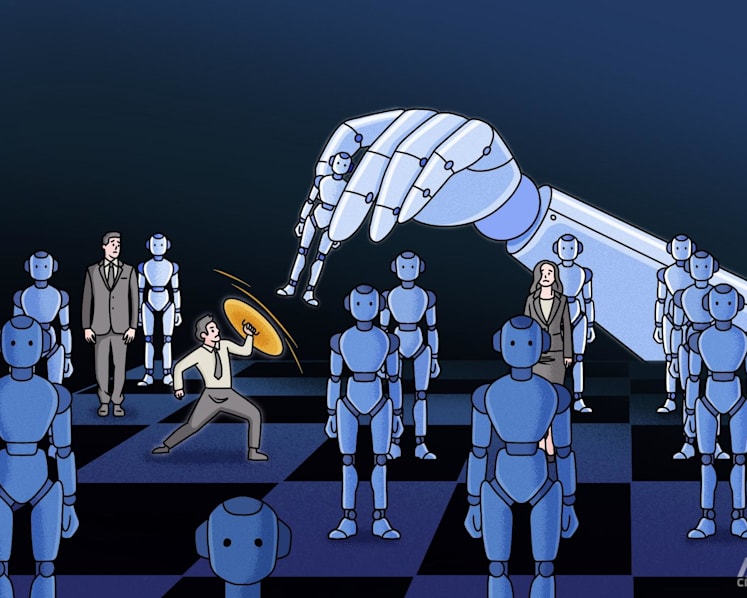
Like Fujifilm, ST Engineering, a global technology, defence and engineering group headquartered in Singapore, is also reshaping early-career roles to make them "more strategic, higher-value and impactful", while keeping entry-level positions stable amid its AI adoption.
Senior vice-president for HR Vanessa Teo said the group is using AI to boost productivity and innovation as part of a wider plan to train and hire 5,000 AI engineers, including 1,000 AI specialists, while building a 10,000-strong AI-enabled workforce.
She said that tasks that were previously administrative are now supported or automated by AI tools. For example, instead of manually reviewing system logs, junior staff now work with AI-powered dashboards to interpret insights and recommend actions.
When deciding what to automate, Ms Teo said that the company weighs repetitiveness, learning value and impact on productivity, ensuring that efficiency gains do not erode foundational training.
At global public relations agency We. Communications, junior consultants once spent their first months transcribing interviews and compiling media lists. Today, AI handles those tasks in minutes, letting interns and junior executives focus on generating insights before adding their own analysis to complete the work.
Mr Daryl Ho, the managing director of its Singapore operations, said AI has fundamentally changed how junior team members create value. "This means we can provide more value to our clients while spending more time building human relationships.”
"Around 30 per cent of work that used to be manual, like transcription and basic research, is now accelerated by AI, but that has not reduced our need for interns and junior roles," he said.
"In fact, the number of interns has stayed consistent within each team, with a 10 per cent year-on-year increase since 2021, as the agency grew."
In financial services, the transformation is even clearer. At market intelligence platform BridgeWise, AI handles the grunt work of data gathering and modelling, allowing junior analysts to focus on pattern recognition and client strategy.
"For junior analysts, AI acts almost like a first-level screener," said Mr Kelvin Phua, its general manager for Asia Pacific.
"Instead of covering a few securities, they can now analyse thousands, which boosts productivity and gives them exposure to a much broader range of markets early in their careers."
Mr Phua noted that while the number of entry-level roles at BridgeWise has remained stable, expectations have changed, with new hires now expected to use AI tools as part of their daily work.

WHY COMPANIES STILL NEED YOUNG WORKERS
While employers are raising the bar, experts also cautioned that AI can amplify errors when used without proper oversight.
Mr Rohith Murthy, chief executive of fintech group MoneyHero, said the risks of overreliance are already evident, with "very public reminders" that speed without supervision is dangerous.
"Every system must be human-in-the-loop by design. Machines can propose, but people must approve. Speed is valuable, but trust is irreplaceable," he said.
He was referring to recent high-profile incidents – such as the Deloitte report in Australia that included fabricated references and Air Canada's chatbot that gave a grieving passenger incorrect refund advice – underscoring why human judgment must stay central in professional work.
Singapore also has its own cautionary tales – two lawyers were reprimanded by the High Court on Monday (Nov 3) for citing "entirely fictitious" legal cases generated by AI tools.
Last month, a lawyer was ordered to personally pay S$800 in costs after his junior cited a fictitious legal case generated by a GenAI tool.
Mr P Sivakumar, director of BR Law Corporation, said that while AI is "all the rage", its utility to the legal industry is still in its infancy, and there is uneven adoption of AI across law firms in Singapore.
"In litigation, for instance, junior lawyers remain valuable for reviewing and drafting court documents that convey the 'look and feel' of the situation as experienced by the client," he said.
"Even if a firm uses AI to draft documents, a lawyer with intimate knowledge of the facts will still be necessary to cross-check and ensure that what is set out is not a hallucination, but verifiable."

Mr Sivakumar added that AI cannot make a lawyer redundant in corporate matters either, as clients will continue to require advice and negotiation from experienced practitioners to safeguard their rights.
And indeed, Ms Lee, the recruiter from Aslant Legal who saw a sharp reduction in junior roles last year, said things have picked up slightly this year. She believes firms have realised they can't run on senior staff alone.
"Firms want juniors who can contribute right away – not just (bright), but also self-aware enough to understand how they come across and where they need to grow.
"This is where client management, communication skills and the ability to manage timelines and expectations have become much more important," she said.
Mr Muzainy Shahiefisally, 24, a final-year law student, can attest to this: He said most big firms are still offering training contracts, and that most of his peers, himself included, have managed to secure them.
He believes that fears about AI taking over legal work are "overblown", noting that generative AI tools still struggle with core tasks like case research, which is "the bedrock of legal practice".
"Even when you feed a case into a chatbot, its summary is rather imprecise and lacking in nuance. Lawyers will be needed until such time that AI can accurately do this demanding aspect of legal work."
HOW TO WORK BETTER IN THE AGE OF AI
Experts told CNA TODAY that graduates entering the workforce today will need sharp critical thinking, adaptability and a strong sense of ethics right from the start. And they must start building their AI literacy even before the job hunt begins.
Dr Peter Finn, generative AI and cybersecurity instructor at training provider Vertical Institute, calls it "human-AI teaming", where graduates can prompt tools effectively, verify outputs and know when to override them.
"The professionals who thrive are the ones who treat AI as a collaborator, not a crutch."
Dr Finn said many young professionals mistake the casual use of ChatGPT for true AI literacy, as there's a big difference between using AI and using it effectively.
"Many learners assume that because the system gives intelligent-sounding answers, it must always be right. But generative AI is probabilistic, not deterministic. The same prompt can produce different results each time."
In his classes, Dr Finn teaches students to manage those inconsistencies by prompting more precisely, providing examples and specifying formats, treating AI as "a creative partner with quirks, not a perfect calculator".
The most valuable skills that "give candidates a real edge", he added, are the ones that connect human judgment with technical ability:
- Prompt-engineering fundamentals – how to communicate with AI systems clearly and systematically
- Critical thinking and "trust calibration" – knowing when to verify or override an output
- Data literacy – understanding bias, context and the patterns behind AI-driven insights.
Ms Sima Saadat, Singapore country manager of tech education firm General Assembly, said that many graduates still believe that landing a job depends primarily on having the right technical credentials, certifications, degrees or platform-specific skills.
"But employers are increasingly hiring for complementary interpersonal skills which are critical for candidates to learn quickly, work well in teams and navigate ambiguity," she said.
"This disconnect often shows up in interviews. Fresh jobseekers may focus on listing technical capabilities and tools learnt, but hirers are listening for how they’ve handled challenges and adapted to change."
She also observed that employers now place greater emphasis on practical experience, such as internships, portfolios, and even freelance or volunteer work, indicating that skills-based hiring and soft skills are at the core of what the market needs.
Fresh graduates and experts also said that companies share the responsibility for helping workers adapt, by being transparent about AI and keeping the ladder open for new talent.
Software engineer S Joseph, 28, who graduated from the Singapore Institute of Technology last year, believes that companies' transparency around AI usage is crucial as it would help new graduates understand how AI tools might impact their daily work and where they should focus their learning.
"Companies can clarify how AI is integrated into projects and the roles humans will continue to play in decision-making and development," said Mr Joseph, who now works at ST Engineering.
"That transparency helps entry-level employees chart their career paths and develop skills that complement AI instead of competing with it."
ACCA's Mr Chiew said ultimately, organisations need to ask whether they are on a sustainable path when it comes to talent management.
"Some are already contemplating moving from a traditional pyramid-shaped structure – where hiring focuses on a large pool of entry-level talent – to a diamond shape, with fewer juniors and more mid-level hires," he said.
"This is unsustainable. We risk choking off development pathways and losing institutional memory."
Mr Chiew added that the design of entry-level roles must evolve with automation, with careful consideration of which tasks are automated and how roles can shift accordingly.
"If we get the balance wrong, we risk losing the next generation of skilled professionals."