Down but not out, Singapore's ageing strata-titled malls still have life in them
Strata-titled malls face unique structural challenges, from fragmented ownership to slow decision-making, making them harder to refresh than single-owner malls.
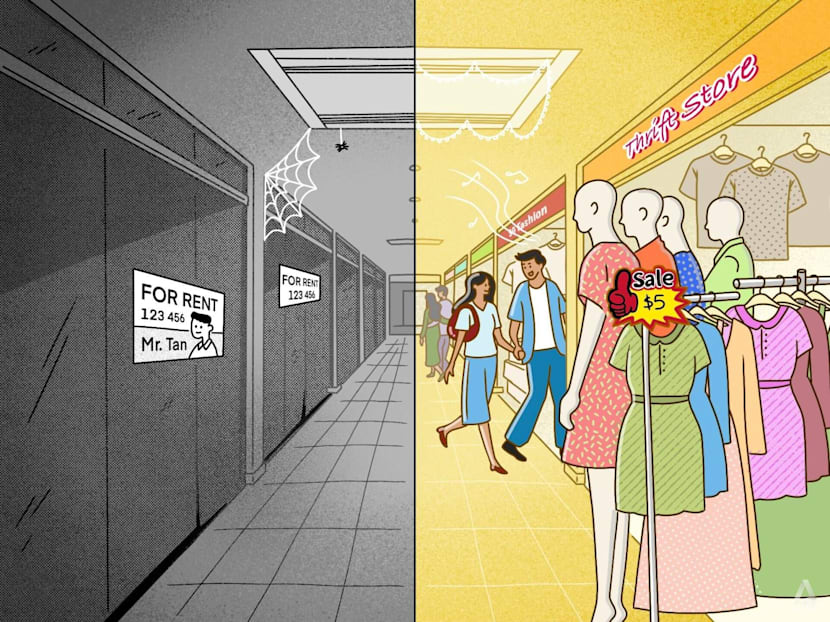
Strata-titled shopping centres were widespread in the 1970s and 1980s. Some of them still manage to survive today, while others steadily age and decline. (Illustration: CNA/Nurjannah Suhaimi)

This audio is generated by an AI tool.


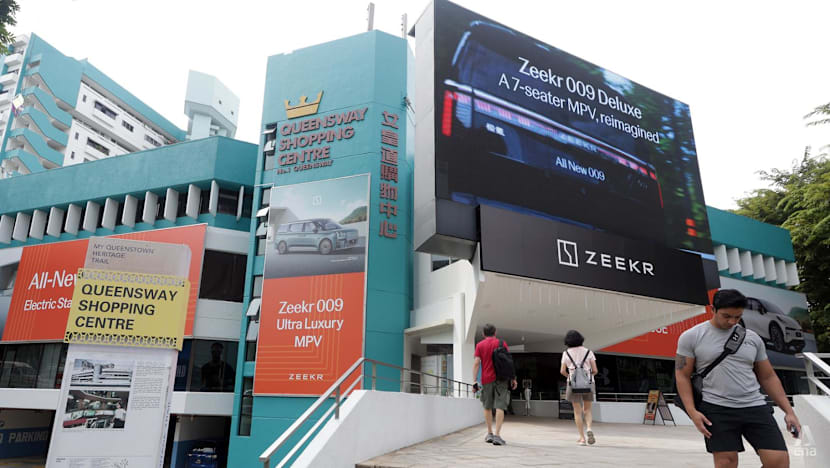
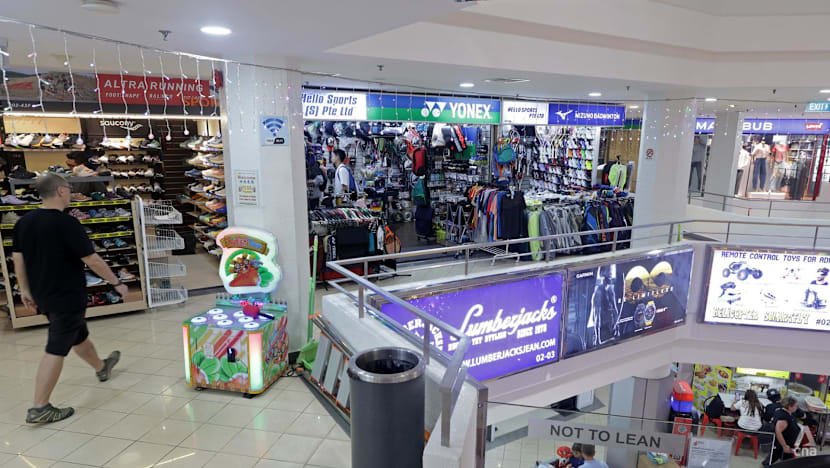
Even on a Thursday afternoon, Queensway Shopping Centre was buzzing with life: a queue had formed at a store selling kueh tutu or steamed cakes, while parents with young children weaved in and out of long-established sports gear shops.
Nearby, teenagers in school uniforms drifted through secondhand shops, a growing number of which have been springing up there in recent years.
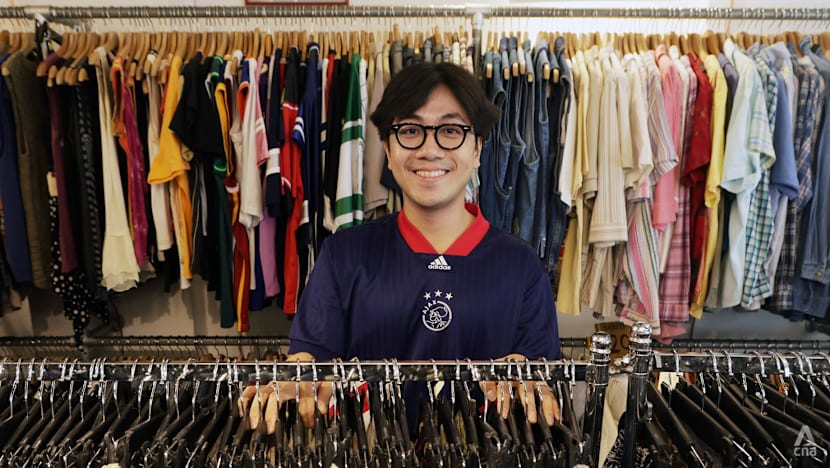
One such thrift store that has breathed new life into this mall, which opened in 1975, is Honsieponsie, run by 24-year-old Hon Liang Lung.
"The lower rent was what drew me in, so I didn't think much about footfall," Mr Hon said. He has been operating his shop there for about four years.
"After I opened, I realised the footfall was actually quite strong – much better than I expected," he added. It was so good that he opened a second outlet selling pre-loved apparel in the mall last year.
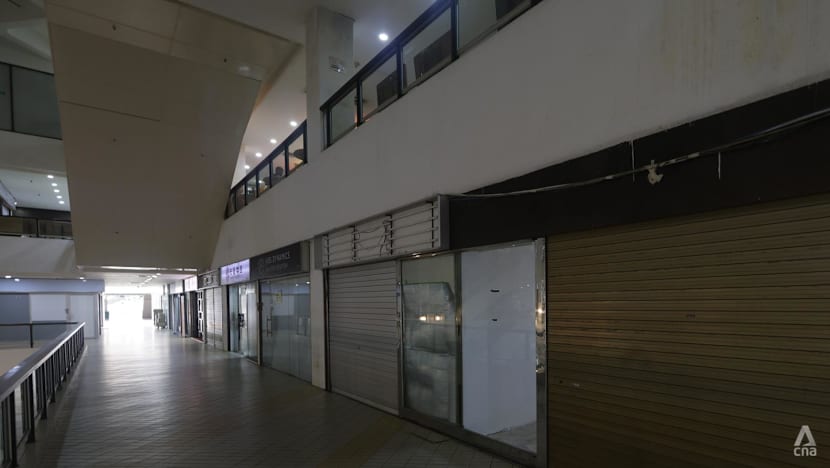
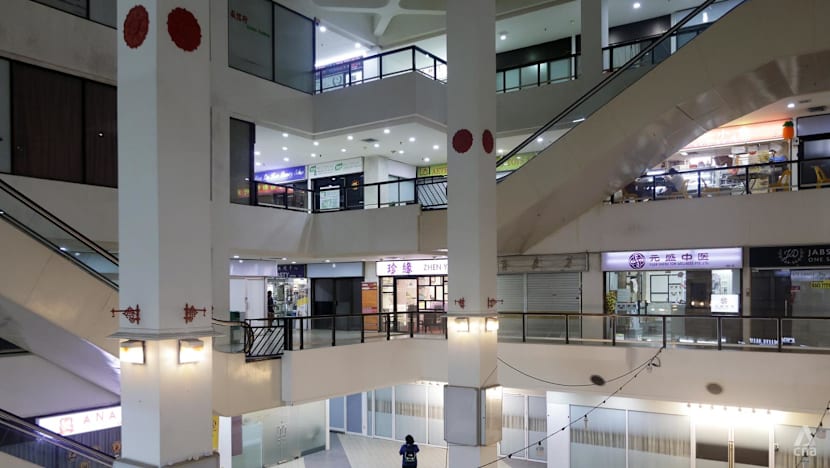
Over at Upper Serangoon Shopping Centre, which was built in 1981, the quiet corridors with few visitors tell a markedly different story.
When CNA TODAY visited on Jan 14, many units were shuttered, their shopfronts covered with "For Rent" notices, while faded signboards harkened back to a busier era.
Most of the human traffic gathered around two food stalls on the third level, where 80-year-old Mary Tan has been running Yun Nam Kitchen with her siblings for about 30 years.
"Footfall has dwindled over the years with the mall's offerings thinning, as some tenants moved out over time due to increased rents," Mrs Tan said.
Both Queensway Shopping Centre and Upper Serangoon Shopping Centre are known as strata-titled malls. They began appearing in Singapore in the 1970s and 1980s, and were a popular model with developers because it allowed them to limit their management risks.
This is because each individual unit in these malls has its own landlord.
Over time, however, a different business model has come to dominate Singapore's mall landscape. Most of the shopping complexes built in the past 20 years or so are owned by real estate investment trusts (REITs). These are companies that buy and manage income-producing real estate such as office buildings and malls on behalf of investors.
Units in such malls are leased to tenants who pay rent to the company, which is the landlord.
Over the same period, the fortunes of strata-titled malls have been a mixed bag: some have transformed successfully to meet modern shoppers' needs, some remain largely unchanged, and many are ageing and losing footfall.
As a result, many have tried to undergo collective sales, with varied outcomes.
Real estate firm Colliers Singapore said that seven strata retail and mixed-use developments, such as Golden Mile Complex, Katong Plaza and Delfi Orchard, have successfully gone en bloc in the past five years or so.
Among these, Tanglin Shopping Centre was sold on its fourth attempt, while Peace Centre required five attempts before a successful en bloc sale.
Nine other strata retail and mixed-use developments, including Upper Serangoon Shopping Centre and Sim Lim Square, have failed to sell and remain unsold.


More recently, around the Orchard Road district, Singapore Shopping Centre and The Centrepoint launched en bloc attempts, with the tender for Singapore Shopping Centre having closed on Jan 16 and the property now in a 10-week private treaty period.
Mr Calvin Chua, founder of research-led design firm Spatial Anatomy and associate professor at the Singapore University of Technology and Design (SUTD), said it may not affect the average consumer if more of these malls die out, but they carry more than their commercial and real estate value.
From an environmental perspective, demolishing concrete buildings just a few decades old for higher rents and intensified development carries a high carbon cost.
"While newer buildings can be more energy-efficient, ultimately, retaining and adapting strata malls would be the more environmentally responsible approach, if we take into account the total embodied carbon of the building," he said.
"On the cultural front, strata malls offer unique retail experiences and carry a strong social memory for many Singaporeans who grew up with these spaces."
Even though REIT-owned malls offer convenience and standardised retail experiences across their portfolios, the decline of strata malls risks stripping Singapore's streets of the unique character they provide.
STRUCTURAL INERTIA, RENEWAL PRESSURES
Sustaining a strata mall is rarely straightforward, thanks to a combination of industry-wide pressures and structural hurdles stemming from having multiple owners for one building.
Mr Nicholas Mak, chief research officer at real estate platform Mogul.sg, said that e-commerce has posed a significant challenge to brick-and-mortar retail overall, alongside changing consumer patterns such as a greater willingness to shop overseas.

With the goods and services tax now at 9 per cent, Mr Mak added that tax-free overseas shopping has become more appealing to consumers, with exchange rates further influencing spending decisions.
Beyond these industry-wide shifts, strata-titled malls face added structural constraints.
Professor Lee Kwan Ok, from the department of real estate at the National University of Singapore (NUS), said that the governance structure of the management corporation strata title places strata malls at a disadvantage from the outset.
An MCST is the managing body of a complex or building with multiple owners.
It is primarily designed to manage common property and enforce by-laws, rather than to run an integrated retail strategy that might involve coordinated marketing or major asset enhancement works.
CNA TODAY reached out to seven MCSTs, but none responded by the time of publication.
Mr Chan Kok Hong, chief executive officer of StrataGuru, a strata management consultancy firm, said that this fragmented control plays out on the ground.
Individual owners lease their units independently, resulting in weak tenant curation, while collective action is often slow as owners differ in priorities, cashflow pressures and time horizons.
"The result is slower decision-making and chronic under-investment compared with single-owner malls, as major upgrades often hinge on multiple-owner consensus and cost-sharing," Prof Lee said.
That structural inertia becomes a growing liability in a retail landscape that demands constant renewal.
Mr Mak from Mogul.sg said that regardless of ownership structure, malls need to refresh their image, market positioning and tenant mix regularly to keep pace with changing consumer preferences, regulations and competition.
While there is no fixed rule, such reinvention typically happens every five to seven years, but for strata-titled malls, responding quickly is often difficult, he noted.
Echoing a similar sentiment, Mr Chan from StrataGuru said it is not that REIT-owned malls are immune to retail cycles, but that they are able to respond to such cycles far more quickly.
"Retail assets need constant renewal to stay relevant," he added. "But in strata malls, necessary works are frequently delayed because owners disagree over costs or perceive unequal benefits."
Over time, such delays can lead to physical and functional obsolescence. Falling footfall sets off a cycle of tenant turnover and longer vacancies, leaving many strata malls struggling to recover.
Given these structural constraints, the question is why some strata malls still manage to survive, while others steadily decline.
Experts noted that a mall's survival often hinges on its connection to its surroundings and its ability to serve a specific community.
Prof Lee said that accessibility and catchment remain first-order drivers – malls near MRT stations and bus nodes in dense, mixed-use areas rely less on being a "destination".
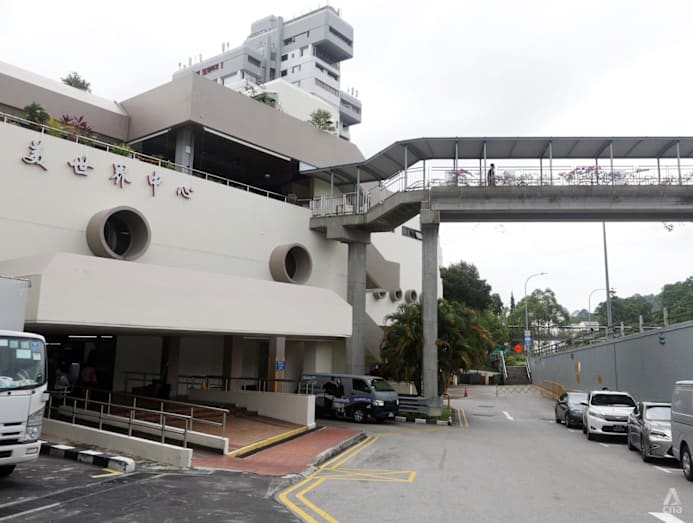
For example, Mr Chua from SUTD noted that Beauty World Centre in Bukit Timah thrives partly because of strong connectivity, with bus stops, direct access to the eponymous MRT station, and even an overhead bridge providing access to Rifle Range Nature Park.
In contrast, Bukit Timah Shopping Centre lacks the same level of connectivity and has less footfall, even though it sits right next to Beauty World Centre.
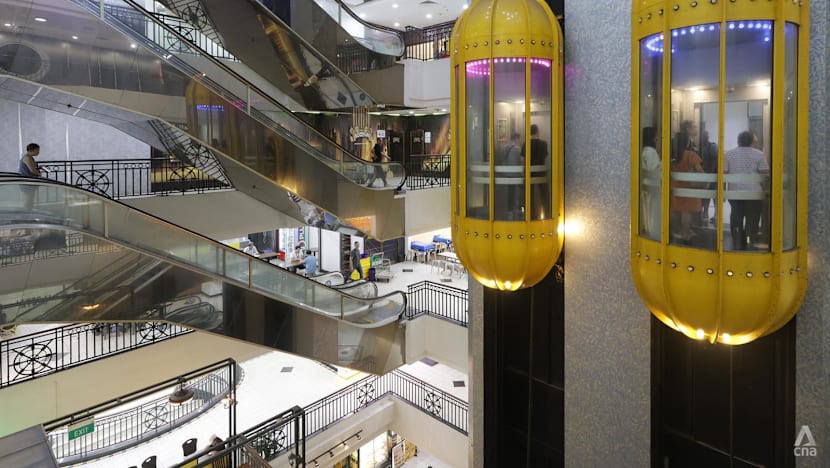
Over in Chinatown, People's Park Complex offers another example of a shopping centre shaped by its surroundings.
"Instead of a closed-off building, it was designed to be connected to the rest of the city through strategically placed entrances, with overhead bridges and large interior atriums as gathering places," Mr Chua from SUTD said.
Another key factor, the experts said, is niche positioning, with surviving strata malls leaning on specialisation of embedded convenience rather than head-on competition with integrated malls.
Queensway Shopping Centre, for example, remains a sports-retail cluster, while also nurturing a growing niche of secondhand shopping and social media-driven demand, even if footfall is lower than in past decades.
"There's a clear reason for people to come here," Mr Hon from Honsieponsie said.
"We have a very strong niche, overlapping audiences, and the food offerings here are also a big draw. Many customers stumble upon us while visiting the mall for other reasons."
Mr Mak from Mogul.sg said that the strata malls doing well tend to be present in shoppers' minds, often by catering to particular communities.
For instance, Lucky Plaza on Orchard Road has long been a hub for the Filipino community, drawing throngs on weekends and now also serving as a destination for shoppers after secondhand goods.
Near City Hall MRT station, Peninsula Plaza has earned the nickname "Little Myanmar" for its authentic Burmese groceries and food offerings, while Golden Mile Complex along Beach Road was widely known as "Little Thailand" before it closed in May 2023 for redevelopment.
"These malls managed to cultivate, sometimes not consciously but through organic evolution, a catchment of loyal shoppers," Mr Mak said.

As for struggling malls, a common pattern is that they are generic and ageing without a coordinating mechanism.
"Holland Road Shopping Centre has been widely discussed as an example of an older mall contending with changed catchment dynamics and weaker commercial momentum," Prof Lee from NUS said.
With the opening of the One Holland Village mixed-use development, Mr Mak explained that higher footfall had been expected at the older shopping centre – but it turned out that visitors largely stayed within the new mall rather than venturing out.
Shop owners at malls such as Parklane Shopping Mall on Selegie Road and Upper Serangoon Shopping Centre also pointed to reputation as a potential factor behind the lower footfall.
Mrs Tan, who runs Yun Nam Kitchen at Upper Serangoon Shopping Centre, said: "I think some might be reluctant to come because of what they've heard about certain vice activities here."
At Parklane Shopping Mall, a shop owner who declined to be named described it as a double-edged sword. Some businesses can draw crowds, but parents with children in tow may be more sensitive about controversial tenants such as certain massage parlours, which can deter a number of visitors.
The presence of businesses with arguably dubious reputations was part of the reason behind an announcement by Member of Parliament (MP) Foo Cexiang in September 2025 to refresh Tanjong Pagar Plaza, a shopping centre in a public housing estate with strata qualities.
Residents, especially young parents, had voiced concerns over vice activities being conducted near preschools in the area.
In a Facebook post, the Tanjong Pagar GRC MP noted that the majority of businesses operate legitimately, but a few massage and beauty parlours had cast a negative light on the mall.
"When the reputation of the mall is affected, it will affect the overall business viability of the other tenants as residents and potential customers are turned away," Mr Foo wrote.
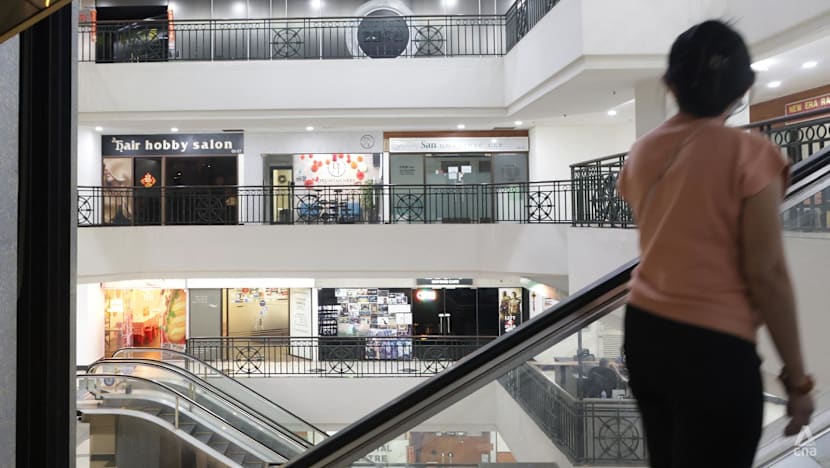
Although it is possible for malls to shed a negative image, Mr Mak from Mogul.sg said that the process takes time, meaning reputational issues can weigh on footfall for years.
He cited Orchard Towers as an example. In 2023, the strata-titled mall, once plagued by a seedy reputation, began a two-year makeover to reinvent its image through a refreshed facade and the introduction of family-friendly tenants.
By December 2025, while occupancy for the revamped mall had reached 80 per cent and foot traffic was rising, its building management continued to receive complaints about alleged streetwalkers touting sexual services.
"They really will have to purge themselves of their former reputation and make sure those previous trades do not return. It takes time, but eventually it can happen," Mr Mak said.
STRATA MALLS IN NEED OF CHAMPIONS
Despite these challenges, experts said the strata-titled mall model remains viable, though increasingly as a niche format rather than the dominant model.
Prof Lee from NUS pointed out that from a planning perspective, policy has increasingly favoured consolidated ownership in key commercial areas.
For example, the Urban Redevelopment Authority's 2022 guidelines restrict strata subdivision of commercial space in prominent parts of the Central Area to support better upkeep and management quality, she noted.
For existing strata-titled malls, keeping them alive and helping them thrive might ultimately come down to having a key stakeholder willing to step up and drive their evolution, championing a clear attractor or a niche that gives people a reason to visit.
Mr Chua pointed to Golden Mile Tower, which revived itself by becoming a destination through attractions such as the now-closed cinema The Projector, its nightlife and its role as a bus transit point to Malaysia.
In the meantime, malls outside of residential catchments and that rely on visitors having to make a deliberate trip, such as Upper Serangoon Shopping Centre, would need "a clear attractor that gives people a reason to go there intentionally", Mr Chua said.
At the mall level, Prof Lee from NUS said that realistic levers tend to be operational rather than grand reinvention, focusing on professionalising managing agents, enforcing consistent marketing standards and tenant coordination.
"Where feasible, voluntary consolidation of lots, or a lead owner assembling units, can enable anchors and refresh the draw," she said.
Mr Mak from Mogul.sg said, however, that in reality, many strata malls struggle even to secure agreement on a budget to hire consultants.


At a broader, systemic level, reforms that make coordinated renewals easier will be crucial for keeping ageing strata malls viable.
Prof Lee from NUS said that the most realistic approach is not to replace MCSTs, but to reduce the frictions in urban renewal for older buildings.
"The government has stated it is reviewing the collective sale regime, including the current 80 to 90 per cent consent thresholds which directly affect many older strata-titled properties that need redevelopment to avoid long-term stagnation," she said.
Such reforms, Prof Lee added, determine whether ageing strata assets can realistically be redeveloped rather than decay in place.
"Golden Mile Complex illustrates the 'renewal' pathway at the extreme end. It was conserved and then sold en bloc, enabling redevelopment while retaining its conserved structure."
Some up-and-coming businesses are also taking advantage of the flexibility offered by the strata model, using it as a way to bring life to the malls while carving out their own niche.
Mr Chua from SUTD noted that strata malls often allow for more creativity and experimentation because the rules are looser.
"New business ideas can be tested more easily compared to REIT malls, which tend to be highly regulated," he said.
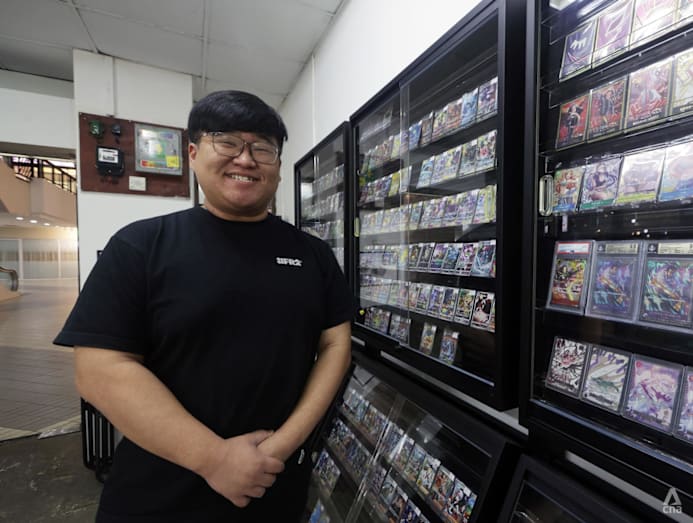
Mr Darren Loh, 29, who has been managing a card shop in Upper Serangoon Shopping Centre for about three months, described how the business has sought to establish a mutually beneficial relationship with the mall's MCST.
The team behind the trading card store, Abyss Collectibles, has written proposals to the MCST to host card shows or flea markets at the mall's atrium space.
"So far, it's looking good, and (the current model) gives us more leeway to expand as individual businesses. It's about how we capitalise on these opportunities," Mr Loh said.
Speaking to CNA TODAY on Jan 19, Mr Foo the Tanjong Pagar GRC MP said that business models must evolve as society progresses, but keeping strata-titled malls alive may require a shift in mindset among the wider community, because their engagement can help sustain these spaces.
He noted a positive trend among younger generations, who are increasingly interested in heritage and culture and willing to support niche businesses that preserve skills and offer unique services.
Even small numbers of patrons can make a significant difference to the viability of niche businesses, such as traditional tailors nestled in the strata malls, who rely on consistent support rather than mass-scale sales.
"That is the most powerful part of these businesses as living heritage – they remain viable because people decide they matter and continue to engage through using their services, spreading the word, and building communities around them," Mr Foo said.
In this sense, keeping strata malls relevant is not only about physical upgrades or strategic management, but also cultivating a culture that values the unique offerings these malls provide, he added.
"NO PERFECT SOLUTION"
There is no straightforward fix for sustaining strata-titled malls, and the experts agreed that keeping them alive requires a multi-pronged effort, with no single stakeholder able to drive renewal on their own.
Mr Chan from StrataGuru said that responsibilities in the strata model are inherently fragmented, making coordination across multiple parties essential.
The MCST coordinates common interests, individual owners shape the tenant mix through leasing decisions, managing agents enforce standards and compliance, while external advisers can help reset strategy. All of these roles need to work in tandem for a strata-titled mall to remain viable.
Agreeing, Mr Foo the MP described renewal efforts as inherently complex and uncertain.
Different stakeholders have varying objectives, risk appetites and levels of commitment, he said. Even when a majority agrees on a direction, external factors, such as market conditions and shifting consumer behaviour, remain beyond their control.
"The process itself can be fraught (with challenges) and success is not guaranteed, so these uncertainties may hold people back from stepping up," he added.
In the absence of a strong central curator, renewal efforts in some strata-titled malls have begun to emerge from the ground up, with some tenants taking on informal curatorial roles and encouraging complementary businesses to move into the building.
At Tanjong Pagar Plaza, Mr Foo spoke of the recent opening of a music school, whose owner has reached out to other music and arts school businesses, in hopes that more of them will set up shop there as well, thus growing a more vibrant mix of tenants.
A similar dynamic has played out at Queensway Shopping Centre. Mr Hon, the secondhand-store owner, said he has personally reached out to other niche businesses he felt would fit the mall's profile, including retailers oriented towards arts and crafts.
"I've found that there's potential for businesses with overlapping audiences to do well here, and I tell them footfall is better than they would expect," Mr Hon added.
Coordinated support from the authorities can also help, though its applicability depends on the mall's context.
Store owners ... need confidence that they are part of a larger movement – that residents, the community and the authorities are all moving together.
Noting that there is no perfect solution, Mr Chua from SUTD said that different approaches may be needed. Malls in public housing estates may benefit from a strategic, top-down vision, while strata-titled malls rely on a champion or key stakeholder to coordinate revitalisation, he added.
For example, for housing estates such as Bedok, there had been student proposals to tie ageing neighbourhood centres to eldercare or active ageing facilities – moving towards a more wellness-themed rejuvenation strategy, Mr Chua suggested.
At Tanjong Pagar Plaza, Mr Foo the MP said that he stepped in because residents live directly above the shops and take their children to preschools within the mall – a proximity that made intervention meaningful.
He added that celebrating small wins along the way, combined with media coverage of intentions and actions, helped build confidence and momentum to refresh the strata-titled mall. However, he did say that it was still too early to tell how successful the efforts would be.
As of this month, about 10 massage and spa establishments at the mall had shut down following police enforcement, with new tenants such as a massage services outlet that hires blind employees coming in to take their place.
Following these efforts to introduce businesses that better serve residents, the stakeholders have organised door-to-door outreach to raise awareness of the mall’s ongoing revamp.
"It's an ecosystem. Indeed, store owners can market themselves more, but they need confidence that they are part of a larger movement – that residents, the community and the authorities are all moving together. That's when people feel encouraged to do their part."
But even if this model can't be applied everywhere, he said, the experience highlights the value of identifying key stakeholders, sharing information and sustained effort.
"Ultimately, this is still a matter of market supply and demand. Market forces must work for malls with strata qualities to be viable. It is not charity," Mr Foo said.
"Our efforts of door-to-door marketing of the new shops simply increased awareness. That's what helps markets function better – facilitating supply and demand."
For shoppers such as student Joan Chen, 30, these ageing complexes are not relics of the past but living places where niche services and familiar shopkeepers still offer something newer malls cannot.
"A lot of malls today all look similar and have the same big brands. It's so boring," she said.
It is the nostalgia and lived-in character of these malls – from their maze-like layouts to family-run shops with dying trades – that Ms Chen says is difficult to find in newer developments.
She still makes regular trips to strata malls such as Roxy Square on East Coast Road to get her clothes altered and Orchard Plaza for Thai food, saying it is the everyday interactions with friendly store owners built over time that keep her coming back.
"I understand the need for development, but we'll be losing a community, and that's really sad for many of us who still enjoy these niche businesses, like traditional watch repair stores."